Illustrated · 1 min

+1 contributors

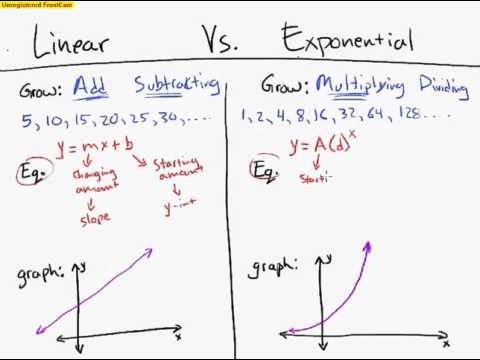
Exponential and linear refer to the type of a function by looking at the power of the independent variable.
A linear function is one where the independent variable is to the power of . For example, in the linear equation , is the aforementioned independent variable. The term linear comes from the plot of the function; regardless of the values of and , the graphed function will always be a line.
An exponential function is one where the independent variable is to a non-trivial (not or ) power. These are typically of the form . The term exponential comes from the use of exponentiation in the independent variable.
The graph below shows a linear function (red) and an exponential function (blue).
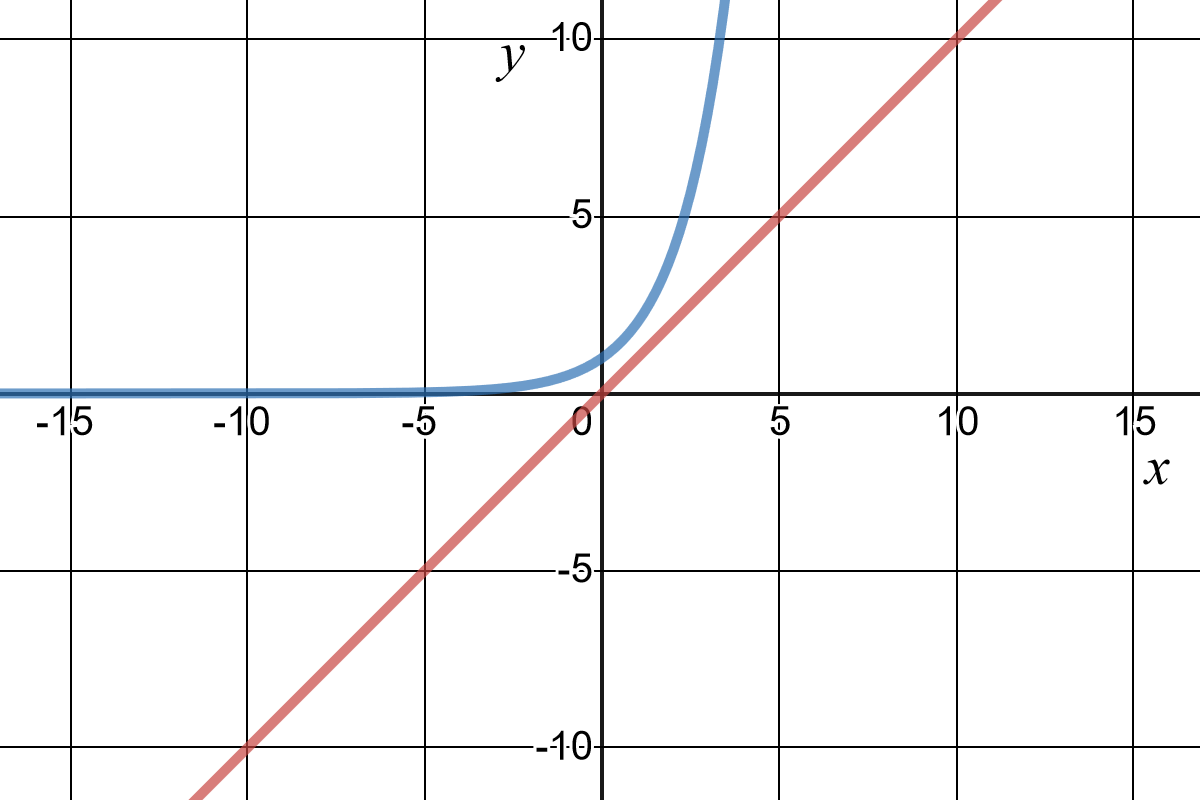
One of the most important distinctions between linear and exponential functions is how (and how quickly) they increase or decrease. Linear functions increase proportionally; an increase in has a corresponding additive increase in . Exponential functions, however, increase exponentially; that is, an increase in has a corresponding multiplicative increase in .