Plano de Argand-Gauss: Gráficos

Interactive · 1 question

The Complex Plane

We've now learned that Complex Numbers take the form of z=a+biz=a+bi. Our next step is to learn how they appear on the complex plane.

The complex plane looks like the regular Cartesian plane, but the x-axis is replaced with the real axis, and the y-axis is replaced with the imaginary axis

Funny, it doesn't look very complex

Made with Desmos

The complex plane is very similar to the Cartesian plane that you are used to working in. The only difference is that the xx-axis is replaced with the real (ReRe) axis, and the yy-axis is replaced with the imaginary (ImIm) axis.

Before we dive into graphing complex numbers, let's think about how we graph points in the Cartesian plane. Every point on the Cartesian plane is written as (x,y)(x,y), where xx is the horizontal component, and yy is the vertical component. For example, the point (3,2)(3,2) is 33 units to the right and 22 units above the origin. Now, let's look at a complex number and break it down a little further. z=a+biz=a+bi Remember that aa is the real component, and bibi is the imaginary component. This means that when we graph this number as a point on the complex plane, it's horizontal position is aa units away from the origin, and its vertical position is bb units away from the origin.

Here is the complex number z=−2+3iz=-2+3i on the complex plane:

The point z=-2+3i is 2 units to the left and 3 units above the origin.

Made with Desmos

The point is placed 22 units to the left of the origin and 33 units above the origin. Just to sure up our understanding, here is the same point with each of the components labeled.
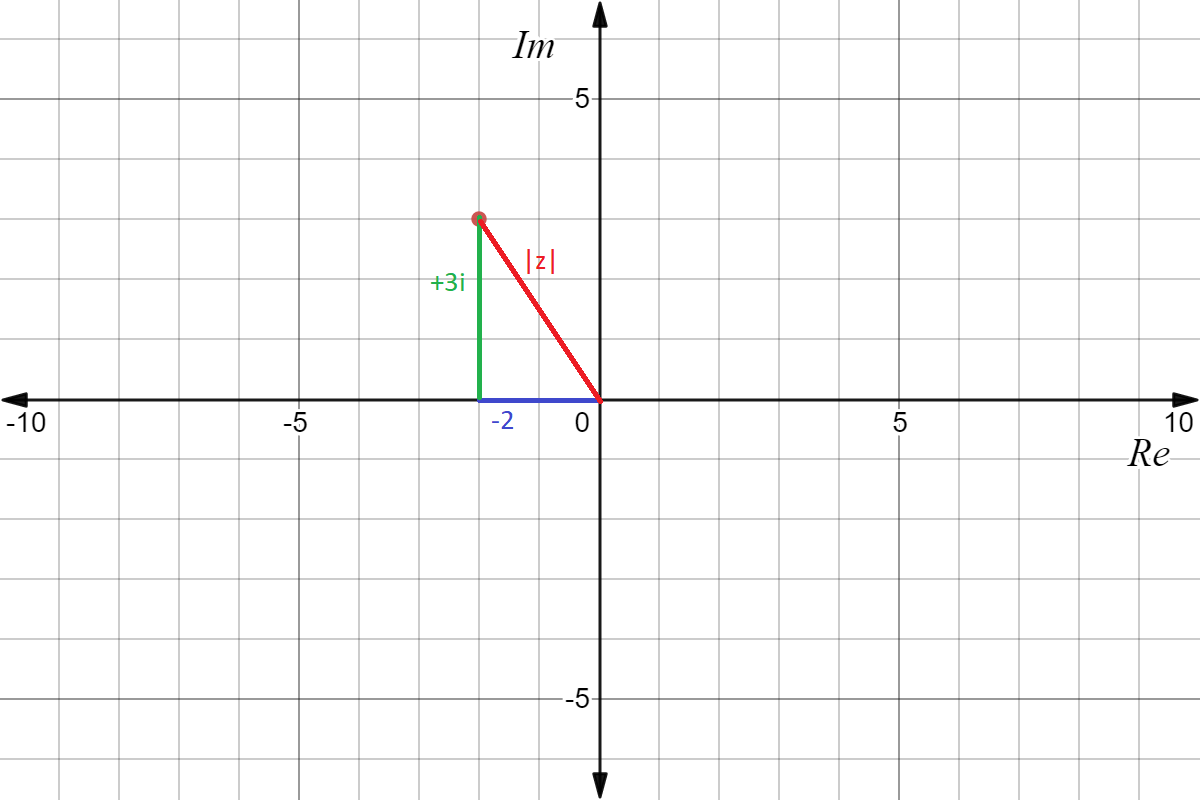
The horizontal component is -2, the vertical is +3i, and there is a diagonal to be explained later

Made with Desmos

The horizontal component is −2-2, the vertical component is 3i3i, and the diagonal is the magnitude of the complex number, which you'll learn about later.

Where would the complex number z=4−5iz=4-5i fall on the complex plane in relation to the origin?

Choose one answer

Read · 1 min

What if we wanted to graph the number zz, where

z=z= 55++3i3i

Well zz is a complex number, so we cannot graph it on the regular Cartesian plane. We must graph it on the complexcomplex planeplane

Instead of a y and x axis, the complex plane has axis that are for imaginary numbers and real numbers. Where the y axis is on a Cartesian plane is where the imaginary numbers go, and where the x would go the real numbers lie.

So if we were to plot our number z,z, we would go to the real numbers and go across five and go to the imaginary numbers and go up three, since we have 3i.3i.

Interactive · 5 questions

The Complex Plane and Vector Analogy

In this explanation, we'll extend imaginary numbers to the set of complex numbers (not as "complex" as they seem!) and we'll look at the geometric interpretation of them.

Complex Numbers

We can define a complex number to be a number of the form a+bia+bi for real numbers a,ba,b. As you might notice, this is just a real number added to an imaginary number!

Note that all real and imaginary numbers are also complex numbers, as you can let a=0a=0 or b=0b=0.

Is π\pi a complex number?

Choose one answer

Video

Here is an awesome video:

The original page is at BetterExplained.com.

Read · 1 min

Let x,y∈Rx,y\in\mathbb{R}. (R=\mathbb{R}= the set all real numbers). Then, z=x+iyz=x+iy is a complex number. Now, how do we graphically represent this? The answer lies in treating zz as a pair of real numbers, namely (x,y)(x,y). Then we simply represent this (zz) as a point in the plane R2\mathbb{R}^2, just like we plot a pair of real numbers. (When we plot complex numbers, we call the plane as Argand plane or Gaussian plane.)

Type a concept, like “slope” or “photosynthesis”.

↑ ↓ to choose · Enter to openSearch explanations and problems
