O que seria uma equação quadratica?

Illustrated · 1 min

A quadratic function is simply a function which has degree 22. Check out the explanations for Standard Form and Degree if you need a refresher on this terminology.

Now, when written in standard form, quadratic functions are of the form f(x)=ax2+bx+cf(x) = ax^2 + bx+c where a,b,a, b, and cc are constants and a≠0.a\neq 0.

Suppose we're given the function f(x)=3x2−2+5x−x2+5f(x) = 3x^2-2+5x-x^2+5. We can write this in standard form by combining terms with the same degree:

3x2−2+5x−x2+5=(3x2−x2)+(−2+5)+5x=2x2+3+5x\begin{align*}3x^2-2+5x-x^2+5 &= (3x^2-x^2) + (-2 + 5) + 5x\\ &= 2x^2+3+5x\end{align*}

We want to put it in standard form. We need to have the degrees in decreasing order:

2x2+3+5x=2x2+5x+3\begin{align*}2x^2+3+5x = 2x^2+5x+3\end{align*}

So, we know f(x)=2x2+5x+3f(x) = 2x^2+5x+3.

We can use the standard form to determine many properties of the function. We'll cover this in a bit.

Sometimes we'll need to find the roots of a quadratic function. A root (or zero) of a function is a number, xx, such that f(x)=0f(x) = 0. You may have seen this with completing the square of the quadratic formula. Graphically, this is the same as finding the xx-intercepts for the function.

Graph of f(x) = x^2-x-2. The roots of the function are x=-1 and x=2, since both of these values make f(x) = 0. On the graph, there are x intercepts at x=-1 and x=2, representing where the roots are.

Made using Desmos

This is a graph of f(x)=x2−x−2f(x) = x^2-x-2 in red. The blue dots represent the xx intercepts at x=2x=2 and x=−1x=-1. Both of these xx values are also roots of f(x)f(x) as they both make f(x)=0f(x)=0.

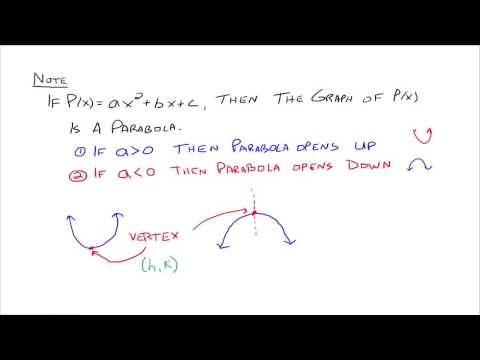
We know that the shape of a quadratic function is a parabola, where the coordinates of the vertex is the minimum or maximum. The real roots, real numbers, are the points where the parabola crosses the x-axis.

It's important to distinguish a function from an equation. A function is something of the form f(x)=ax2+bx+cf(x) = ax^2 + bx + c, which defines the formula in terms of xx. An equation is when we set the formula equal to something. So ax2+bx+c=0ax^2+bx+c = 0 is a quadratic equation, not a function.

Video

(Video) An Introduction to Quadratic Functions

by Randy Anderson

Randy Anderson has a good video introduction to quadratic functions.

Summary\large{\text{Summary}}

Quadratic functions are quadratic equations that are set up to be graphed. They take the following form: f(x)=ax2+bx+cf(x)=ax^2+bx+c where a,b,a, b, and cc are constants and a≠0.a\neq 0.

This is a little bit different than a quadratic equation. Equations are set equal to some constant that you then solve. Functions are defined in terms of a variable, and primarily used for graphing.

Each coefficient in a quadratic function gives us information, but the most important is the aa value. If a>0a > 0, the parabola opens upwards. If a<0a < 0, the parabola faces downwards.

Every parabola has a vertex and an axis of symmetry. The vertex is the point where the graph "turns around". The axis of symmetry is a vertical line that splits the parabola in half.

All of those values can be determined with information given by the function.

Illustrated · 1 min

Quadratic Functions

Quadratic functions have the standard form: f(x)=ax2+bx+cf(x)=ax^2+bx+c where a,b,a, b, and cc are constants and a≠0.a\neq 0.

Quadratic Functions have the form f(x)=ax^2+bx+c where a, b, and c are constants and a is nonzero.

Image source: By Caroline Kulczycky

Quadratic functions have a degree of two (i.e., the highest exponent of the variable is 22) and when you graph them, they form parabolas. In the following sections, you will learn how to graph quadratic functions and solve quadratic equations!

Type a concept, like “slope” or “photosynthesis”.

↑ ↓ to choose · Enter to openSearch explanations and problems