Aplicações e problemas

Before this, knowmedida de unidadesO que seria uma proporção?

Interactive · 1 question

Ratio and Proportion Word Problems

Ratio and proportion word problems are really applicable to real life when you need to calculate costs, determine time limits, or even convert between measurement systems! Here's a breakdown of what a ratio and proportion word problem might look like. We'll also see how to understand what the problem is asking, and how to solve it!

Ratio and Proportion Word Problems. Word Problem: Kelsey can read 4 sci-fi books in 10 hours. Assuming all of the books are the same length, how many hours would it take her to read 50 sci-fi books? Step One: Identify Knowns and Unknown. 4 sci fi books (known) in 10 hours (known). 50 sci-fi books (known) in x hours (unknown). Step Two: Plug values into proportion. 4 books / 10 hours = 50 books / x hours. Step Three: Solve proportion. 4/10 = 50/x means 4x = 500 which means x=125.

Image by Caroline Kulczycky

It's important to note that in Step Two, when you plug the appropriate values into the proportion, the units in both the numerators must be the same, and the units in both the denominators must be the same. For example, in the graphic above, the units in the numerators are books\textit{books}. The units in the denominators are hours.\textit{hours}. If the units given to you in the word problem are not consistent, you must somehow make them match. This next problem will show you how. For certain units we will use conversion factors to help make the units the same. We don't always have conversion factors, but it's good to know what ones we do have. Here are some examples:

  1. Units of length: convert between feet and meters
  2. Units of mass: convert between grams and kilograms
  3. Units of time: convert between minutes and days

Once that's done, the numerators will have the same units as each other. Likewise for the denominators. Then we'll be able to solve the proportion just using algebra. The equation will have a variable times a number on one side, and a number on the other side. Thus we can solve the equation in one step using division.

Practice Problem

Trisha can make 55 pairs of earrings in 11 week. Assuming she works at this constant rate, how many complete pairs of earrings can she make in 1010 days?

Choose one answer

Math as a puzzle

Many contest problems feel more like puzzles than homework. They are a good way to find out how much fun math can be. These are real problems from the AMC 8, AMC 10, AMC 12 and AIME, the national math competitions for middle and high school students, each with a worked solution on LIVE by Po-Shen Loh.

Interactive · 1 question

Math in Music: Rhythm

Now that the basic concepts of ratios and proportions have been covered, we are going to dive a little deeper into working with them through the subject of music.

Ratios are found in music within two main concepts: Rhythm/Polyrhythm and Pitch Intervals. These may seem a little foreign right now, but I promise they won't be too hard to understand. This explanation will focus on Rhythm and Polyrhythm, but the explanation on Pitch Intervals has been linked above.

Rhythm/Polyrhythm

All rhythms are referred to by names based off of fractions/ratios. There are whole notes (44\frac{4}{4} of a measure), half notes (24\frac{2}{4} of a measure), quarter notes (14\frac{1}{4} of a measure), eighth notes (18\frac{1}{8} of a measure), sixteenth notes (116\frac{1}{16} of a measure), etc. and the name denotes how much of a 44 beat measure the note takes up, as shown below. For our purposes, we are always going to use a 44 beat measure to describe our ratios.

Line of sheet music showing Whole, Half, Quarter, Eighth, and Sixteenth Notes

In order, Whole Note, Half Note, Quarter Note, Eighth Note, Sixteenth Note, all taking up the same amount of time

Not all notes and rhythms are based on groups of 44, notes can be based on any division! Triplets can be used to split a four beat measure into groups of 33 or 66 instead of groups of 22 or 44.

Musical triplets. The first set are 3 half note triplets that take up a full measure, next are 6 quarter note triplets that take up a measure, then finally 12 eighth note triplets that take up a whole measure

Three half note triplets take up a measure, 6 quarter note triplets, 12 eighth note triplets, etc.

The brackets over the notes tell how many notes are played in the span of the bracket. You can see the 33 placed above all of the notes. This is because each group of 33 takes a set amount of time. The half note triplets take up 44 beats (one full measure) with 33 notes, the quarter note triplets take up 22 beats (one half of a measure) with 33 notes, and the eighth note triplets take up 11 beat (one quarter of a measure) with 33 notes. As ratios, these could be written as 3:43:4, 3:23:2, and 3:13:1. If we wanted to write these notes as fractions, they could be called 13\frac{1}{3}, 16\frac{1}{6}, and 112\frac{1}{12} notes.

When we start combining these rhythms to be played at the same time, we get what are called polyrhythms. These are normally defined by ratio of how many notes are being played in the same amount of time.

Polyrhythms 4:3 and 3:2 are being shown. The ratios are written as the top line against the bottom line

The ratios in this case are going to be written in terms of the top line against the bottom line. The first measure is a 4:34:3 while the second measure is a 3:23:2. These same polyrhythms can be written without needing a second line to compare by once again using the brackets above the notes.

Five-lets and seven-lets shown. On the top line they are 5:4 and 7:4 as they take up the whole measure, and on the bottom they are 5:2 and 7:2 to take up only 2 beats

The groupings on the top line both take up an entire measure, 44 beats. That means that the first measure on the top line shows a 5:45:4 ratio (aka five-lets), and the second shows a 7:47:4 (aka seven-lets) ratio. The bottom groupings take up 22 beats , so they show a 5:25:2 and 7:27:2 ratio.

We're gonna try a practice question that builds on some of these concepts.

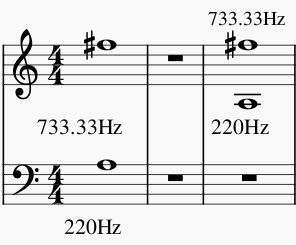
Brandon is playing a trombone solo that has 2424 evenly spaced notes. How many evenly spaced notes would Libby need to play in her counter melody to make the entire section a 4:34:3 polyryhthm?

Choose one answer

Video · + 1 min read

(Video) Proportion Examples and Word Problems

by Math Meeting

This video by Math Meeting explains proportions and works through a few examples.

Summary\large{\text{Summary}}

A proportion is two ratios that are set equal to one another.

An example of a proportion would be: 1 dollar10 pesos=10 dollars100 pesos\frac{1\text{ dollar}}{10\text{ pesos}}=\frac{10\text{ dollars}}{100\text{ pesos}} As you can see, they are equivalent. The units are the same, and then we notice the fractions are equivalent. The fractions are equivalent because 10100\frac{10}{100} can be reduced to 110\frac{1}{10}.

If you multiply the numerator and denominator of the first ratio by 1010, you get the second ratio. If you have 1010 times more dollars, you will have 1010 times more pesos.

The standard proportion problem is as follows: 5x=103\frac5x=\frac{10}3 You are given two proportions and you want to solve for xx.

The best way to solve these types of equations is with cross multiplication.

To cross multiply, you take the product of the numerator of the first ratio and the denominator of the second ratio. Set that equal to the product of the numerator of the second ratio and the denominator of the first ratio.

a/b = c/d becomes ad = bc

Let's solve this problem now. 5x=103⇒5⋅3=x⋅1015=10x1510=10x10315210=10x1032=x\begin{align} \frac5{x}=\frac{10}3\Rightarrow5\cdot3&=x\cdot10\\ 15&=10x\\ \frac{15}{10}&=\frac{10x}{10}\\ \frac{^3\cancel{15}}{_2\cancel{10}}&=\frac{\cancel{10}x}{\cancel{10}}\\ \boxed{\frac32}&=x \end{align}

Another Example

Here's a word problem using proportions.

The currency in Spain is the euro. If I exchange $250\$250 at the airport, how many euros will I get in return? (11 euro = 1.381.38 dollars)

The parentheses at the bottom give us our first ratio. 1 euro1.38 dollars\frac{1\text{ euro}}{1.38\text{ dollars}}

Within the question itself is our second ratio. x euros250 dollars\frac{x\text{ euros}}{250\text{ dollars}}

Set them equal to each other. Remember that the same units have to be in the top/bottom. 11.38=x250\frac{1}{1.38}=\frac{x}{250}

To solve, we cross multiply. 11.38=x250⇒1⋅250=1.38⋅x250=1.38x2501.38=1.38x1.382501.38=1.38x1.38181.16=x\begin{align} \frac{1}{1.38}=\frac{x}{250}\Rightarrow1\cdot250&=1.38\cdot x\\ 250&=1.38x\\ \frac{250}{1.38}&=\frac{1.38x}{1.38}\\ \frac{250}{1.38}&=\frac{\color{#29A603}{\cancel{\color{black}{1.38}}}x}{\color{#29A603}{\cancel{\color{black}{1.38}}}}\\ 181.16&=x \end{align}

You will get approximately 181.16181.16 euros!

Interactive · 1 question

Math in Music: Pitch

Now that the basic concepts of ratios and proportions have been covered, we are going to dive a little deeper into working with them through the subject of music.

Ratios are found in music within two main concepts: Rhythm/Polyrhythm and Pitch Intervals. These may seem a little foreign right now, but I promise they won't be too hard to understand. This explanation is going to cover Pitch and Intervals, and Rhythm/Polyrhythm is linked above.

Pitch and Intervals

When two notes are being played at once, there is an Interval between the two pitches. Every pitch can be written as both a note (think A,B,C,A, B, C, and their placings on a staff) or as a measurement of Hertz (Hz\text{Hz}). We are going to use A=440 HzA=440 \text{ Hz} as a baseline to demonstrate how ratios are used in intervals and tuning in music.

As notes move in octaves, there is always a 2:12:1 ratio between the notes. Based on A at 440 Hz440\text{ Hz}, the AA one octave higher is going to be measured at 880 Hz880\text{ Hz}, and the AA one octave lower is going to be measured at 220 Hz220 \text{ Hz}.

4 As shown in a musical staff. In order, A=440Hz in the second space, A=880Hz one ledger line above the staff, A=440Hz in the second space again, and A=220Hz two ledger lines below the staff

This pattern continues in both directions (up and down) from AA in the second space until eventually the note is outside of the range of human hearing.

The ratios between notes exist for every interval and are the basis for tuning many instruments as well as playing in tune with another musician. For example, were going to use the next two most common intervals, the perfect fifth and the major third. Using A=440 HzA=440 \text{ Hz} as a basis again, we are going to use the intervals of 3:23:2 to find the measurement of the perfect fifth (EE), and a ratio of 5:45:4 to find the major third (CC# or CC Sharp).

32=x440\frac{3}{2}=\frac{x}{440}

In this case we are going to put 440440 as a denominator because we want to find the Hz\text{Hz} of a note that is higher than our original AA.

32=x4402x=1320x=660\begin{align} \frac{3}{2}&=\frac{x}{440}\\ 2x&=1320\\ x&=660 \end{align}

Our perfect fifth of EE will be at 660 Hz660\text{ Hz} when it is perfectly in tune. Now lets calculate the pitch of the major third, CC#. Once again, the 440440 is going to be in the denominator as we are finding a note higher than AA.

54=x4404x=2220x=550\begin{align} \frac{5}{4}&=\frac{x}{440}\\ 4x&=2220\\ x&=550 \end{align}

Our major third of CC# is going to be at 550 Hz550\text{ Hz} when perfectly in tune. Combining all of these notes, you get a nice consonant AA major chord. Just to make sure our musical brains are keeping up with the math, here is what this looks like on a staff.

A at 440 Hz, E at 660Hz, A at 440 Hz again, and C Sharp at 550Hz written on a staff to show where each note would lie when reading music.

Let's try a practice problem to see if everything is sticking.

Brandon and Libby are trying to practice their duet. If Brandon is playing a low AA at 220 Hz220\text{ Hz}, and Libby wants to play a perfectly in tune FF# that is one octave and a major sixth (5:35:3) higher, what pitch should she play?

Choose one answer

Type a concept, like “slope” or “photosynthesis”.

↑ ↓ to choose · Enter to openSearch explanations and problems