Metodologia de redução

Before this, knowO que seria a forma simplificada

Interactive · 7 questions

Divide the numerator and the denominator by the same number

The best way to simplify, or reduce, a fraction is to divide the top (the numerator) and the bottom (the denominator) by the largest common factor (in other words, the biggest number that they can both be divided by evenly). That can be tricky if your numerator and denominator are really big, so here are some steps that might make simplifying fractions, well, simpler. We call this reducing a fraction to lowest terms. That's just a fancy way of saying "reduce". You might see it in your textbook called that.

Step 1: Check if the denominator is evenly divisible by the numerator

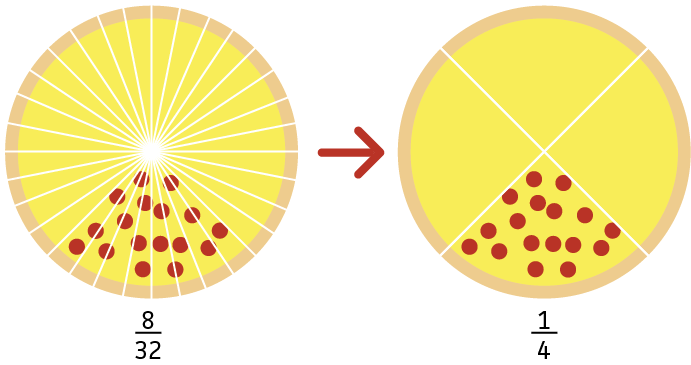
Sometimes, the bottom number of the fraction will be evenly divisible by the top number. If it is, simplifying the fraction is easy! Just divide the numerator and the denominator by the numerator, and you've got your simplified fraction. Let's try it on an example: 832\frac{8}{32}

What is 3232 divided by 88?

Choose one answer

Video · + 2 min read

(Video) Simplifying Fractions

by Math Antics

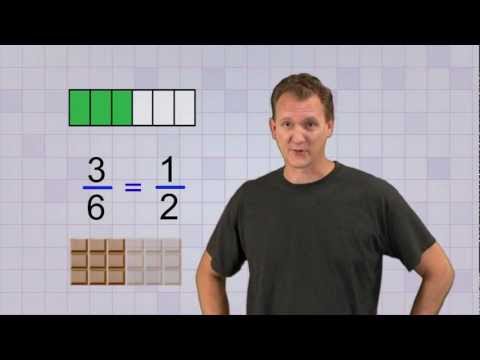
In this video by Math Antics, he goes over what simplifying fractions means, how you simplify them, and then some examples.

Summary\large{\text{Summary}}

So how do you find the simplest form of a fraction? Well, you need to look at the prime factorizations of the numerator and the denominator.

In the previous example, we looked at how 36\frac36 and 12\frac12 are equivalent fractions. We also stated that 12\frac12 was the simplest form of 36\frac36.

To show this, we write out the prime factorization of both the numerator and denominator. 36=1×32×3\frac36=\frac{1\times3}{2\times3} They both have a common factor of 33. We can rewrite this expression as the product of two fractions: 1×32×3=12×33\frac{1\times3}{2\times3}=\frac12\times\frac33 And since 33=1\frac33=1, this becomes: 12×33=12×1\frac12\times\frac33=\frac12\times1 And anything times 11 stays the same. 12×1=12\frac12\times1=\frac12

Let's look at another example: 3036\frac{30}{36}. Start by writing out the prime factorization of both the top and bottom of the fraction. 3036=2×3×52×2×3×3\frac{30}{36}=\frac{2\times3\times5}{2\times2\times3\times3} As you can see, both the numerator and denominator have common factors of 22 and 33. 2×3×52×2×3×3\frac{\color{#29A603}{2}\times\color{#8925AE}{3}\times5}{\color{#29A603}{2}\times2\times\color{#8925AE}{3}\times3} Because these are common factors, we can just cross them out. 2×3×52×2×3×3\frac{\color{#29A603}{\cancel{2}}\times\color{#8925AE}{\cancel{3}}\times5}{\color{#29A603}{\cancel{2}}\times2\times\color{#8925AE}{\cancel{3}}\times3} This leaves us with: 52×3=56\frac{5}{2\times3}=\frac56 Therefore, 56\frac56 is the simplest form of the fraction 3036\frac{30}{36}.

Notes on Reducing Improper Fractions

Everything we just said will still work if your original fraction is still improper. There is one extra step, though. If you reduce an improper fraction, it'll still be improper. That means it can be written as a mixed number. You might want to review converting fractions to mixed numbers.

Prime Numerators and Denominators

There's something else to be said for reduced fractions. We can check if the numerators and denominators are prime numbers. If both of these numbers are prime, then we know the fraction is fully reduced. The only exception is if the numbers are the same. For example, 33 is a prime number, but

33\frac{3}{3}

can be reduced to 11. If the fraction is a mixed number, this trick won't work. You'll have to convert back to an improper fraction.

Interactive · 7 questions

Simplifying Fractions

When we simplify a fraction, we put it in its simplest form. This is also called reducing a fraction.

The whole idea of simplification in math is the same as in the rest of life—to reduce clutter, and make things easier to see and use.

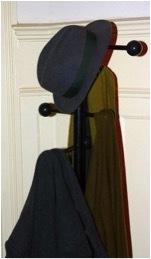
coat rack

Image source: By Kjetil Ree CC BY-SA 4.0, via Wikimedia Commons

Think of messy fractions like a messy coat rack. Yes, it's still a coat rack no matter how many coats you fling on it. But, the clutter makes it darn near impossible to find the coat you want when you want it.

Messy fractions are like that. Yes, they are still fractions as long as they've got a numerator and a denominator. But, the more cluttered and un-simplified they are, the harder they are to work with.

So, let's get down to the business of how we can simplify fractions!

For both proper and improper fractions:

When a fraction is fully reduced (simplified), there is no number other than 1 that can evenly divide both the numerator and denominator.

The fractions below are all examples of fractions that are not simplified:

2/6, 5/15, and 4/10

The easiest way to simplify a fraction in the smallest number of steps is to divide the numerator and denominator by their greatest common factor (GCF). Of course, one must find the greatest common factor.

Consider the first fraction in green: 26\frac{2}{6}.

What is the numerator?

Choose one answer

Type a concept, like “slope” or “photosynthesis”.

↑ ↓ to choose · Enter to openSearch explanations and problems