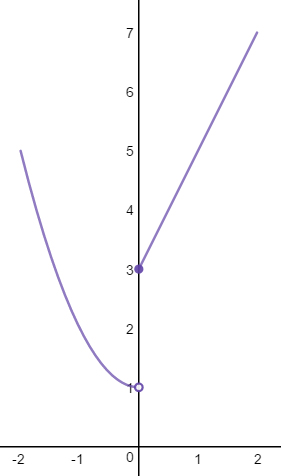
Video · + 3 min read

(Videos) Finding Limits from a Graph
by PatrickJMT
In this video by patrickJMT he shows you how look at a graph an evaluate a limit.
He explains this idea by looking at an arbitrary graph which has a break in it at the value of .

If we take an value that gets closer and closer to , whether it's from the left of or the right of , what are the values getting closer to?
As gets closer to , (the values) gets closer to .
Even though is undefined at because of the open circle, the graph still gets closer and closer to that value as we move closer to . We can write this in mathematical terms using a limit. All this says is if you have some function and you plug in values close to you get out values close to .
He then looks at a graph and starts answering some questions. It looks similar to:

The first question he looks at is: what is ? All we do is plug in the value of and figure out what the corresponding value is. So we can write:
The next question is: what is ? What we need to do is look at the values on both sides of as they approach it. Then look at their corresponding values and see if they get closer to a number. If we look at our graph, we can see they get closer to . So we can write:
Next up is: what is ? If we plug in , since our dot is up at , we get out that. So:
Following that we have: what is ? Well, as we get closer to from both sides, the graph gets closer to the value of . So:
The next problem is: what is ? In this case, as the values approach the values get bigger and bigger. So we say that the limit approaches infinity, or:
Then he asks: what is ? If we plug in we get out the value . So:
What if we were asked to find ? If we approach from the left, that is take points smaller than , the limit approaches . But if we approach from the right, that is take points larger than , the limit approaches . Since these are two separate numbers that the limit is approaching, we say the limit does not exist.
However, we can talk about limits specifically from the left or right. If you were asked to find (there's a little negative sign above the 4) we would look at the values as they approach from the left, or values smaller than 4.
If you were asked to find (there's a little positive sign above the 4) we would look at the values as they approach from the right, or values larger than 4.
So:

In this video he looks at another graph and asks some questions about it regarding limits.
The graph he looks at is:
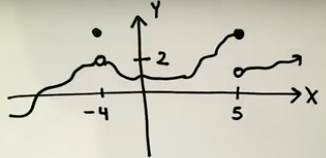
See if you can answer these questions on your own!
Does the limit as approaches exist for ?
Does the limit as approaches exist for ?