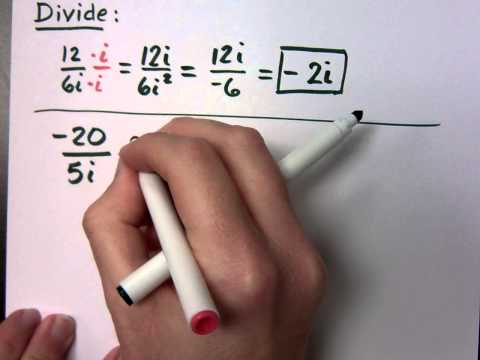
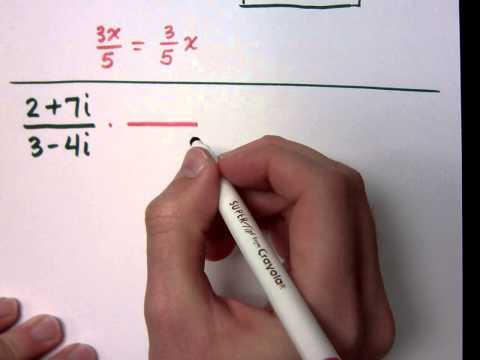
To get rid of an i in the denominator, all you have to do is multiply the numerator and denominator by i. This cancels out i in the denominator. This method is really helpful when you are trying to convert to rectangular form. Let's look at a simple example to illustrate how to do this.
Consider i1+i. To get rid of the i in the denominator, we must multiply both 1+i, the numerator, and i, the denominator, by i.
i1+i=i1+i⋅ii=(i)(i)(1+i)(i)=i2i+i2=(−1)i+(−1), since i2=−1=−1i−1=1−i
Now, we have a complex number, 1−i, in rectangular form! Let's do one more example.
To put 2i5+3i into rectangular form, we need to get rid of the i in the denominator. To do this, we multiply both 5i+3, the numerator, and 2i, the denominator, by i.
2i5+3i=2i5+3i⋅ii=(2i)(i)(5+3i)(i)=2i25i+3i2=2(−1)5i+3(−1), since i2=−1=−25i−3=23−5i=23+2−5i
Remember, the big takeaway of this section is that, in order to get rid of an unwanted i in the denominator of a fraction with complex numbers, you just need to multiply the numerator and the denominator by i. It makes it easier to convert to rectangular form!