Interactive · 1 question

+2 contributors

The Complex Plane
We've now learned that Complex Numbers take the form of . Our next step is to learn how they appear on the complex plane.

Funny, it doesn't look very complex
Made with Desmos
The complex plane is very similar to the Cartesian plane that you are used to working in. The only difference is that the -axis is replaced with the real () axis, and the -axis is replaced with the imaginary () axis.
Before we dive into graphing complex numbers, let's think about how we graph points in the Cartesian plane. Every point on the Cartesian plane is written as , where is the horizontal component, and is the vertical component. For example, the point is units to the right and units above the origin. Now, let's look at a complex number and break it down a little further. Remember that is the real component, and is the imaginary component. This means that when we graph this number as a point on the complex plane, it's horizontal position is units away from the origin, and its vertical position is units away from the origin.
Here is the complex number on the complex plane:

Made with Desmos
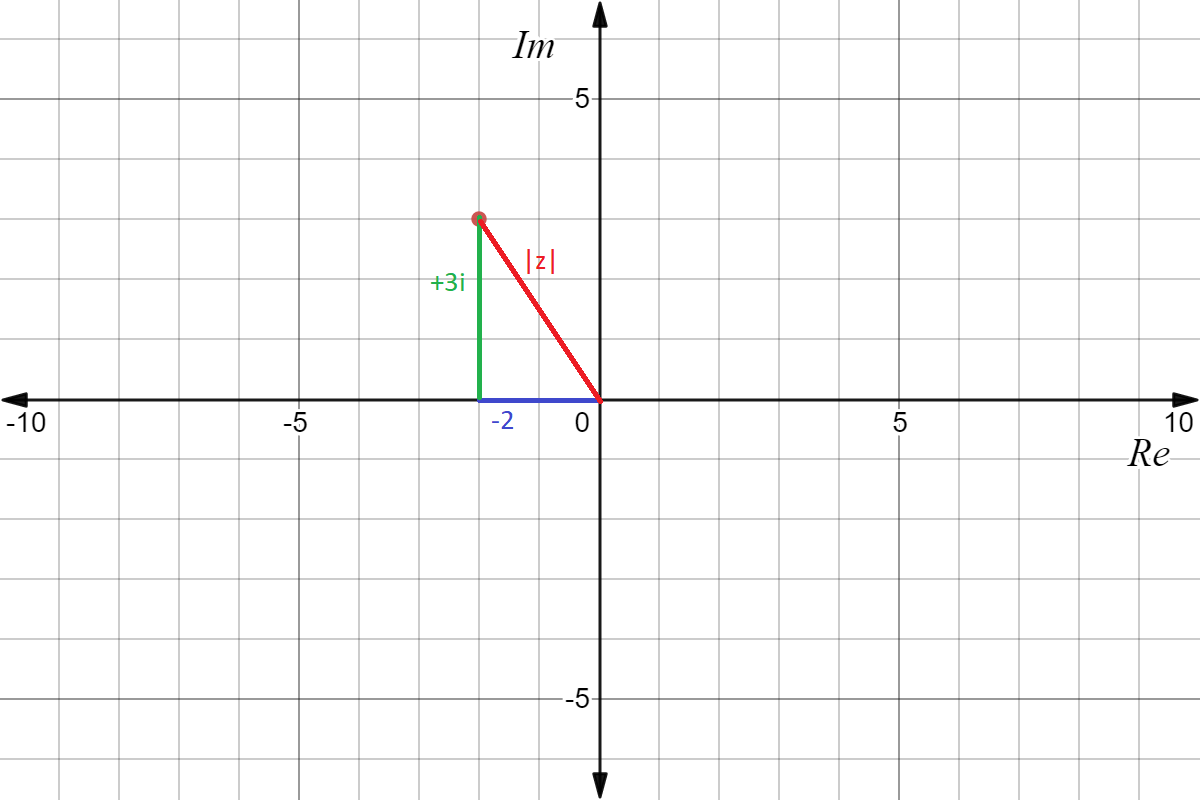
The point is placed units to the left of the origin and units above the origin. Just to sure up our understanding, here is the same point with each of the components labeled.
Made with Desmos
The horizontal component is , the vertical component is , and the diagonal is the magnitude of the complex number, which you'll learn about later.
Where would the complex number fall on the complex plane in relation to the origin?
This number would be units to the right and units below the origin.
The big takeaway here is that graphing points in the complex plane isn't very different than graphing points in the Cartesian plane. Remember that with the form , your horizontal component will be , and your vertical component will be .
