Illustrated · 1 min
By Gabi Slizewska

+1 contributors
Contributors

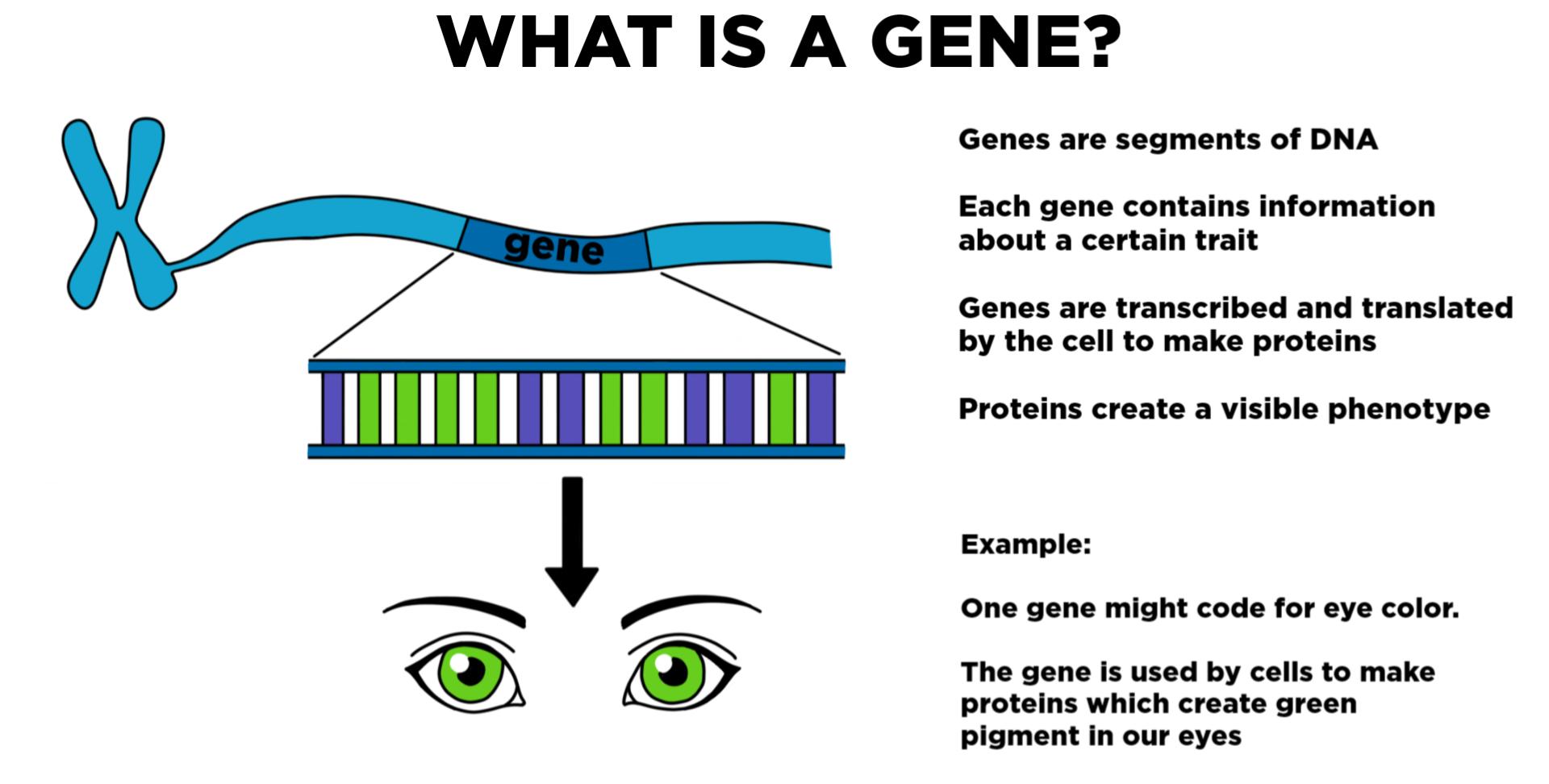
Image source: By Gabi Slizewska

Before this, knowDNA (Role in Inheritance) — Overview & Importance
Illustrated · 1 min
Image source: By Gabi Slizewska
Illustrated · 2 min
Genes are segments of a strand of DNA that code for specific proteins. They control almost every aspect of an organism: what it looks like, how it acts, the way it develops, and the way it grows. Each one is made up of thousands of base pairs.
Genes are the instructions our bodies use to control how much, what kind, and when specific proteins are produced. The proteins created are responsible for certain traits, which are just genetically determined characteristics. All of your traits are contained within these genes, from how tall you are to how big your nose is. Changing them on purpose so that an organism has certain traits is called genetic engineering. There is also gene therapy, in which scientists use genes to treat or prevent diseases, like sickle cell disease. Both are hot topics in science today.

Image source: By Thomas Splettstoesser CC BY-SA 4.0, via Wikimedia Commons
The location of every gene in DNA is the same for every human. So, the gene that codes for eye color is located in the same place on the same chromosome for everyone.
Each pair of the 23 homologous chromosomes in humans contains different genes. It is estimated that humans have 20,000 genes across their 46 chromosomes. (You can learn more about how scientists came up with this number by checking out the Human Genome Project.)
If you remember, when humans are made they get one set of chromosomes from both of their parents (totaling 23 pairs of chromosomes). When some gene sequences switch places during the first part of meiosis, they create a unique mix of both parents' genetics. This happens because the genes are in the same location on both of the chromosomes.
: A chromosome is a long, single, coiled piece of DNA
: The macromolecule that stores all of an organism's genetic information
: The genetic code. A segment of DNA that codes for a specific trait or protein
: Genes of the same type that contain different kinds of information
Video
by Stated Clearly

Genes are regions of DNA that code for proteins. They are the functional units of heredity. In this video, Stated Clearly explains how these regions work. They include some cool examples of proteins and also show what happens when you mix and match DNA from different organisms.
Illustrated · 1 min
DNA molecules are very large. However, not all of our DNA contains genetic information. Genes are the regions of DNA which contain the necessary instructions to make proteins. These regions get transcribed into RNA and then translated into the amino acids that make up proteins. The proteins then go on to perform various important functions in the cells.
Often, there are two or more versions of a single gene. These different versions are called alleles. The different versions all code for the same type of trait (such as eye color), but their products are slightly different (blue eyes vs. brown eyes).
A gene has many regulatory factors that make it stand out so that it can be seen by enzymes. These enzymes copy the segment of DNA that holds the gene and turn it into RNA. This RNA eventually becomes a protein.
Even within gene sequences in DNA, there are parts that do not code for a product. The regions which are needed for expression of traits are called exons. The regions which do not code for a product are called introns. There are also regulatory regions (like promoter regions) which don't code for a protein, but they help with transcription. Once the gene sequence is transcribed, the introns (and sometimes exons) can be spliced out. The resulting molecule is called mRNA, and it goes on to be translated into a protein.

Image source: By National Human Genome Research Institute [Public domain], via Wikimedia Commons



