Illustrated · 2 min

+2 contributors


Meiosis II: The Sequel
One cell division was not enough. Now the daughter cells of meiosis I are back for round two.
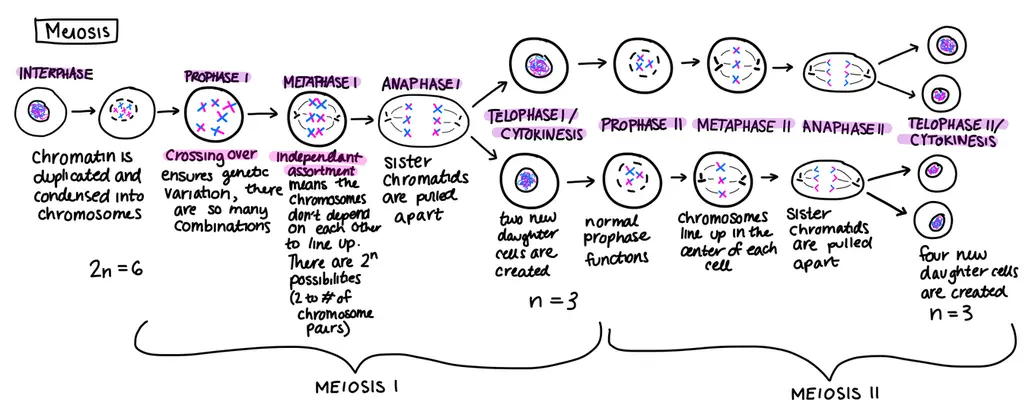
Remember, meiosis happens in sex cells (sperm or egg cells) only. At the end of meiosis II, we form special sex cells called gametes. This process ensures that these gametes only contain one set of chromosomes. They get their other set of chromosomes when they are fertilized by another gamete.
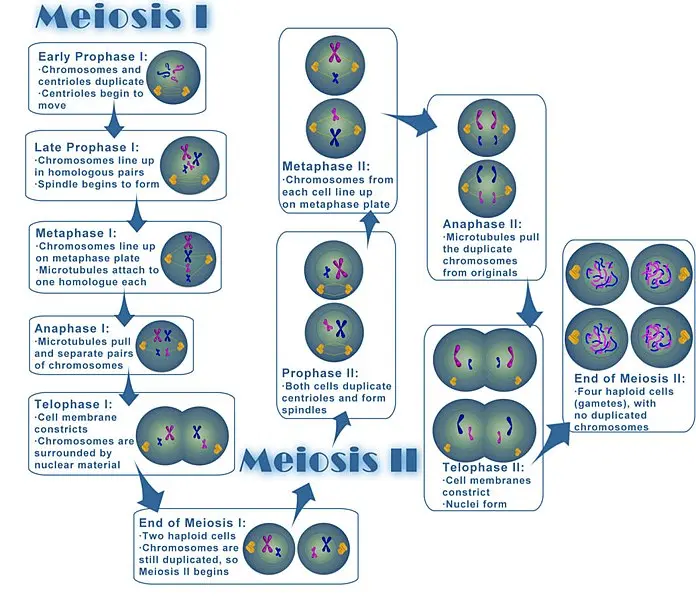
Meiosis II goes through similar phases to meiosis I, but now we are starting with two haploid cells. DNA does not get replicated before this division, but each chromosome consists of two chromatids.
Prophase II:
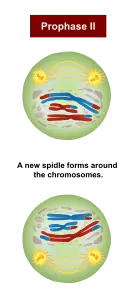
Once again, the nuclear membrane disintegrates and chromosomes are free to roam the cytoplasm. The mitotic spindle begins to form in preparation for the following phases.
Crossing-over does not happen again because there are no homologous pairs of chromosomes.
Metaphase II:
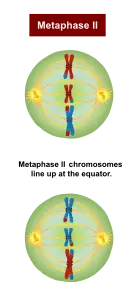
The chromosomes begin to line up along the center of the cell, and the spindle fibers attach at the centromeres. This looks similar to metaphase of mitosis, but remember that there are no homologous chromosomes here.
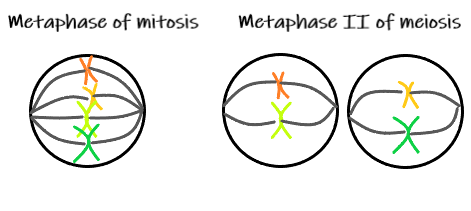
Image source: By Gabi Slizewska
Remember, just like in meiosis I, the cell needs to pass a checkpoint before heading to the next phase. The cell makes sure that each chromatid is attached to spindle fibers.
Anaphase II:
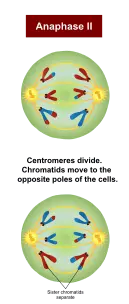
During anaphase I, the spindle pulled apart homologous chromosomes. This time, the spindle pulls apart the sister chromatids of each chromosome. This means that after meiosis II, the daughter cells will have one copy of each chromosome, and each chromosome will have one chromatid.
Telophase II:
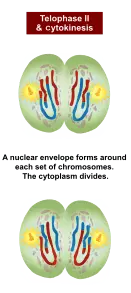
A new nuclear envelope can now form around each cluster of chromosomes. This forms two nuclei. Simultaneously, a process called cytokinesis splits the cytoplasm to form two daughter cells.
Remember that this is happening for each of the daughter cells that resulted from meiosis I. This means that we now have a total of four daughter cells.
Although not specifically pictured, each daughter cell is genetically different. This is due to the crossover that occurred in meiosis I.
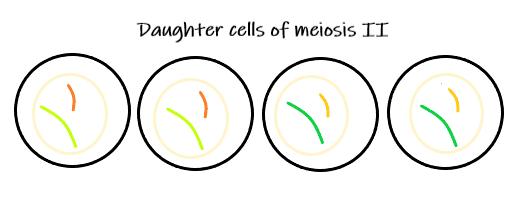
Image source: By Gabi Slizewska
Understanding Chromosomal Numbers
Each cell is haploid because it only has one copy of each chromosome. This is very important. Meiosis only occurs in sex cells, or the egg and sperm. An egg cell will have one set of chromosomes, and a sperm cell will have one set. When they combine during fertilization, they create a diploid cell called a zygote. In this way, you get half of your DNA from your mom and half from your dad.