Nondisjunction — Definition & Overview

Illustrated · 1 min

Definition of Nondisjunction

Nondisjunction is when chromosomes fail to separate during meiosis. Nondisjunction can happen during anaphase I or anaphase II. Either homologous chromosomes or sister chromatids can fail to separate.

On the left is an instance of nondisjunction during anaphase II, which leads to one of the four sex cells having an additional chromosome. On the right is an instance of nondisjunction occurring during anaphase I, which leads to two of the sex cells having an additional chromosome.

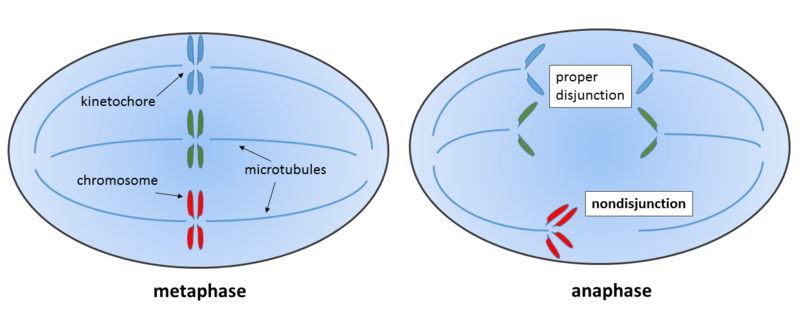
Image source: By Tweety207 CC BY-SA 3.0, via Wikimedia Commons

Nondisjunction can lead to a sex cell having an additional chromosome, which can cause disorders like Down Syndrome. On the left in the image above is an instance of nondisjunction during anaphase II, which leads to one of the four sex cells having an additional chromosome. On the right is an instance of nondisjunction occurring during anaphase I, which leads to two of the sex cells having an additional chromosome.

Illustrated · 1 min

What Is Nondisjunction?

Nondisjunction is an error during meiosis that creates eggs or sperm cells that have the wrong number of chromosomes. Recall that meiosis is the process of making haploid gametes from diploid cells. During fertilization, two of these haploid cells combine to create a new diploid cell with a set of chromosomes from each haploid.

Nondisjunction creates diploid cells with too many or too few chromosomes.

Image source: By Wpeissner CC BY-SA 3.0, via Wikimedia Commons

Well, sometimes meiosis goes a bit wrong and the chromosomes do not separate properly during anaphase. When this happens, you end up with haploids that have the wrong number of chromosomes, either one too many or one too few. If one of these incorrect haploids becomes fertilized, the offspring produced will have an abnormal number of chromosomes.

Vocabulary Review:\color{#8925AE}{\text{Vocabulary Review:}}

Meiosis\color{#8925AE}{\text{Meiosis}} : The process of dividing one nucleus into four unique haploid cells. Only occurs in sex cells

Nondisjunction\color{#8925AE}{\text{Nondisjunction}} : Homologous chromosomes fail to separate during meiosis, causing gametes to have the wrong number of chromosomes

Illustrated · 1 min

How Does Nondisjunction Affect an Organism?

When major mutations arise, it could be due to nondisjunction.

During nuclear division (meiosis or mitosis), pairs of chromosomes line up across the center of the cell. This looks a little different for meiosis and mitosis. The pairs are pulled apart to opposite sides of the cell before the cell divides so that each of the daughter cells ends up with a copy of each chromosome.

A chart showing cell division for an organism with four pairs of chromosomes, eight in total. In meiosis 1, two homologous chromosomes separate, but they don't if nondisjunction occurs. If they don't separate, one of the daughter cells ends up with an extra chromosome and the other is missing a chromosome. In meiosis 2, sister chromatids separate. If nondisjunction occurs, then both chromatids end up in one daughter cell while the other cell doesn't get a copy. In mitosis, sister chromatids separate unless nondisjunction occurs. Then, one cell ends up with both chromatids and the other cell gets none.

Image source: By Gabi Slizewska

Nondisjunction is what we call it when a pair of chromosomes doesn't separate before cell division. As a result, one of the daughter cells ends up with an extra chromosome and the other is missing a chromosome. This could cause all sorts of problems.

It's easy to understand why a missing chromosome can be bad. You're missing a whole set of genes. An example is Turner Syndrome, which is the result of a missing X chromosome.

It's a little more confusing why having an extra chromosome would be a bad thing, but too much DNA can be just as bad as having too little. A lot of the time, an extra chromosome in a developing baby results in a miscarriage or very early death. In some cases, people can live with extra chromosomes—as is the case with Down Syndrome—or even show no symptoms at all.

Video

(Video) Visualizing Nondisjunction

by Jack Lewis

Nondisjunction results in sex cells that don't have the right number of chromosomes. It has a chance of happening during meiosis I and also meiosis II.

Type a concept, like “slope” or “photosynthesis”.

↑ ↓ to choose · Enter to openSearch explanations and problems

