Interactive · 8 questions
+2 contributors


Inclusion-Exclusion Principle
Before we get to practice word problems using the inclusion-exclusion principle, it might help to see what the principle looks like in a picture.
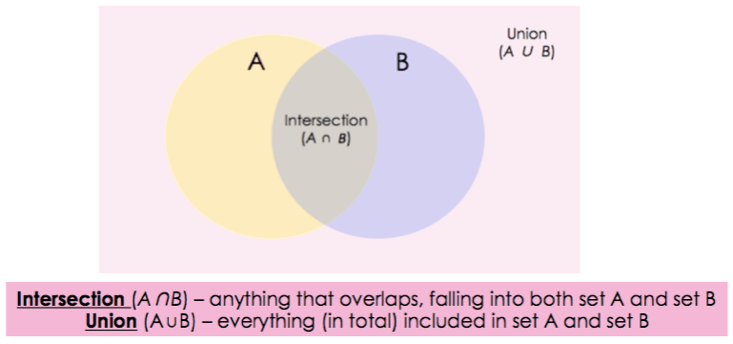
With the inclusion-exclusion principle, we're going to use our knowledge of what's in each part of the Venn diagram to solve for a missing value.
Let's try an example.
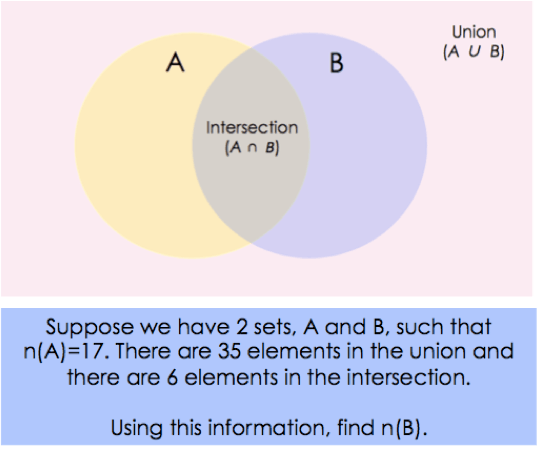
Before we start trying to find let's fill in what we already know on our diagram.
What number should we put in the pink area of our diagram?
HINT: This is the union. Think of it like our total.
What number should we put in the yellow area of our diagram?
HINT: This represents set A.
What number should we put in the overlap area between the yellow and purple circles?
HINT: This represents the intersection of sets A and B. This is where these two sets overlap.
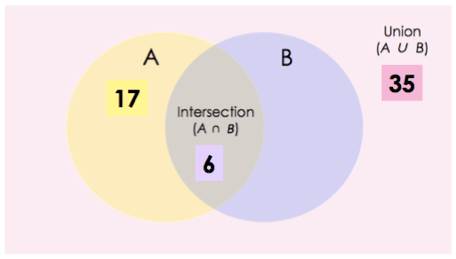
Now, let's get down to finding out what is. This is the number that we'll put in set B, the purple circle.
There's a pretty easy formula to follow every time. Here it is:
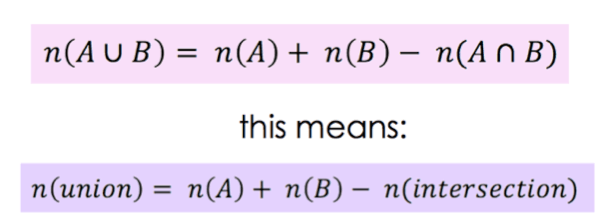
If we plug the numbers in from our picture, here's what we get:
Using the equation in green above, solve for
Now, let's try this inclusion-exclusion principle with a word problem.
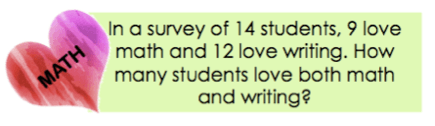
Let's start by creating a Venn diagram showing the info we've been given.
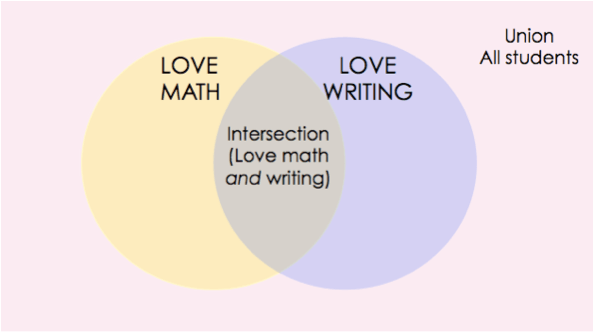
What value should we put in the pink area of our diagram?
HINT: This is the union; it's the total number of students in our survey
What value should we put in the yellow area of our diagram?
HINT: This is the group of students that love math only.
What value should we put in the purple area of our diagram?
HINT: This is the group of students that love writing only.
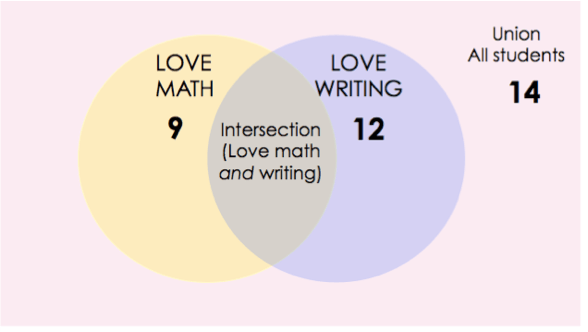
We're almost done! Let's look again at the equation to solve inclusion-exclusion problems.
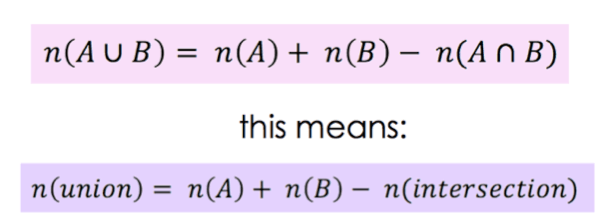
When we plug our values in, we end up with:
Solve the equation above. How many students love math and writing*?
HINT: This is the value we'll put where our yellow and purple circles meet. It's the intersection or overlap area.