Probability: Two Independent Events

Interactive · 1 question

Suppose AA and BB are two independent events. Then P(AP(A and\textrm{and} B)B) or more commonly P(A∩B)=P(A)⋅P(B)P(A \cap B) = P(A) \cdot P(B). In other words, to find the probability of two independent events occurring, you just multiply the two.

Alright that's great, but what makes two events "independent"? Two events are independent simply if the occurrence of one does not affect the occurrence of another.

If you toss a fair coin, what is the probability that you flip two heads in a row?

Choose one answer

Interactive · 7 questions

Independent Events

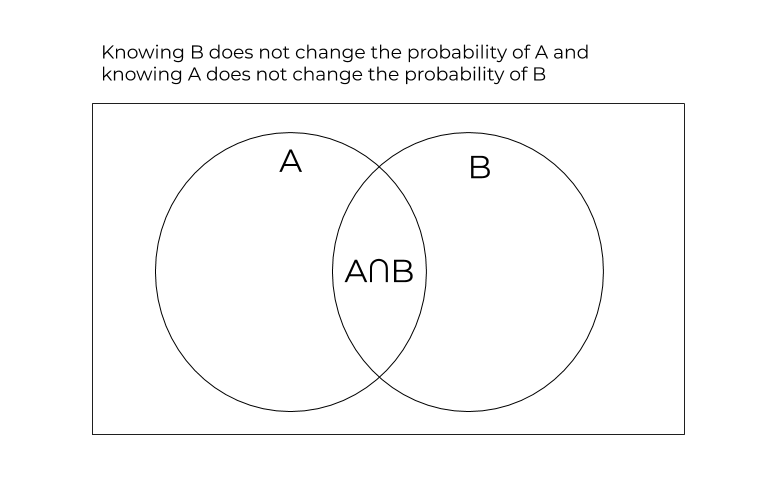
If 22 events (AA and BB) are independent, they have NO effect on each other. This means that the outcome of event AA has absolutely NOTHING to do with event BB.

Venn diagram showing two independent events

Here's an example of 22 independent events:

The probability of rolling a 4 on a die GIVEN that you flipped a coin and landed on tails

In this example, one event (rolling a 44) has nothing to do with the other (flipping a coin and getting tails).

In other words, the events are independent. This means that the event of rolling a 44 will remain completely unchanged regardless of whether or not we land on tails.

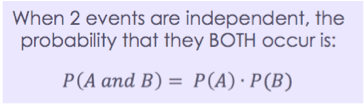
When 2 events are independent, the probability that they BOTH occur is:
P(A and B) = P(A) * P(B)

Let's try an example:

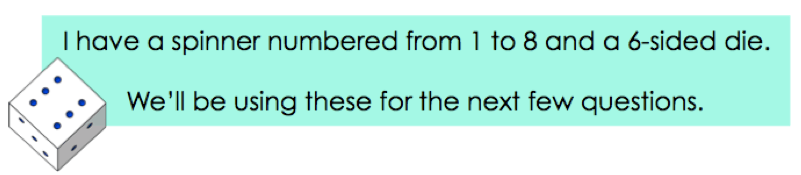
I have a coin and a 6-sided die.  We'll be using these for the next few questions

What is the probability of flipping the coin and getting heads?

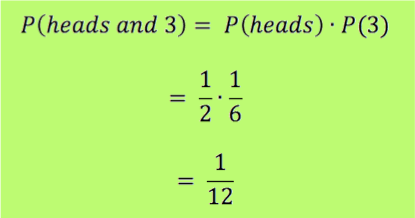
This can be written as P(heads)P(heads).

Choose one answer

Interactive · 3 questions

Two events are said to be independent if the probability of one event does not affect the probability of the other. For example, a coin flip and drawing a card from a standard deck of 5252 cards are independent events. Similarly, rolling a fair, six-sided die will have no influence on a subsequent roll of the same die, meaning that the rolls, or trials, are independent of one another. Suppose AA and BB are independent events. To find the probability of AA and BB both occurring, denoted P(A⋂B)P(A \bigcap B), simply multiply their individual probabilities together. P(A)×P(B)=P(A⋂B)P(A) \times P(B) = P(A \bigcap B)

What is the probability of flipping a fair coin twice, resulting in a heads on the first flip and a tails on the second?

Choose one answer

Video

(Video) Probability of Independent Events

by MathHelp.com

MathHelp.com has a good video on how to find the probability of two independent events.

Summary\large{\text{Summary}}

In the problem given, we want to find the probability of getting a heads and then another heads when we toss two coins. Since the coins are independent of each other, meaning the result of one coin will not affect the other, we can just multiply their individual probabilities together. P(heads)=12P(heads) = \frac{1}{2} for any standard, two-sided coin, so P(heads,heads)P(heads, heads) will be:

P(heads,heads)=12×12=14P(heads, heads) = \frac{1}{2} \times \frac{1}{2} = \frac{1}{4}

Type a concept, like “slope” or “photosynthesis”.

↑ ↓ to choose · Enter to openSearch explanations and problems