Interactive · 1 question

When you always replace or put back selected items, calculating probability can be pretty straightforward!
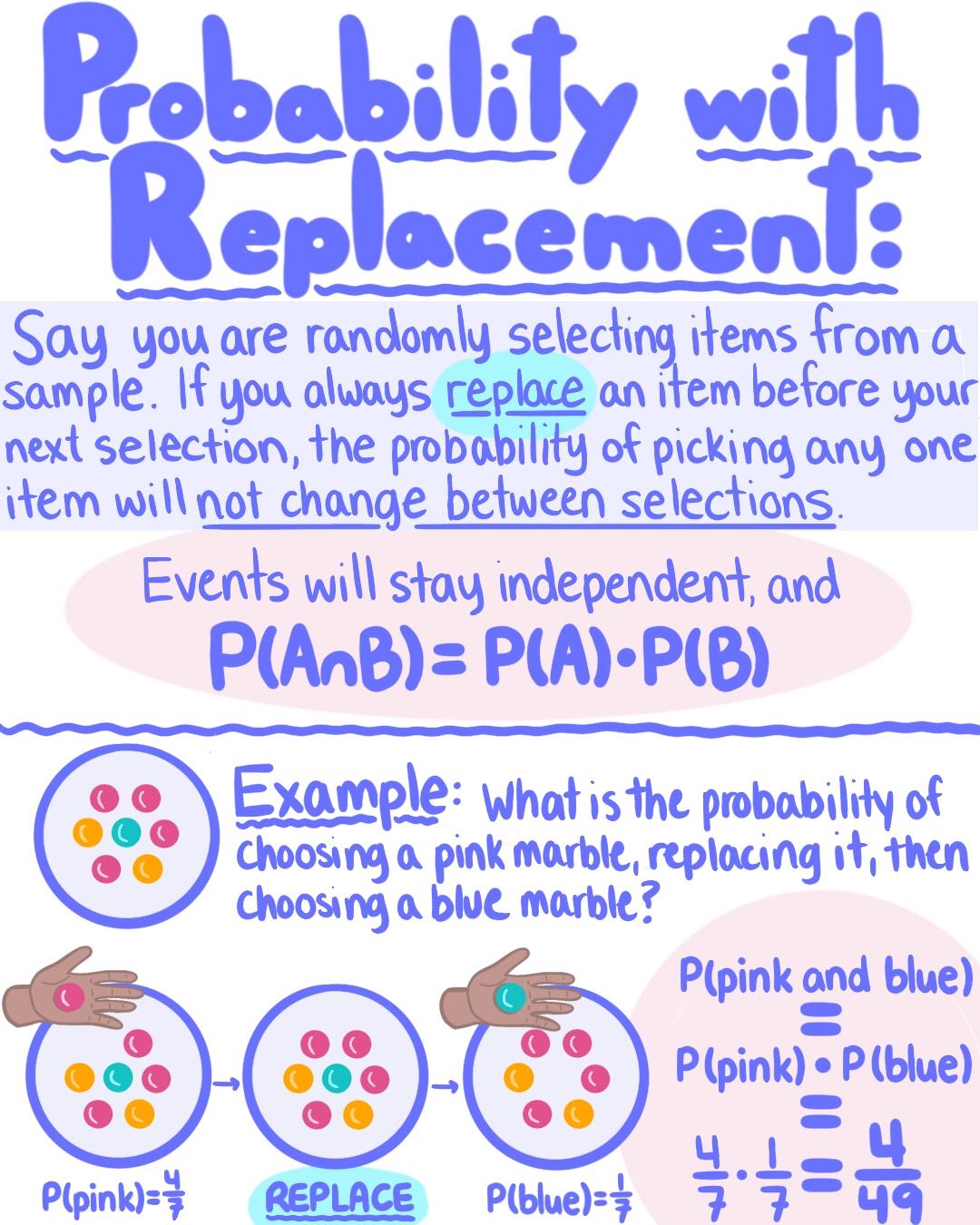
Hand by Sylvia Freeman. Image by Caroline Kulczycky
Notice how when you replace a marble, the amount of marbles in the bag stays the same, and thus the denominator of your fraction stays at
Let's do another example with marbles. Here are refreshers on theoretical probability and probability of independent events to help you if you need it.
Like the example in the graphic above, consider a bag with pink marbles, blue marble, and orange marbles. What is the probability of drawing a pink marble, replacing it, drawing an orange marble, replacing it, and finally drawing another pink marble?
Since there are pink marbles in the bag and marbles total, the probability of choosing a pink marble is In other words:
Then, you replace whatever marble you drew, so there are still marbles in the bag.
Next, since there are orange marbles in the bag and marbles total, the probability of choosing an orange marble is In other words:
Then, you replace whatever marble you drew, so there are still marbles in the bag.
Finally, since there are still pink marbles in the bag and marbles total, the probability of choosing a pink marble is In other words:
Remember, all these events are independent since you always replaced the marble you drew, and the probability of picking any one marble will stay the same between selections.
Thus, to find the probability of drawing a pink marble, replacing it, drawing an orange marble, replacing it, and finally drawing another pink marble is equal to the probability of drawing a pink marble times the probability of drawing an orange marble times the probability of drawing a pink marble. So: