What Is Meiosis? — Definition & Overview

Illustrated · 2 min

What Is Meiosis?

During fertilization, the sex cells of two parents join together and eventually develop into a fully-functioning organism. It's pretty amazing that each one of us started out as a single cell.

This incredible process begins with meiosis.

This is the process by which sex cells (germ cells) divide. Sex cells include the sperm and the egg. These cells do not undergo mitosis like other body cells.

The overall process can be divided into two parts: meiosis I and meiosis II.

It all starts with a diploid cell (2n2n) containing two copies of each chromosome. Each chromosome consists of one chromatid. The DNA is replicated before meiosis begins so that each chromosome contains two chromatids. This is exactly how mitosis starts too.

A diagram of cells before and after DNA replication for meiosis and mitosis.

Image source: By Gabi Slizewska

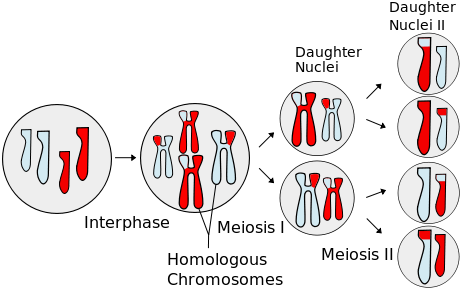
Now the cell is ready to enter meiosis. The cell goes through a series of phases and then divides, making two haploid cells (1n1n), also called daughter cells. These cells have one copy of each chromosome, but each chromosome still has two chromatids.

Remember: this is different from mitosis. After mitosis, the two daughter cells have two copies of each chromosome, but each chromosome has one chromatid.

If you notice in the diagram below, the chromosomes of the meiosis I daughter cells don't look the same anymore. The homologous chromosomes undergo a process called crossing-over which allows them to exchange bits of genetic material. This only happens in meiosis, not mitosis.

A diagram showing the difference between meiosis I and mitosis.

Image source: By Gabi Slizewska

The two daughter cells go on to meiosis II. It's important to know that the cells do not replicate their DNA again before this second division. The two cells are haploid because there is only one variation of each chromosome, but each chromosome has two identical chromatids.

During meiosis II, the two cells go through a series of phases similar to those in meiosis I. The cells then divide again, each one producing two more daughter cells. Each of the four final daughter cells has one copy of each chromosome, and each chromosome has one chromatid. These final cells are haploid.

A diagram of meiosis II

Image source: By Gabi Slizewska

After all of this, the final daughter cells are called gametes (sperm or egg cells) and contain only half of the original DNA. The egg and sperm can join in a process called fertilization. Through this process the DNA from one parent and DNA of another parent combine. This forms a diploid cell called a zygote which now has two copies of each chromosome, one from each parent.

From here, the cell divides and an organism begins to develop.

A diagram of the fertilization of egg and sperm, and the resulting zygote.

Image source: By Gabi Slizewska

Illustrated · 1 min

How Do Sex Cells Divide?

Meiosis is when sex cells replicate and divide to make more sex cells. The overall process can be divided into two phases of division.

The goal of meiosis is to produce four genetically different cells from one parent cell. By producing four cells instead of two, meiosis reduces the chromosome number of each cell by half. The resulting cells are called haploid cells. A normal somatic cell is called diploid because it has two copies of each chromosome, one from the mom and one from the dad.

One cell divides into two daughter cells, which then divide again.

Image source: By National Institutes of Health [Public domain], via Wikimedia Commons

The general process is as follows:

  • Chromosomes condense and the nuclear membrane dissolves.
  • Crossing-over occurs and the meiotic spindle begins to form.
  • Chromosomes line up along the metaphase plate in the middle of the cell. Spindle fibers attach to each chromosome.
  • Homologous chromosomes are pulled apart.
  • Two new nuclear membranes form as the cell splits in half.
  • The whole process repeats one more time so that there are four genetically unique daughter cells.

Illustrated · 1 min

The Steps of Meiosis

Meiosis is the type of cell division used for sex cells (called gametes) like sperm and eggs. This process produces haploid cells, which are cells that have one set of chromosomes. These cells are used in sexual reproduction because both the sperm and the egg each have half the number of chromosomes needed, so when combined their offspring will have a full set. This genetic recombination is why we see so much variation in the world—because new combinations of genes are always being made,

Meiosis has two cell divisions that lead to the creation of four unique haploid cells. The steps of meiosis I and meiosis II are shown in the picture below.

During prophase 1, the chromosomes condense, and the nuclear envelope breaks down. Crossing-over occurs. During metaphase 1, pairs of homologous chromosomes move to the equator of the cell. During anaphase 1, homologous chromosomes move to the opposite poles of the cell. Finally, during telophase 1 and cytokinesis, chromosomes gather at the poles of the cells. The cytoplasm divides.
The next step is meiosis 2. During prophase 2, a new spindle forms around the chromosomes. During metaphase 2, the chromosomes line up at the equator. During anaphase 2, centromeres divide. The chromatids move to opposite poles of the cells. Finally, during telophase 2 and cytokinesis, a nuclear envelope forms around each set of chromosomes. The cytoplasm divides.

Image source: By Ali Zifan CC BY-SA 4.0, via Wikimedia Commons

This process is what creates genetic diversity. It is what lets us look and act differently from one another. If humans were reproduced by mitosis, we'd all be identical copies of one another. That's just too weird.

Vocabulary Review:\color{#8925AE}{\text{Vocabulary Review:}}

Interphase\color{#8925AE}{\text{Interphase}} : The longest part of the cell cycle where the cell grows and DNA is replicated to prepare for nuclear division

Nuclear Division\color{#8925AE}{\text{Nuclear Division}} : The process of dividing the nucleus

Meiosis\color{#8925AE}{\text{Meiosis}} : The process of dividing one nucleus into four unique haploid cells. Only occurs in sex cells

Cytokinesis\color{#8925AE}{\text{Cytokinesis}} : The final step of cell division where the cytoplasm is divided to form daughter cells

Diploid Cell\color{#8925AE}{\text{Diploid Cell}} : Cells that contain two sets of chromosomes

Haploid Cell\color{#8925AE}{\text{Haploid Cell}} : Cells that contain only half the number of chromosomes. These are sperm and egg cells

Video

(Video) Meiosis: Where the Sex Starts

by CrashCourse

In this video, Hank from Crash Course discusses what happens during the process of meiosis and why it's necessary to create offspring that's different from its parents.

Type a concept, like “slope” or “photosynthesis”.

↑ ↓ to choose · Enter to openSearch explanations and problems