Поглинання

Before this, knowЕлектромагнітне випромінювання

Illustrated · 2 min

What is Absorption and Emission?

Absorption is when electrons in a substance take up energy from electromagnetic radiation or types of light. Emission is when a substance gives off electromagnetic radiation. The electromagnetic radiation in both cases has some type of energy with a specific wavelength.

Importance of Absorption

Absorption is commonly used in chemistry to determine properties of a substance or concentration. The Beer-Lambert Law describes how absorption at a specific wavelength is related to the concentration of a substance. Substances can be placed in a path of light or electromagnetic radiation and the amount of energy absorbed can be measured. Some substances have a known amount of light they can accept at that wavelength, also known as molar absorptivity or molar extinction coefficient. The molar absorptivity and absorbance can be used to calculate the solution concentration.

Beer-Lambert Law Equation: A=ϵlcA=\epsilon lc

  • A = absorbance

  • ϵ\epsilon = molar absorptivity

  • ll = path length

  • cc = concentration

Image description: a absorbance spectrum which shows where the substance being measure absorbs light energy.

This is an example of an absorbance spectrum which shows the wavelength of light absorbed and how much it is absorbed.

Image source: By Cassie Gates

It's important to note than if a species absorbs in one wavelength region, it will appear visually the the opposite color. For example, if a solution is blue it will absorb in the orange visible light region.

Importance of Emission

Emission is also used to determine substance properties. Different substances emit light at different wavelengths. Sometimes heat energy can be added to substances to create measurable emissions. When the energy is added to the electrons, they become excited and move between energy levels. When electrons release this energy to relax to their original position, they emit energy and light. Some emissions are even visible with using your eyes.

There is an experiment often called the flame test which investigates emission colors. Some chemical salts with metallic ions can be heated. When they are heated, the energy from the heat excites the electrons. The electrons move up to an excited state. Electrons relax to their original state and release the energy. The color visible corresponds to the energy emitted. There are a variety of different compounds that can emit colors, some examples can be seen below.

Image description: flame colors of some metallic ions.

The emission of certain colors is visible from metallic ions in the presence of heat.

Image source: By Cassie Gates
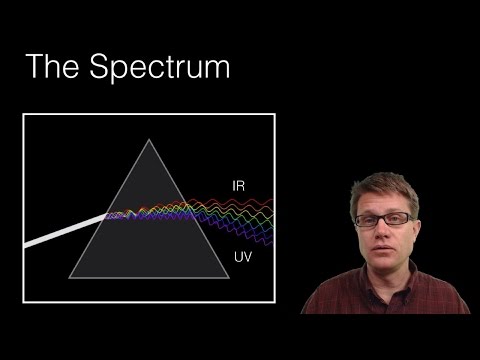
Video · + 1 min read

(Video) Emission and Absorption Spectra

By Bozeman Science

In a discharge chamber, hydrogen gas is bombarded with electrons and the gas gives off light. This light can be broken apart to see the different wavelengths of light that make it up. These are discreet light or photons. Some light is absorbed in the chamber while other light is emitted.

Light can absorb a photon or give off a photon when it interacts with the correct wavelength of light. This is described by the Conservation of Energy which means that when a photon of light interacts with an atom, absorption occurs at the atom takes on some of that energy. When the photon is released, energy is emitted. The emitted spectra can relate to specific atoms.

Energy level diagrams can be used to depict the movement of electrons when they interact with different wavelengths of light. If the energy matches that of the electron, it will move. If the light is a different energy level the electron will not move.

Illustrated · 2 min

Black Body Radiation - Relationship Between Absorption and Emission

radiated energy, black body radiation, transmitted energy, and reflected energy

Transmission, Reflection, and Absorption

Interactions with radiation can be summarized by three characteristics:

Transmission – radiation passes through a surface

Reflection – radiation bounces off of a surface

Absorption – energy from radiation is absorbed into the surface

Each of these characteristics can have a maximum value of 1. For example if a material had a Transmission value of 1, then ALL light passes through uninterrupted. Black Bodies have an absorption value of 1 since all radiation is absorbed.

transmission, reflection, and absorption values; black bodies have maximum absorption; opaque body, transparent body, and white body values

Cavity with a Hole

cavity with a hole; very good example of a true black body; true black bodies do not exist in nature

Emissivity

There are three main forms of heat transfer:

Convection – heat transfer across a fluid when a bulk velocity is present. Think of blowing on your food to reduce its temperature. Increasing flow across the food increases air’s convective heat transfer capabilities.

Conduction – heat transfer of internal energy within a body, solid or liquid. Think of a humid day ”feeling” hotter than a dry day because more water is present in the air. Water increases the conductivity of the air, and its conductive heat transfer capabilities.

Radiation - heat transfer independent of a body, generated by thermal motion of particles. All matter with a temperature greater than absolute zero will emit thermal radiation. People can radiate considerable heat, particularly after an intense workout, or having walked around in the sun for an hour or so.

The ability for a body to retain heat in this explanation is defined by the balance between emissivity and thermal conductivity.

Emissivity is a measure of a body’s ability to radiatively emit heat. Assuming an area is in thermal equilibrium, and a body will not readily release heat through convection or conduction, its only option is releasing heat through radiation. If a body has a high emissivity, then its temperature will drop very slowly.

High thermal conductivity means that heat moves through a body very quickly. Assuming no exterior forces are present, the body will lose heat quickly, and the temperature will drop proportionally.

emissivity with cavity with hole; low wall conductivity of cavity, small opening for heat to leave
values of emissivity vs thermal conductivity of various materials

The Ultraviolet Catastrophe

There is a limit to the energy that a body can emit.

Lord Rayleigh (John William Strutt) and Sir James Jean predicted emitted energy to increase indefinitely as wavelength decreased, where increasing temperature exaggerates this effect. In other words, as frequency increases at a given temperature, the amount of energy emitted should increase to infinity. This is not true.

Max Planck empirically obtained a similar prediction, where emitted energy peaks somewhere in the visible light range of incident radiation. The maximum achievable emitted energy can only be achieved by a black body.

The difference, or error, between these two predictions is known as the Ultraviolet Catastrophe.

Ultraviolet catastrophe, error, rayleigh-jeans, max planck, wavelength, spectral radiance

Type a concept, like “slope” or “photosynthesis”.

↑ ↓ to choose · Enter to openSearch explanations and problems