Електромагнітне випромінювання

Before this, knowWavelength and Frequency — Definition & Overview

Illustrated · 3 min

Electromagnetic Radiation

What Is Electromagnetic Radiation?

  • Electromagnetic Radiation (also referred at ER or EMR) is defined as a type of radiation that has both a magnetic and an electric field.
  • These magnetic and electric fields cause electromagnetic radiation to travel in the form of waves. This is because the electric field and the magnetic field cause a vibration of an electrical charge, which causes a wave-like formation.
  • Electromagnetic waves, can also be described as a stream of photons/particles. This is because of the wave-particle duality. Because they are photons and travel through space, they have an energy and momentum. But, there's a catch! They don't have any mass.
  • Electromagnetic waves are also referred to as light. Most of the electromagnetic spectrum is not visible to the human eye. The exception is visible light.

That was a lot of information, but here is an overview of the basics of Electromagnetic Radiation:
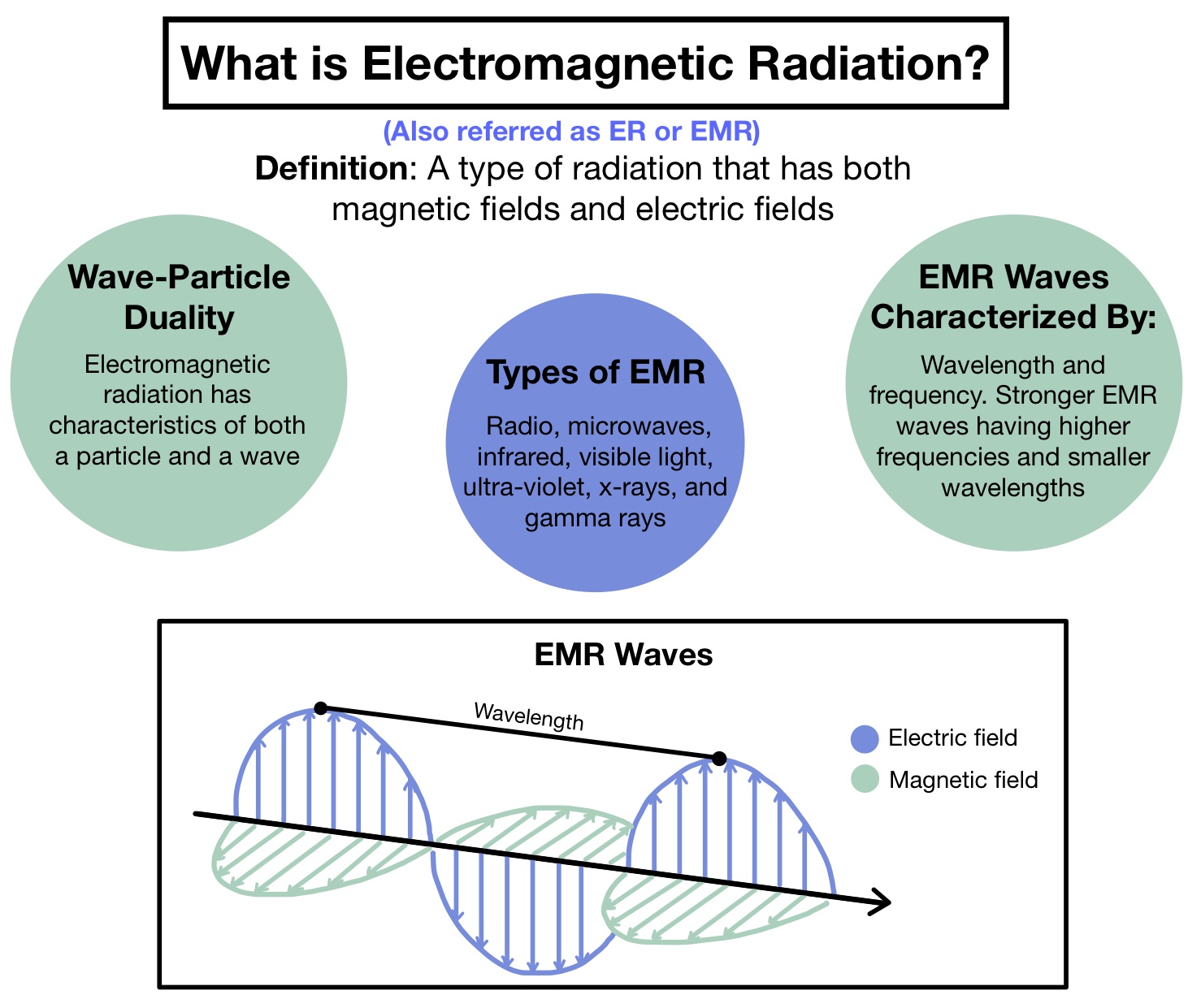
Image showing an overview on electromagnetic radiation (The different types of EMR, how EMR waves are characterized, as well as explanation on wave-particle duality)

Image source: Caroline Monahan

Electromagnetic Waves

  • Wavelength (λ): Is described as the distance between identical points on a wave. It is typically measured using the distance between the crests/peaks of two waves. Wavelength is measured in nanometers (nm). In scientific notation, that 10−910^{-9} meters!
  • Frequency (𝜈): Is described as the number of waves that pass a given point for a given amount of time. Frequency has the units, Hertz (Hz).
  • Wavelength and Frequency are inversely related. This means that when the frequency of a wave is big, the wavelength will be small (and vice versa). This relationship is described via the equation: c=λ𝜈, where c is the speed of light (3.00x10⁸^8 m/s).
  • Smaller wavelengths and higher frequencies result in stronger electromagnetic waves, and bigger wavelengths and smaller frequencies result in weaker electromagnetic waves.
Image visualizing wavelength and frequency, as well as the relationship between wavelength and frequency, and the equation to find wavelength/frequency

Image source: Caroline Monahan

The Electromagnetic Spectrum

Here are the different types of electromagnetic radiation (from weakest to strongest):

  • Radio Waves: Radio waves are the lowest/weakest electromagnetic waves. They have frequencies between 3kHz and 300GHz, with 1mm to 100km wavelengths. We use radio waves broadcast to radios, televisions, and cell phones.

  • Microwaves: Microwaves have frequencies between 1GHz and 300GHz, with wavelengths between 1mm and 30cm. So, they are a subclass of radiowaves. You probably know about microwaves from your kitchen appliance. A microwave uses electromagnetic radiation to increase the rotation of the water molecules in your food. Rotation is a form of kinetic energy. So, as the molecules rotate faster, your food's temperature increases.

  • Infrared: Infrared waves have frequencies between 300GHz and 400THz, with wavelengths between 780nm and 1mm. Infrared waves are used to transmit heat. Infrared waves are produced by any object that produces heat. That's how night vision goggles work! In chemistry, infrared radiation causes covalent bonds to bend and stretch. Organic chemists can tell which bonds are in a sample molecule by the absorbed frequencies. For example, a carbon-oxygen-hydrogen (an alcohol) group absorbs between 32003200 and 3500cm−13500cm^{-1}.

  • Visible Light: Visible light waves have frequencies between 4x10¹⁴^{14}Hz and 8x10¹⁴^{14}Hz, with wavelengths between 380nm and 740nm. Visible light waves make up everything that we can see.

  • Ultra-Violet: UV-light has frequencies between 8x10¹⁴^{14}Hz and 3x10¹⁶^{16}Hz, with wavelengths between 10nm and 380nm. Ultraviolet waves can be absorbed by the skin. They are also commonly used to kill bacteria. In chemistry, ultraviolet and visible light are used to determine a solution's concentration. The molarity is proportional to the absorbance.

  • X-Rays: X-rays have frequencies between 3x10¹⁹^{19}Hz and 3x10¹⁶^{16}Hz, with wavelengths between 0.01nm and 10nm. They are used to image objects and bodies. In chemistry, we use them to discover the 3D structure of crystals. In a crystal lattice, the X-rays interact with the atom's electron cloud. The diffraction pattern allows the chemist to determine the atom's location.

  • Gamma Rays: Gamma waves have frequencies greater than 1019^{19} Hz, with wavelengths less than 100pm. Gamma rays are the strongest electromagnetic waves on the spectrum and are used to help kill cancer as well as in sterilization. We'll talk more about gamma decay when we study radioactivity.

Image showing the electromagnetic wave spectrum (with all seven types of electromagnetic radiation)

Image source: Caroline Monahan

Read · 3 min

Electromagnetic Radiation

Electromagnetic radiation (EMR) can be a complicated term to fully understand without discussing physics. In simple terms it is a description of energy that moves in waves. These waves are influenced by an electric and magnetic field, which is why they are called electromagnetic. Often times this type of radiation is described as photons. Photons are electromagnetic particles which have no mass, but have energy. Photons can often be described as light particles. This is why EMR is described as light energy. The waves of light energy are not visible to our eyes, but some waves create light we can see.

Electromagnetic Waves

EMR is made up of various types of waves. These waves have different properties which distinguish them from each other. The waves have both a wavelength and frequency which are inversely related to each other. This means that if the wavelength is small, the frequency is high.

The wavelength is defined as the distance between two of the same types of points on a wave. The wavelength can be measured from the crest (top of the wave), trough (bottom of the wave), or the midpoint (point where wave y-direction is zero). Wavelength is represented as λ\lambda and is measured in nanometers (nm).

Frequency is the number of times the wave is repeated within a specific region. Frequency of EMR waves is measured as the number of cycles per second. This is represented as ν\nu and is measured in hertz (Hz).

Wavelength and frequency are related to each other using the speed of light constant (cc, where c=2.998×10⁸m/sc=2.998 \times 10^8 m/s). The relationship is represented by the equation: c = νλc\ =\ \nu \lambda

Types of Electromagnetic Radiation

There are different types of EMR which are categorized by wavelength, frequency, and properties. These main types of EMR waves are organized on the electromagnetic spectrum (EMS) which organizes the waves by wavelength and frequency. The types of EMR are radio waves, microwaves, infrared, visible light, ultraviolet, x-rays, and gamma rays.

Visible light is one of the smallest portions of the EMS, but this is the only type of light human eyes can see. Any light we can see from light bulbs, the sun, and stars is part of the visible light spectrum. When wavelengths of light are combined it appears red to our eyes. Colors arise when only specific wavelengths of EMR are present. For example, 450-495 nm wavelengths correspond to blue light. Interestingly, for something to appear blue, it must absorb more visible light in the orange region (590-620 nm).

Radio waves have the longest wavelengths of the EMS and vary a lot in their size. Radio waves have been used to transmit radio stations, TV, and mobile devices.

Microwaves are well known because we used them at home! Microwave ovens use microwave radiation to heat food quickly.

Infrared can be used in devices to detect heat. Infrared radiation is released when heat is present. Night vision goggles detect infrared radiation. This is useful for locating living things in the dark like people or animals.

Ultraviolet light can be damaging to the skin. The sun releases large amounts of UV light which is why sun screen is important. UV light has also been used to kill bacteria from surfaces. Some chemicals fluoresce or glow under UV light bulbs.

X-rays are used to scan different things to look through the object. For example, x-ray machines are used in the medical field to look for broken bones. X-rays machines are also used to scan bags and luggage at airports.

Gamma rays have also been used for medical imaging, similar to x-rays. Gamma rays have the smallest wavelength of the EMS. Gamma rays have been emitted from explosions and in space.

Video

Electromagnetic Radiation

(Video) GCSE Physics - Electromagnetic Waves #64

by: Cognito

This video breaks down what electromagnetic waves are as well as the seven different types of electromagnetic waves that exist (plus examples!). This video also explains the relationship between wavelength and frequency and what happens when these waves come in contact with an object.

Type a concept, like “slope” or “photosynthesis”.

↑ ↓ to choose · Enter to openSearch explanations and problems