Acid-Base Indicators, also known as pH indicators, are certain organic substances that will change color with pH. In this sense, they quite literally indicate when an acid changes to a base, or a base changes to an acid, by changing color when the hydronium ion concentration reaches a certain value. These indicators can either be a weak organic acid for a weak organic base and will dissociate in water to yield either the weak acid and its conjugate base or the weak base and its conjugate acid.
To better explain how these indicators work, consider one which is a weak acid, with the formula HIn. At equilibrium, the following equation is established with the weak acid and its conjugate base:
HIn(aq)+H2O(l)⇔H3O(aq)++In(aq)−
On the left side of the equation lies the water and the acid, HIn, which is at color A, and on the right lies hydronium and the conjugate base, I−, which presents color B. At low pH values, the concentration of the H3O+ is high, and the equilibrium lies to the left. In this case, the equilibrium solution will present as color A. At low hydronium concentration, the equilibrium position lies to the right, giving the solution color B.
An indicator's color is a direct result of the ratio of concentrations of the two species, In− and HIn. If the majority of the indicator is present as In−, then the color of the In− ion would be observed. On the other hand, if more of the indicator is present at HIn, then the solution will assume the color of the HIn molecule.
Equilibrium law can be applied to indicator equilibria-- we will continue with the same general weak acid indicator:
Kin=([HIn][H3O+][In−])eq
- This is the equation for determining the indicator dissociation constant, Kin. Sometimes you will see this value presented as Ka. At its turning point where the color of the indicator changes from color A to color B,
[HIn]=[In−], or Kin=[H3O+]
The above expressions can be rearranged to give the Henderson-Hasselbalch equation, which is used to describe the equilibrium of indicators:
Kin=([HIn][H3O+][In−])eq
Ka[H3O+]=[In−][HIn]
log(Ka[H3O+])=log([In−][HIn])
log([H3O+])−log(Ka)=−log([HIn][In−])
−pH+pKa=log([HIn][In−])
pH=pKa+log([HIn][In−]) or pH=pKa+log([acid][base])
When exactly half of the indicator is in its acid form and the other half is in its conjugate base form, the ratio of base/acid concentrations will be equal to 1. This means that at an indicators turning point, the pH of the solution will be equal to its pKa.
As a general rule, for titrations of strong acids with strong bases (and vice versa), any indicator with a pKin between ~4.0 and 10.0 will be sufficient. To titrate a weak acid, where the pH at the equivalence point is above 7.0, an indicator with a pKin>7.0, such as phenolphthalein or thymol blue, should be used. Lastly, to titrate a weak base where the pH at the equivalence point is less than 7.0, an indicator with a pKin<7.0, such as methyl red or bromocresol blue, should be used.
Examples of acid-base indicators can vary but depend on the particular reaction that is to be monitored, including litmus paper, phenolphthalein, and red cabbage juice. Red cabbage juice contains a mixture of colored substances that will appear deep red at low pH, blue at intermediate pH, and yellow at high pH.
Despite the particular substance, all good acid-base indicators will have the following properties:
- The color change must be easily detectable
- The color change must be quick.
- The indicator molecule must not react with the substance being monitored
- And last, to minimize errors, the indicator's pKin should be within one pH unit of the expected pH at the equivalence point. However, this is less important for strong acid-strong base titrations than it is for titration of weak acids or weak bases.
However, it is important to note that an indicator does not change color abruptly at a particular pH, although it would ideally happen quite quickly. Just like any other acid or base, the indicator undergoes a pH titration. This means that as the concentration of weak acid (or weak base) decreases and the concentration of the conjugate base (or conjugate acid) increases, the color of the solution slowly changes from the characteristic color of the weak acid to that of the conjugate base.
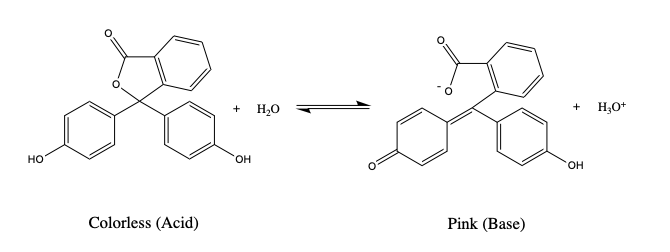
Let's take a look at phenolphthalein, a colorless, weak acid that will dissociate in water to form pink anions: