Відношення площ і трапеція

Before this, knowСпіввідношення площ

Illustrated · 1 min

Assume that a and b are the bases and c and d are the other two sides:

Next, how do you find out the lengths of the diagonals?
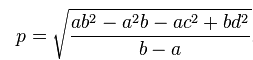
Formula

Formula

Then, what's next?

Look at this trapezoid:

Make the intersection of the four lines (two diagonals), O.

Therefore, we know that ∠AOD=∠BOC\angle AOD = \angle BOC and ∠DOC=∠AOB\angle DOC = \angle AOB.

From this, the ratio of the areas of each pair of adjacent triangles is equal to that between the lengths of the parallel sides.

Read · 1 min

Trapezoid ABCDABCD has parallel edges ABAB and CDCD, and diagonals ACAC and BDBD intersect at OO. Suppose that [△AOB]=1[\triangle AOB]=1, [△COD]=25[\triangle COD]=25. Find the area of [ABCD][ABCD].

We are trying to find the area of the whole trapezoids. It looks like that the diagonals divide it into 44 parts. What's nice is that we already have 22 of them! Now what do we do to find the remaining 22?

Maybe ratios will help, since trapezoids have 22 parallel sides, and parallel lines induce similar triangles which give ratios. But how?

We can observe that △AOB\triangle AOB is similar to △COD\triangle COD. Thus AOOC=BOOD\frac{AO}{OC}=\frac{BO}{OD}. Now this obviously helps us relate the areas of △AOB\triangle AOB and △COD\triangle COD.

Since they're similar, their areas are in the ratio AO2:OC2=1:25AO^2:OC^2=1:25, so the ratio of areas of △AOB\triangle AOB and △COD\triangle COD is 125=15\sqrt{\frac{1}{25}}=\frac{1}{5}. We're now really close!

But the ratio of areas of AOBAOB and AODAOD is just BO:OCBO:OC, which is also 1:51:5. Hence AOD=5AOD=5. Similarly BOC=5BOC=5, so we're almost there!

ABCD=AOB+BOC+COD+DOA=1+5+25+5=36ABCD=AOB+BOC+COD+DOA=1+5+25+5=\boxed{36}. We're done!

Type a concept, like “slope” or “photosynthesis”.

↑ ↓ to choose · Enter to openSearch explanations and problems