Read · 4 min
I love to make flatbread. The texture is a perfect combination of soft and crunchy. Dipping it in spiced olive oil adds exceptional flavors. I typically let my dough rise for about an hour. I've noticed my bread has more volume in the summer than in winter. Why is that?
Reaction rates depend on temperature. In my house, we don't have air conditioning. So, in the summer the kitchen is hot. In the winter, we run the heater, but it's not too hot. Bread rises because yeast microbes catalyze the breakdown of starch. The products are glucose and carbon dioxide. The carbon dioxide gas gets trapped in the dough. So, it expands. The reaction is faster at higher temperatures.
So, temperature increases the reaction rates. But, why? Let's study the factors that cause chemical reactions.
How do Reactions Happen? Collisions.
Right now, you're being hit by molecules constantly. Our air consists of diatomic nitrogen and oxygen. There is a little bit of the noble gas, Argon. All these gases are inert, so they don't react with you. But, in a chemical reaction, the molecules experience ten billion collisions per second.
Molecular collisions are the basis of collision theory. For a chemical reaction to happen, the reactant molecules need to collide. Anything that increases the number of collisions heightens the reaction rate. That's part of the reason that temperature affects it. The phase of matter also affects it. Solids have significantly less movement than liquids and gases. So, reactions between solids are slow.
I said ten billion collisions are happening every second. So, why are some reactions so slow? Every chemical reaction should occur within a second. It turns out the number of collisions isn't the only factor.
How do Reactions Happen? Orientation.
We know that molecules need to collide. But, for the reaction to happen, they need the correct orientation. For example, consider the decomposition reaction . We know from VSEPR theory that hydrogen iodide is a linear molecule. So, we have a few possible collision orientations. An could hit another . An could hit an . Or, an could hit another . The reaction only happens when hits another . So, even though we have ten billion collisions a second, only a fraction of them could produce a reaction.
Why did I say, "could produce a reaction"? Because not every correctly oriented collision reacts. There is one more factor we need to consider.
How do Reactions Happen? Energy.
So, we know the molecules have to collide with the proper orientation. But, they also need to have enough energy. Let's think about our hydrogen iodide example. The collision needs enough energy to break the hydrogen-iodine covalent bond.
How does a collision store energy? As kinetic energy! When the molecules collide, the kinetic energy transfers to potential energy. With enough potential energy, the bond breaks. The collision overcame the bond energy. So, the reaction proceeds. We call the energy needed to start a reaction its activation energy. As the bond breaks, the molecule enters a transition state. That's the peak energy on an energy diagram.
Here, we also see another reason why temperature affects chemical reactions. Higher temperatures equal more kinetic energy. With more kinetic energy, the system's potential energy increases. When the potential energy exceeds or equals the activation energy, the reaction occurs. It does not ensue when the potential energy is less.
Arrhenius Equation
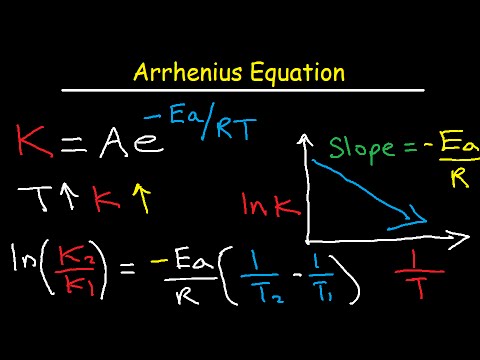
In the 1890s, Svante Arrhenius created an equation relating rate laws and temperatures. We creatively call it the Arrhenius equation.
-
k is the rate constant.
-
A is a constant that comes from the frequency of correctly oriented collisions. Typically, we look up the A value for our reaction.
-
is the activation energy. Its units need to match the gas constant.
-
R is the gas constant. Typically, we use . So our activation energy will be in joules.
-
T is the kelvin temperature.
Calculating Activation Energy
We can use the Arrhenius equation to find the activation energy.
Let's take the natural log of both sides.
.
Notice, this is a style equation. If we plot versus than our slope is . So, we can use the slope of the Arrhenius plot to calculate activation energy.
Remember, we determine rate constants experimentally. Let's say we know two rate constants at two temperatures.
Let's subtract the natural logs of each rate constant.
Now we can use the rules of logarithms and simplify.
.
So, if we know the rate constants at two different temperatures, we can calculate the activation energy.