We've started to study chemical kinetics. It's a branch of physical chemistry that makes quantitative descriptions of chemical reactions. Specifically, we care about reaction rates. That's how fast a chemical reaction occurs. We measure rates as the change in concentration per unit of time. So, we often use molarity (moles per liter) per second. Sometimes, we'll have reactions that finish in seconds. For example, do you remember the reaction between alkali metals and water? Some are such violent reactions that they explode! Some chemical reactions are unbearably slow. For example, later, we'll study nuclear chemistry. Some radioactive elements have massive half-lives. For example, the isotope Xenon-122 has a half-life of 18 billion trillion years! That's over a trillion times longer than the age of our universe!
Anyway, kinetics isn't only about reactions being fast or slow. We also want to understand what factors affect the rate. Why? Once we know what influences rates, we can manipulate those factors. For example, many physical chemists work in catalysis. A catalyst speeds up a chemical reaction by lowering the activation energy. Theoretical chemists might use computer models to study them. An experimental chemist will confirm and quantify a catalyst's effectiveness in the lab. But before we get to that, we want to understand how to describe the rate mathematically. To do that, we use a rate law!
What is a Rate Law?
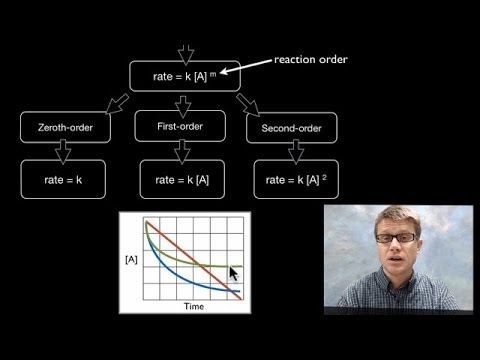
The rate law is a mathematical equation. It defines the relationship between our reactant concentration and the reaction rate. How does it look? Let's say we have a generic synthesis reaction A+B→AB. The rate law would be rate=k(T)[A]x[B]y.
You'll notice that a rate equation has a couple of components. The first is the rate constant k(T). It varies for each chemical reaction and is temperature-dependent. In a future lesson, we'll study the Arrhenius Equation. It calculates the rate constant as a function of temperature and activation energy. So, you'll learn more about why it varies. But, at a set temperature, it will be a specific value. That's why it's called a constant. As a side note, it was the same Arrhenius who developed the Arrhenius acid-base theory.
The second thing to notice is that each reactant has an exponent. That's the reaction order. It demonstrates the relationship between the concentration change and the rate. For example, let's consider if the exponent was one. What would happen if we doubled the concentration? The rate would also double. What about an exponent of two? Doubling the concentration would quadruple the rate.
How do I Determine the Rate Law?
To use our rate law equation, we need to determine the rate constant and the reactant orders. Unfortunately, to do that, we need experimental data. You can only determine the rate law experimentally! Why? The rate is dependent on the reaction mechanism. We'll learn more about reaction mechanisms in a future lesson. But for now, know that we can split chemical reactions into multiple steps. In reality, these steps often happen in nanoseconds. We can't distinguish them during the reaction. But, one of the steps will be the rate-limiting step. It's a little bit slower than all the rest. That step will influence the reaction order. To discover its impact, we need experimental data.
So, what's our experimental setup? It's called the method of initial rates. Let's imagine we had a chemical reaction with two reactants. As it proceeds, we record the concentration change of each reactant. Then, we repeat the experiment. But there's a trick! We double the starting concentration of one reactant. Now, we do a third trial. This time, we return our first reactant to its earlier concentration. What about the other reactant? We double it. In the end, we have three tests. For each reactant, two trials will correspond to doubling the concentration. That will alter the reaction rates. So we can determine the order for each reactant. But we still need the rate constant. Thankfully, that's easy! We plug in the values from one of the trials. We know the reaction rate, the reactant concentrations, and the orders. So we can solve for the rate constant.
The method of initial rates does have some drawbacks. The most common source of error and uncertainty is the instrument's sensitivity. We have to detect small, rapid changes in concentration. Most often, we use spectroscopy. The spectrometer passes a specific wavelength of light through our sample. The intensity of the light that hits the detector correlates to the concentration. In analytical labs, the instruments cost thousands of dollars. Those work well. In general chemistry, your school will provide less expensive options. They can be frustrating.
Weird but Interesting: Partial and Negative Orders
If you study more advanced chemistry, you'll encounter reactions with weird reaction orders. For example, free radical reactions can produce reaction orders of one-half. Another possibility is that the order can change throughout the reaction. Sometimes, the concentration of a reactant drops below a certain threshold. At that point, the reaction mechanism changes. So, it alters the reaction order. Finally, you might even encounter a reaction order that's negative! So, the rate increase as the concentration decreases. All these are way beyond general chemistry. But, it's fun to know about.