Атомна маса

Interactive · 1 question

Atomic mass has two slightly different connotations. It can either be the mass of a particular atom, or it can be the average mass of an element. In chemistry the latter is used more commonly.

Atomic mass is typically measured in atomic mass units (AMU). 11 AMU is 112\frac{1}{12} the mass of a carbon-12 atom, and is approximately†^{\dagger} the mass of 1 proton, or 1 neutron. If you go to another source you may be confused by the use of unified atomic mass units (u) and daltons (Da). These, in essence, are all the same thing. The name has just changed slightly and diverged over time as the unit has been redefined. AMU may be converted into grams by multiplying by Avogadro's number. That is to say, 11 AMU == 1 gmol1\text{ }\frac{\text{g}}{\text{mol}}.

In order to determine the atomic mass of an atom, simply count the number of protons and neutrons. Since the mass of protons and neutrons are both 1 AMU, the mass of the atom expressed in AMU is the number of protons plus the number of neutrons. Electrons are much smaller than protons and neutrons, having a mass of approximately 0.00050.0005 AMU, so their effect on the mass of the atom is negligible.

Since elements exist in different isotopes (the number of neutrons is variable), atomic mass is typically not expressed as an integer. For example, periodic tables will list carbon as having a mass of 12.0112.01 AMU, rather than just 1212. This is because there is a small amount of carbon atoms that have masses of 1313 or 1414 AMU. This results in the average mass of carbon being just over 1212 AMU.

An atom is found to have 13 protons, 15 neutrons, and 14 electrons. What is the mass in AMU?

Choose one answer

Video

(Video) What Is Atomic Mass? | Don't Memorise

by Don't Memorise

In this video, you will learn how atomic mass relates to atomic number. You will also see that atoms can have different numbers of protons and neutrons. This point leads us to the topic of isotopes.

Illustrated · 1 min

The Atomic Mass Unit

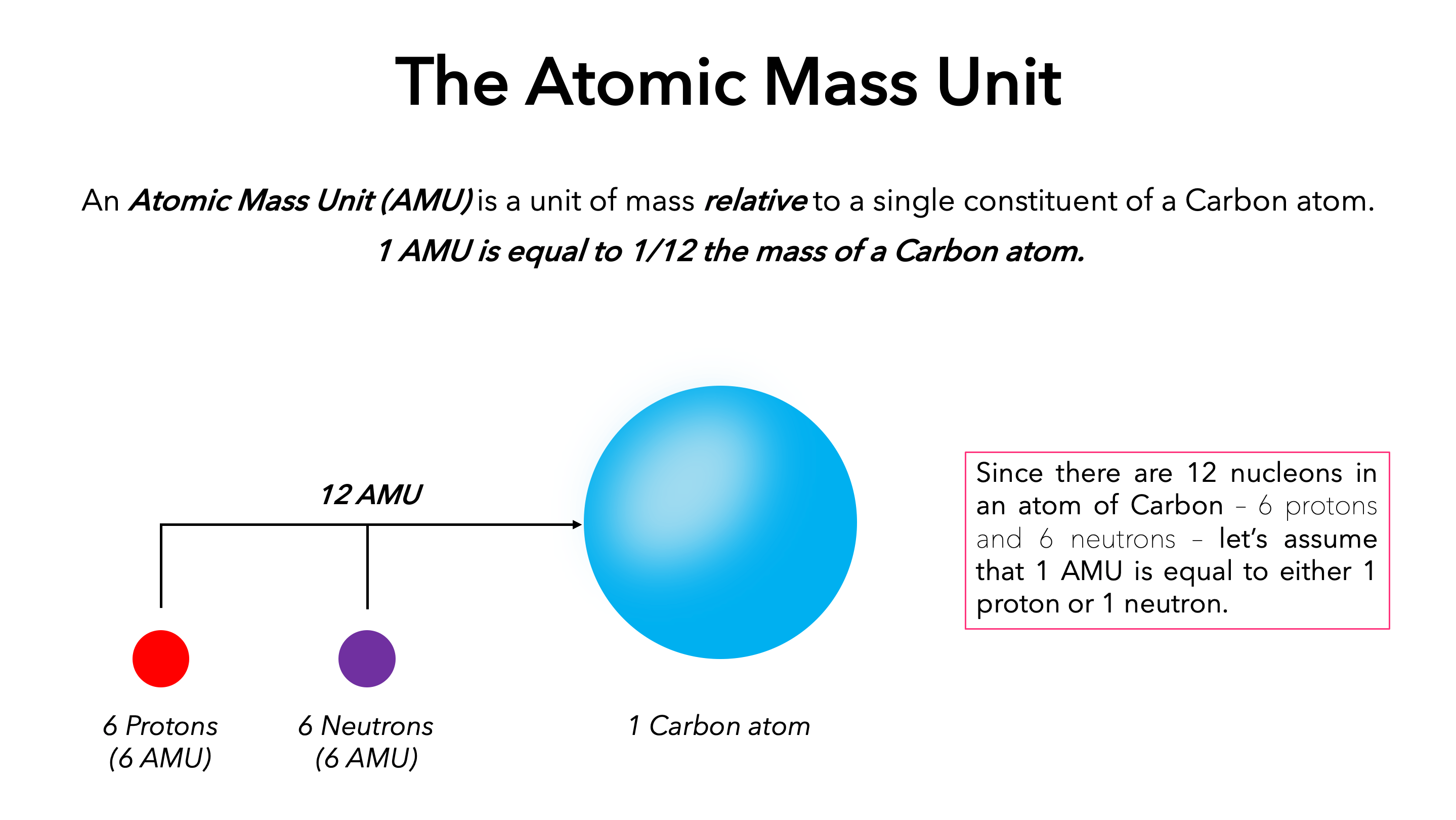
The AMU was defined by John Dalton to be 1/12 the mass of a carbon atom. Since carbon has 12 individual units (6 neutrons and 6 protons, neglecting electrons), an AMU is essentially the mass of either a single proton or neutron. It is a unit of relative atomic mass; relative specifically to an atom of carbon.

Carbon AMU

The AMU is defined relative to a unit of Carbon

Summary of AMU data

Stating that the relative atomic mass of an atom is equal to its number of protons and neutrons is not a bad assumption. The actual mass in terms of grams per mole is nearly identical, making these two units of measurement synonymous within chemistry naming conventions.

Read · 1 min

Atomic mass is exactly what it sounds like- a measure of the mass of an atom. As mentioned in the sections on protons and neutrons, both of these particles have an equal mass of one atomic mass unit, abbreviated as "amu," which corresponds to 1 g/mol of that atom. Electrons have such a small comparative mass that we approximate their mass as 0 amu.

The Atomic Mass Number indicates the sum of protons and neutrons- for example, an atom of carbon has 6 protons, and usually has 6 neutrons, so the Atomic Mass Number of carbon is 12. You may notice I said usually. This is because atoms of the same element can have isotopes, or atoms with a different number of neutrons, and therefore a different weight. The form of carbon that has 6 neutrons is the most stable and the most common, but versions with more neutrons exist, so the average mass of a carbon atom is slightly higher than 12 amu. Therefore, when you have a mole, or 6⋅10236 \cdot 10^{23} atoms of carbon, the molar mass is 12.01 g/mol.

Type a concept, like “slope” or “photosynthesis”.

↑ ↓ to choose · Enter to openSearch explanations and problems