Ізотопи

Interactive · 1 question

Using Isotopes to Date Fossils

Skeleton of a Cryolophosaurus dinosaur

Image source: By Zissoudisctrucker CC BY-SA 4.0, via Wikimedia Commons

Have you ever wondered how scientists know how long ago dinosaurs lived? The answer lies in isotopes.

As we learned in the sections about atoms and elements, atoms contain protons, neutrons and electrons, and each atom's identity as a specific element is defined by its number of protons. Because protons are positively charged and electrons are negatively charged, any neutral atom has an equal amount of protons and electrons. But how do we know how many neutrons an atom has?

As it turns out, the same chemical element can contain different amounts of neutrons per atom. Two atoms with the same amount of protons but a different amount of neutrons are called isotopes.

Two different isotopes of an atom have the same atomic number (proton count) but different mass numbers (sum of proton and neutron count). These mass numbers are usually written as superscripts before the element. For example, a carbon atom has six protons and its most stable form has six neutrons, resulting in a mass number of 12. Therefore, it is written as 612C^{12}_{6}C, with the mass number on top and the proton count on the bottom. You can find the number of neutrons by subtracting the top number from the bottom number.

As mentioned above, carbon usually has six neutrons. What does that mean? It turns out that elements tend to have a certain number of neutrons when they are most stable. While isotopes do exist, they tend to decay into this lighter and more stable form over time. Unstable isotopes that are likely to decay are called radioactive isotopes.

So, what does this have to do with dinosaurs or biology? Living things contain a lot of carbon, which you'll learn about more in depth later. While carbon tends to decay towards 612C^{12}_{6}C, called carbon-12, living organisms produce 614C^{14}_{6}C, or carbon-14. Since carbon-14 decays over time to carbon-12 and organisms no longer produce it after they die, scientists can predict how long ago a creature died by measuring the amount of carbon-14 present in a fossil. This process is called carbon dating.

Radioactive decay follows an exponential function. This means that when more of the radioactive material is present, it decays more quickly. In other words, it takes the same amount of time for half of the material present to decay, regardless of how much stuff that is. The amount of time that it takes for half the stuff to disappear is called a half-life. Carbon-14 has a half-life of 5,730 years, so if a fossil has exactly half of the carbon-14 that a living organism should contain, it died 5,730 years ago.

If an organism died 11,460 years ago, how much of its original carbon-14 should still be present in its fossils?

Choose one answer

Interactive · 1 question

Understanding Isotopes

When atoms of the same element have a different number of neutrons, they are called isotopes. All isotopes of an element differ only in mass number.

Now, that's all well and good, but what does it really mean?

Hydrogen atoms typically have no neutrons, but isotopes of hydrogen may have several neutrons in the nucleus.

Image source: By BruceBlaus CC BY 3.0, via Wikimedia Commons

Each of the hydrogen isotopes in the picture above will have the same atomic number, atomic mass, and chemical properties.

The atomic number for all of them is one because they all have only one proton. The atomic mass is an average of the masses of all isotopes, so it must also be the same for each one. However, the mass number of each isotope will be different. The mass number is the total number of protons added to the number of neutrons in an atom.

Remember that the mass number is the sum of protons and neutrons, so isotopes will have a different mass number than the standard element. Thankfully, this makes identifying them fairly easy. The weighted average of all of these isotopes is called the atomic mass. That's why when you look at the periodic table you don't see a whole number. Rather, you see a number followed by a decimal.

What is different between isotopes of the same element?

Choose one answer

Illustrated · 1 min

What Are Isotopes?

Isotopes are atoms of the same element that have different numbers of neutrons.

Recall that neutrons are found in the nucleus of an atom and have zero charge.

Atoms have protons, neutrons, and electrons.

Image source: By Hannah Bonville

Isotopes have the same number of electrons and protons. The only thing that's different is the number of neutrons.

Recall that we calculate atomic mass (the mass of an atom) by adding together the number of protons and the number of neutrons in an atom's nucleus.

Atomic mass can be calculated by adding the number of protons and the number of neutrons.

Image source: By Hannah Bonville

So, if we change the number of neutrons, we end up changing the atomic mass. Different isotopes of the same element will have different atomic masses.

When you look at the periodic table, you'll often see atomic masses written as decimals. These are calculated by finding the average mass among the isotopes of a given element that exist in nature.

Atomic mass can be calculated by averaging the number of protons and neutrons in all isotopes of a given element.

The atomic mass of aluminum [Al] on the periodic table is 26.98. This is found by averaging together the atomic masses of aluminum's isotopes.

Image source: By Klingoncowboy4 CC BY-SA 3.0, via Wikimedia Commons

Example of an Isotope

Isotopes of an atom have the same number of protons and electrons, but differ in the number of neutrons. This means that they also differ in atomic mass.

Image source: By Dirk Hünniger, Balajijagadesh CC BY-SA 3.0, via Wikimedia Commons

Let's look at the three major isotopes of hydrogen in the picture above.

Each one has only one proton in its nucleus. However, protium has zero neutrons, deuterium has one neutron, and tritium has two neutrons.

Not all isotopes have their own names (like protium, deuterium, or tritium). Usually, we just name them according to how many neutrons they have.

For example, carbon-12 (12C^{12}C), carbon-13 (13C^{13}C), and carbon-14 (14C^{14}C) are all isotopes of carbon. They have 12, 13, and 14 neutrons in their nuclei, respectively.

Key Vocabulary:

  1. Isotope
  2. Atom
  3. Nucleus
  4. Neutron
  5. Proton
  6. Atomic mass
  7. Atomic number

Illustrated · 1 min

Stable and Unstable Isotopes

Isotopes can both be very useful and dangerous to humans. Carbon-14 is an example of these useful isotopes and is the basis for how we perform radioactive dating.

Not all isotopes are unstable. This is due to the balance between the strong nuclear force and the electrostatic force present in an atom's nucleus.

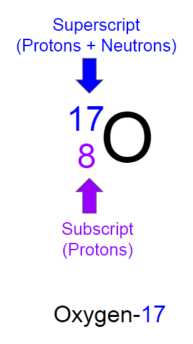
The following image shows examples of isotope notation:

Carbon 14 Isotope

Tin has several stable isotopes. In the examples of Sn-139 and Sn-99 (unstable), Tin must either beta- or beta+ decay to reach a stable state. Beta- occurs when it is too neutron rich and Beta+ occurs when it is too proton rich.

Illustrated · 1 min

Atoms are organized by the number of protons in the nucleus: for example, if an atom has 8 protons, then it is Oxygen. Not all oxygen atoms have the same number of neutrons, though. Isotopes are atoms of the same element that have varying number of neutrons.

Shown above are three different isotopes of hydrogen: (from left to right) on with no neutrons, one with 1 neutron, and one with 2.

Isotopes are usually named in the following way: [element name]-[mass number]. Recall that the mass number = # of protons + # of neutrons. For example, the second isotope of hydrogen is called Hydrogen-2.

Isotopes are generally very interesting to study because they are often radioactive. Extra neutrons sometimes makes the nucleus unstable, which leads to radioactive decay. Radioactive isotopes have many useful applications: Carbon-14 is often attributed to carbon dating, and Uranium-235 is commonly used in nuclear power plants.

Video

(Video) Isotopes

by RicochetScience

This quick video goes over what isotopes are, how they are different from the standard form of an element, and how scientists can use them to study other things like fossils.

Type a concept, like “slope” or “photosynthesis”.

↑ ↓ to choose · Enter to openSearch explanations and problems