The Aufbau Principle
In the early 1920s, physical chemists Neils Bohr and Wolfgang Pauli formulated the Aufbua principle. Remember, this was before Schrodinger published the quantum mechanical model. So, they used the Bohr model to develop it. The goal was to explain the behavior of electrons using physical properties. To do this, they modeled the electrostatic interactions. The nucleus consists of protons and neutrons. So, it has a positive charge. Each additional electron interacts with the electric field created by the atomic nucleus. The electron's energy depends on the distance from the nucleus. In the Bohr model, electrons are in circular orbits. So, a larger orbital radius equals a higher electron energy. But there's more! The electrons also influence each other. Negative charges repel, which also increases energy.
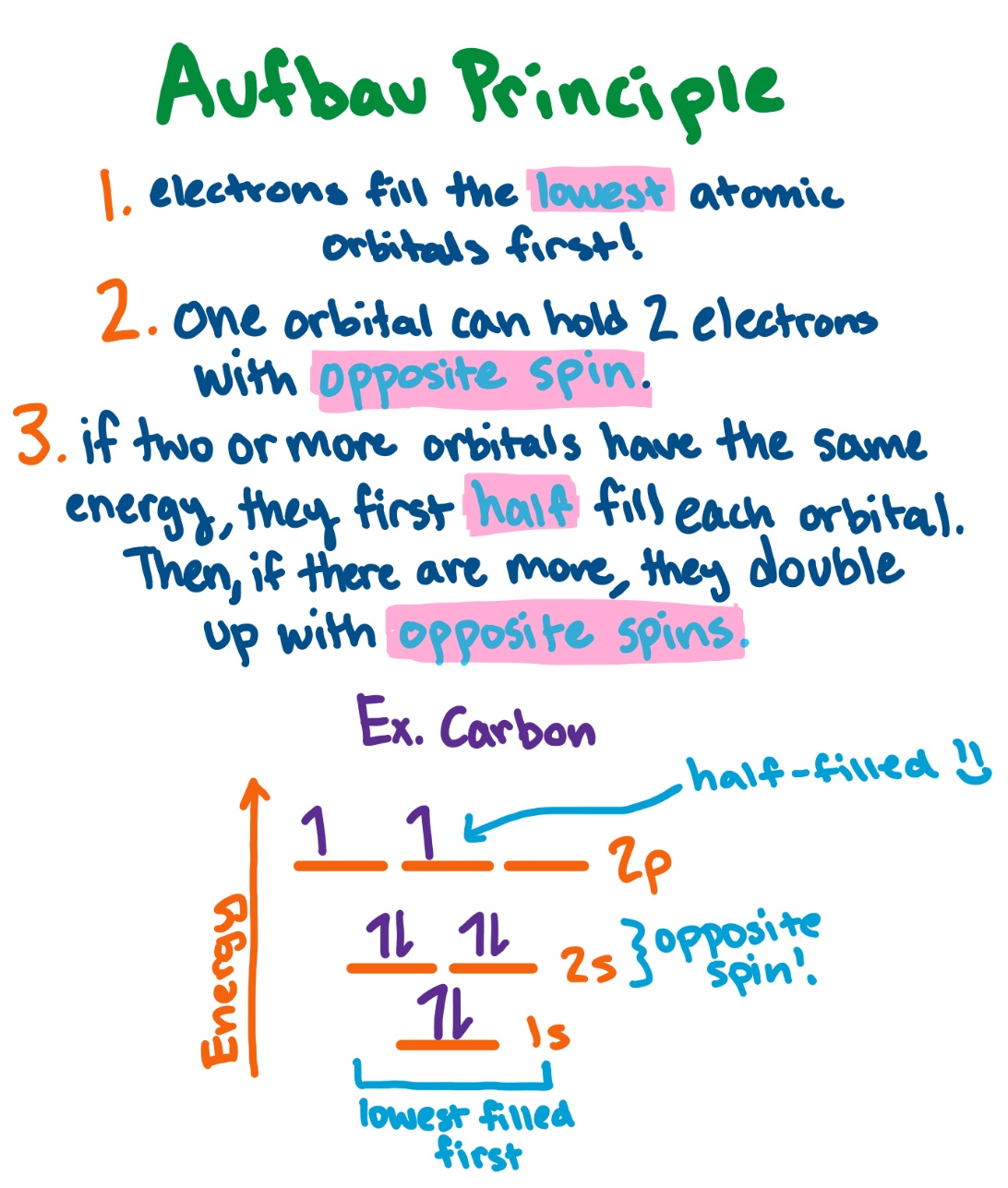
So, what is the Aufbau principle? It states that electrons will fill the lowest energy orbitals. We can combine the Aufbau principle with Hund's rule and the Pauli exclusion principle. Hund's rule says electrons will singly fill an orbital before pairing. Hund's rule is another example of lowering energy. Electron pairing increases repulsion. So, we minimize it by singly filling the orbitals. The Pauli exclusion principle says two electrons cannot have the same quantum numbers. It's a little more complicated. The wavefunction of two electrons in the same state equals zero. So, it's technically impossible. But, we can consider it from the energy perspective. Paired electrons with opposite spin have lower energy.
Electron Configurations and the n+l Rule
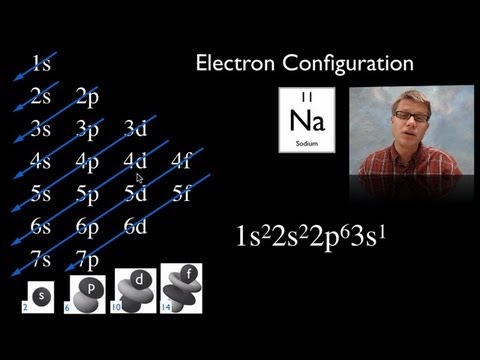
What's the goal of the Aufbau principle? We wanted to determine electron configurations. To do that, we use the n+l rule. n is the principle quantum number, and l is the azimuthal quantum number. The principal quantum number defines an electron's length from the nucleus. For the valence electrons, it's the atomic radius! The distance from the nucleus also tells us about the orbital's energy. The electrons closest to the nucleus have the lowest energy. Electrons further from the nucleus have higher energy. The azimuthal quantum number is also called the angular momentum quantum number. It defines the shape of the orbital.
So, how does summing n and l equate with energy? The distance corresponds to energy because of the electrostatic interactions. It's a measure of potential energy. Angular momentum corresponds to kinetic energy.
How do we use the n+l rule? Let's consider the 1s and 2s orbitals. The principal quantum number is one and two, respectively. In each case, the azimuthal quantum number is the same. For the s-orbital, it's zero. So, in this case, we see that the 1s-orbital has a lower energy than the 2s-orbital. So, the 1s-orbital fills first. This rule works very well for tinier elements. Unfortunately, for the transition metals, the lanthanides, and the actinides, the n+l rule doesn't always work. Why? The energy values of the larger orbitals are very close. For example, the 3d and 4s-orbitals have almost equal energy. So, various factors can cause them to swap. What's the result? Some elements have unique electron configurations that disobey the n+l rule. Unfortunately, you have to memorize the exceptions. What if two orbitals have the same n+l value? The smaller n value gets filled first.
As a side note, in 1928, Charles Janet proposed a periodic table based on the n+l rule. He started by relocating the s-block to the left side of the periodic table. Then, he shifted the s-block up one row. Finally, he placed hydrogen and helium next to each other. His new table was called the left-step table. It's a unique idea to consider. The elements remain ordered by their atomic number. Also, reading the table from right to left gives you the electron configuration. The only problem is that it still contains the exceptions we discussed previously.