Принцип заборони Паулі

Illustrated · 2 min

Pauli Exclusion Principle

What is the Pauli Exclusion Principle?

  • The Pauli Exclusion Principle states that no two electrons can have identical values for all four quantum numbers. (See the example below to better understand!)

  • The four quantum numbers being referred to are: n, the principle quantum number (shell number), ll, the secondary quantum number (subshells), mlm_{l}, the magnetic quantum number (divides subshells into individual orbitals), and msm_{s}, which is the spin quantum number (which way the electron spins).

  • For example, let's say two electrons are filling an orbital. If both electrons have n=1n= 1, l=0l= 0, and ml=0m_{l}=0, then the msm_{s} value must be +1/2 for one of the electrons and -1/2 for the other electron. Why? The Pauli exclusion principle states that no two electrons in the same orbital can have the same values for the four quantum numbers. If the first three are the same, then the spins must be different.

  • Overall, the Pauli Exclusion Principle tells us that when the maximum number of electrons are in an orbital (which is two electrons), then they must spin in opposite directions.
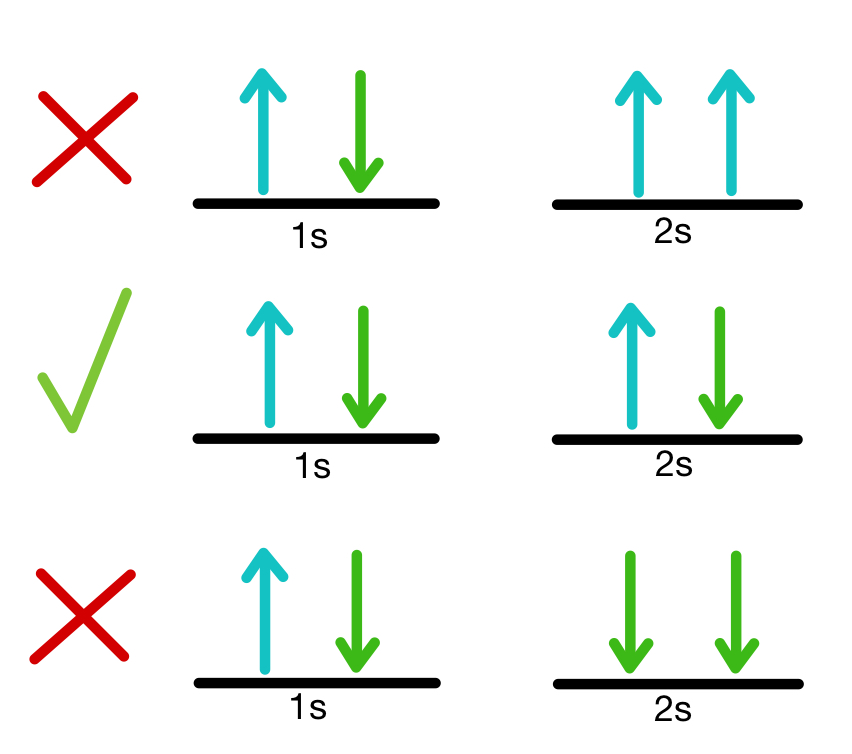
Image showing how no two electrons in the same orbital can have the same four quantum numbers, which means that they must spin in different directions

Image source: Caroline Monahan

  • As seen in the example above, in order to have the 4 quantum numbers be different in the 2s orbital, the electrons must spin in different directions. This is because the n, ll, and mlm_{l} are all the same when referring to the same orbital (in this case 2s), so the msm_{s} number MUST be different to ensure that the two electrons do not have the same 4 quantum numbers

Another way to think of the Pauli Exclusion Principle:

Let's say you have a set of twins and they are wearing the same shoes, skirt, shirt, and hairstyle

Image showing a set of twins wearing identical outfits

Image source: Caroline Monahan

  • The Pauli Exclusion Principle states the the 4 quantum numbers (in this case the 4 outfit pieces: hair, shirt, skirt, and shoes), CANNOT be identical (one of these things must be different)

  • In order to satisfy the Pauli Exclusion Principle, the one of the twins can change the color of their shirt, since they are no longer exactly the same, the Pauli Exclusion Principle is satisfied!

Image showing one of the twins wearing a pink shirt and the other twin wearing a green shirt

Image source: Caroline Monahan

  • The change of shirt make is so the twins no longer have the same outfit which satisfies the Pauli Exclusion Principle

  • Changing the shirt is the same as changing the msm_{s} number (so that one is +1/2 and the other is -1/2)

Video

(Video) Pauli Exclusion Principle

by Webcast-legacy Departmental

In this video, you will learn about the Pauli Exclusion Principle and also Hund's Rule. Specifically, the Pauli Exclusion Principle states that no two electrons can have the same set of quantum numbers. That is to say, they cannot occupy the same quantum state at the same time.

Read · 3 min

In the early 1900s, various chemists tried to determine electronic structures and electron configurations. They were toying with the octet rule. But we didn't understand atomic structure. They were close but still off. For example, Lewis developed the octet rule. But, he thought the electrons got distributed in a cubic shape. In 1922, Neils Bohr updated his Bohr model of the atom. But he wasn't sure how many electrons fit into each orbit. His model only explained the atomic spectra for hydrogen. So, it was hard to predict the structure of the more extensive elements. But he and various other chemists developed some clues. For example, they noticed that the elements with even electrons were more stable. They also realized that two, eight, and eighteen electrons created completed shells. All of this helped to make sense of the periodic table. But it was all a starting point.

In the 1920s, Wolfgang Pauli tried to explain the atom's electronic structure. To do so, he had to develop a new quantum number. Today, we call it electron spin. But at the time, it was just a number that made everything work.

What is the Pauli Exclusion Principle?

The Pauli exclusion principle states that "two fermions cannot have the same quantum state within a quantum system." What's a fermion? A fermion is any particle that has half-integer spins. In general chemistry, that's only protons, neutrons, and electrons. But in advanced physics, we also include particles like neutrinos, quarks, and leptons. We define the quantum state by the four quantum numbers. So, two particles cannot have identical quantum numbers. A quantum system is anything on the molecular, atomic, or subatomic scale. We apply the quantum mechanical model to quantum systems.

The Pauli exclusion principle only applies to fermions. Particles with whole-integer spins are bosons. They can share the same quantum state. The most common example is photons. Imagine we had a laser that produces one wavelength of radiation. All of the photons could share the same quantum state. We could generate as many photons as we wanted. They would be indistinguishable from one another. So, we can pile up bosons. But, fermions stay discreet.

The Pauli Exclusion Principle in General Chemistry

So, what do you need to understand for general chemistry? The Pauli exclusion principle is the basis for electron configurations. Consider a helium atom. Its ground state is the 1s-orbital. We know that each orbital holds two electrons. One is spin-up, and the other is spin-down. What happens when we move up to the alkali metal lithium? Lithium has three protons. So, it also has three electrons. The third electron cannot fit in the 1s-orbital. Why? It would have the same set of quantum numbers as one of the other electrons. So, it has to go into the 2s-orbital. What about the p-orbitals? We combine the Pauli exclusion principle with Hund's rule and the Aufbau principle. So, each p-orbital will half-fill before spin pairing.

** The Pauli Exclusion Principle in Everyday Life**

The Pauli exclusion principle is why matter has volume. An atom is mostly empty space. But, we define the empty space by the outermost orbitals. That's why atoms have atomic radii. Electrons cannot continuously occupy the lowest energy states. They must fill successively larger energy levels. In this way, electrons take up space. As a side note, electrons themselves don't have volumes. In the classical model, they are point particles. In quantum mechanics, they are waves moving through space. But, they take up space by filling orbitals. This gives atoms and molecules their bulk physical properties.

Type a concept, like “slope” or “photosynthesis”.

↑ ↓ to choose · Enter to openSearch explanations and problems