
Interactive · 1 question
Balancing Chemical Equations
We've been studying the different varieties of chemical reactions. So far, we've investigated synthesis, decomposition, combustion, single-replacement, and double-replacement reactions. We also saw some common subtypes like precipitation and acid-base neutralization.
How did we describe all of our chemical reactions? We used a chemical equation! They told us the molecular formulas, states of matter, and the number of moles. But, the mole counts the number of particles. So, we need to make sure they're equivalent on both sides of a reaction. We call this balancing a chemical equation. But, before we start learning how to balance equations, let's recall the different parts that make up a chemical equation.

Image source: By Caroline Monahan
The coefficient tells you the number of each molecule or element. Remember, we use moles to count the number of particles. So, the coefficient is also equivalent to moles. We call the relationship between the coefficients the mole ratio.
In the above example, the coefficients indicate that every time this reaction occurs, two molecules of hydrochloric acid react with two atoms of sodium. We can also think of it in terms of moles. So, two moles of hydrochloric acid reacts with two moles of sodium. The product is two moles of sodium chloride and one mole of diatomic hydrogen gas.
The chemical equation is balanced when there are equal numbers of each element on both sides. In this case, it's two hydrogens, two sodium, and two chlorine. When balancing the equation we don't care about ionic or covalent bonds. We just want the number of each atom to be identical.
Remember, in molecular formulas, the subscript tells you the number of atoms within the molecule. The subscript only relates to the atom it comes after!
- Example: contains 2 hydrogen atoms and 1 oxygen atom. The number of atoms also needs to be balanced.
Reactants and Products: The reactants are what reacts together to form the products
When Balancing Chemical Equations:
: The law of conservation tells us that matter and energy are never created nor destroyed. So, when dealing with a chemical reaction, each atom in the reaction must be conserved. There should be equal numbers of each atom on both sides of the chemical equation.
Steps to Balance a Chemical Equation:
-
Count the number of each individual atom on BOTH sides of the reaction. There should be an equal number of each atom. If there’s not, that means that the equation needs to be balanced.
-
Add coefficients to the equation until the chemical equation is balanced.
-
Double-check to make sure there are equal numbers of each specific atom on both sides.
Practice Problem Walk-Through
Chemical equation: + → +
1) Count the number of each individual atom on both sides of the equation

- As you can see, there is **NOT ** an equal number of each atom on both sides of the equation, which means that we need to add coefficients to balance the equation!
2) Adding coefficients: This is where things get hard. Sometimes, to balance the equation you have to try out different coefficient combinations. It’s mostly trial and error!
- A thought process when trying out coefficients: There are 6 carbons on the product side and only one carbon on the reactant side. First I will try adding a coefficient of 6 to the and see if that balances everything out.
New Chemical Equation: + → +
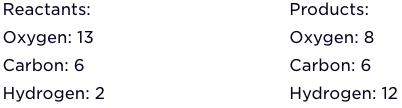
3) If it is still unbalanced, add more coefficients (or see if you might have to change the coefficient you already added).
- I need 12 hydrogens on the reactant side to match the number of hydrogen atoms on the products side, so I’ll add another coefficient of 6 in front of the .
New Chemical Equation: + → +
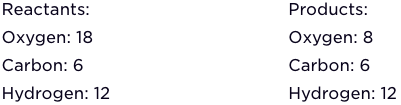
4) This equation is still unbalanced, so more coefficients (or a change in coefficients) is needed!
- I have 18 oxygen atoms in the reactants but only 8 oxygen atoms in the products, so let me try adding a coefficient on the products side to balance them out!
New Chemical Equation: + → +
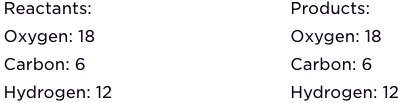
5) Double check to make sure everything is even, then you’ve successfully balanced the equation!
- This equation has an equal number of atoms on each side so it was successfully balanced! It's always good to make sure, just in case a mistake went unnoticed!
Here's a problem to practice with!
Balance the following equation: + → +

