Illustrated · 1 min
Mole Ratios
What is a mole ratio?
-
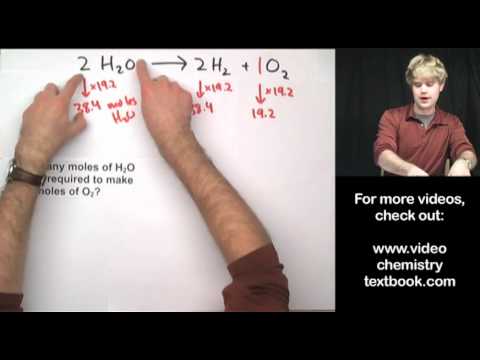
The mole ratio is the relationship between the number of moles of each species in a balanced chemical equation. It tells us the proportions of each element or molecule in our chemical reaction.
-
The mole ratio is important when converting from one molecule to another in a chemical reaction (typically used to convert from reactants to products).

Image source: By Caroline Monahan
In the image above, the coefficient of each species indicates the mole ratio. In this reaction, two sulfur (S) atoms react with three diatomic oxygen () molecules. They produce two sulfur trioxide () molecules. So our mole ratio is 2:3:2.
- As a side note, sulfur trioxide is an interesting compound. It's a precursor to sulfuric acid. So, it gets produced on an industrial scale. If you were to draw the lewis structure, you would find that each oxygen is double bonded to the sulfur atom. So, sulfur is acting as an exception to the octet rule. It can do that because it has access to the d-orbitals. This also gives it the trigonal planar VSEPR geometry.
When do you use a mole ratio?
The mole ratio is used in stoichiometry problems. Stoichiometry studies the relationships between different quantities of reactants and products. You use the mole ratio to convert from one quantity in a reaction to another.
In future lessons, we'll learn how to use the mole ratio to...
-
convert reactant mass to product mass.
-
convert the volumes of reactants and products.
-
calculate the limiting reagent.
-
calculate theoretical, actual, and percent yields.
0.9873 mol = 1.9746 mol FeO
- As you can see, the mole ratio between and was used to find the number of moles of