Барометр/барометричний тиск

Before this, knowАтмосферний тиск

Read · 2 min

What is a Barometer?

A barometer is an instrument that measures atmospheric pressure. On average, at sea level, the atmospheric pressure is 1 atm. However, the atmospheric pressure can fluctuate due to weather and other environmental changes.

Most often barometers are used to indicate changes in the weather. The greater the pressure changes, the greater the weather will change. A quick decrease in pressure indicates that rain is likely. A rapid increase in pressure indicates that the weather is improving.

Types of Barometers

  • Water barometer: sometimes called a "weather glass" or weather ball barometer. This apparatus is a sealed container with water inside the main chamber. Attached to the chamber is a smaller arm or spout which starts below the water level and extends above the water level. The spout is open to air while the main water container is sealed under a single air pressure. If the outside air pressure is lower, the water level in the spout will rise. If the outside pressure is higher, water in the spout will decrease.

  • Mercury barometer: a simple mercury barometer has a glass tube placed in an open basin. The tube is closed at the top and the basin is filled with elemental mercury. Remember, it's a liquid at room temperature. When the atmospheric pressure increases, mercury moves into the tube. When the pressure decreases, mercury moves out of the tube and into the basin. This type of measurement is why we have the units, millimeters of mercury (mmHg). We measure the length that mercury moves in its tube. 760 mmHg is equal to 1 atm.

  • Aneroid barometer: this type of barometer does not use a liquid. This instrument has an internal component called an aneroid capsule. The capsules are made of a copper-beryllium metal alloy. The capsules are evacuated which means they contain no matter or air inside. Sometimes a small spring is placed inside each capsule to prevent it from collapsing. Several of these capsules are stacked on each other. When changes in pressure occur, it causes the capsules to expand or contract. This movement causes the mechanical components of the barometer to move. The movement is displayed on the face of the aneroid and is usually indicated with a needle.

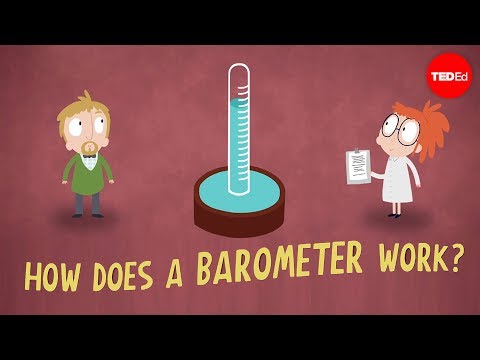
Video

(Video) The History of the Barometer (and How It Works) - Asaf Bar-yosef

by TED-Ed

In this animated video, you will learn about what a barometer is and how this controversial invention came to be.

Video

(Video) Measuring Pressure With Barometers and Manometers

by Professor Dave Explains

In this video, professor Dave explains everything you might want to know about the barometer. You'll learn why we use mercury (HgHg) inside them instead of water, what hydrostatic pressure is, and how to calculate it.

Read · 1 min

How do Barometers Work? A Molecular Perspective

We know that our atmosphere is composed of gases. The prominent gases are nitrogen, oxygen, and argon. They have a percent composition of 78%, 21%, and 1%, respectively. As a side note, all other gases make up less than one percent of our atmosphere. That includes the greenhouse gases responsible for climate change. Depending on the gas, we measure them in parts per million, billion, or trillion. Even at such minuscule concentrations, they have a huge impact!

Anyway, let's return to thinking about the gases in our atmosphere. Do you remember the kinetic molecular theory? We learned that gases collide and bounce off any object. They experience elastic collisions. In fact, trillions of gas molecules slam into you every second! The collisions exert a force. The force per unit area is the air pressure! What does this have to do with barometers? The air in the atmosphere pushes on the liquid in the basin. It flows into or out of the tube to balance the forces.

You may wonder why gases don't dissolve in the liquid. Remember, all liquids have surface tension. In barometers, the most common fluid is elemental mercury. It has metallic bonds, so it is very attracted to itself. It would prefer to cohere to itself than to interact with other molecules. What about water? Water's surface tension is also quite powerful. Why? Because of water's hydrogen bonds. Some atmospheric gas molecules will dissolve in water. But the concentrations are unbelievably tiny. Also, the water is always at its saturation point. So, it can't dissolve more gases and doesn't affect the barometer's reading.

Illustrated · 1 min

Bowl with a tube on top is filled with mercury. An arrow is drawn on top of the tube pointing both upwards and downwards to indicate that the mercury can rise and fall within the tube. 

Description on the left says that mercury is liquid at room temperature.

On the right, it says as atmospheric pressure rises, the mercury rises in the tube. As atmospheric pressure decreases, the mercury lowers in the tube.

Image Source: By Trisha

Type a concept, like “slope” or “photosynthesis”.

↑ ↓ to choose · Enter to openSearch explanations and problems