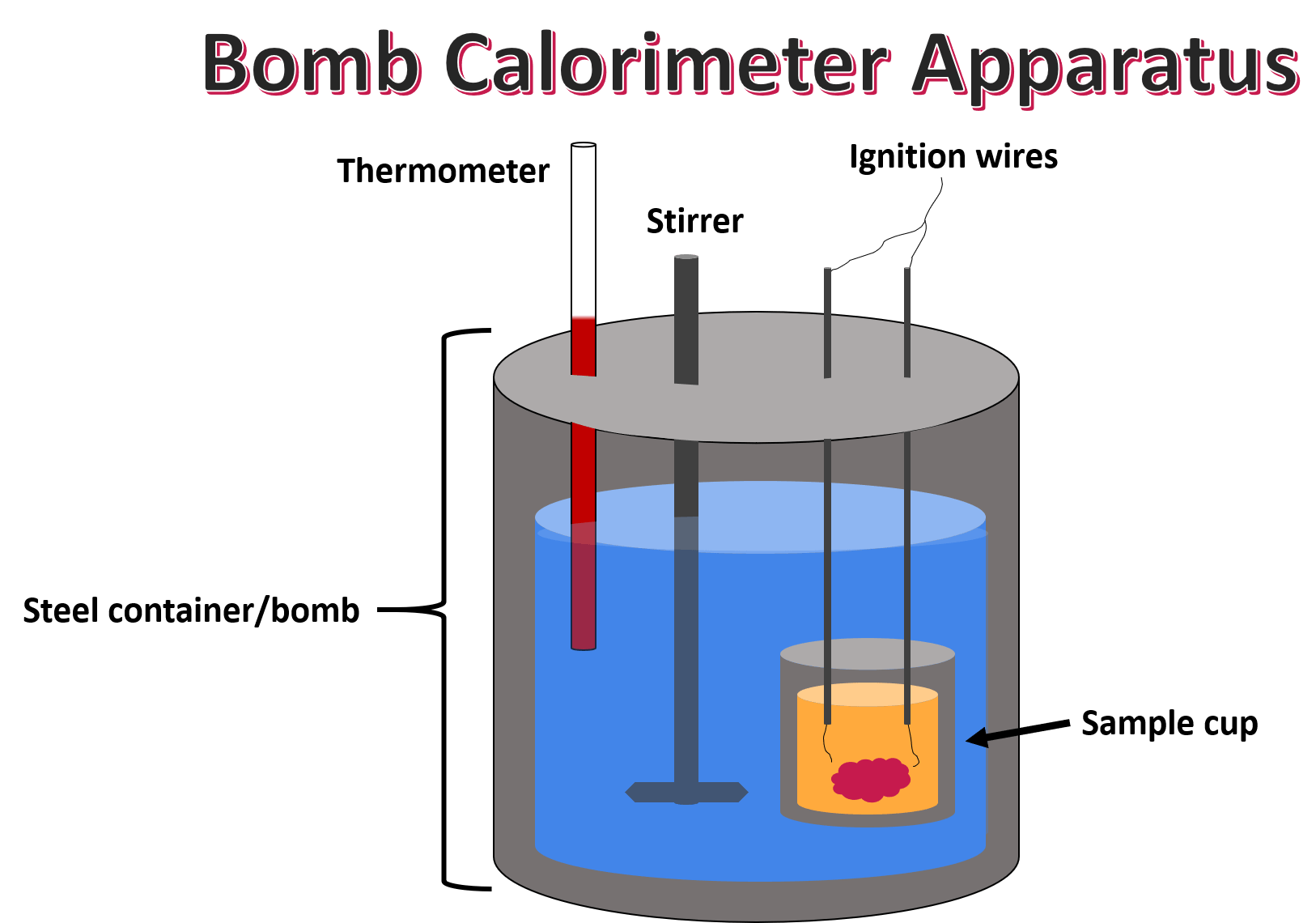
How do we experimentally find energy changes? By using a calorimeter! A calorimeter is a device that allows us to measure a reaction's energy. In the lab, calorimetry is fun!. You get to do so many different chemical reactions. But, the most fun is bomb calorimetry!
Bomb calorimeters are a unique type of calorimeter. They keep the system at constant volume instead of constant pressure. No volume change means there's no pressure-volume (PV) work. So, the internal energy equals the reaction's heat. That's a little bit different than enthalpy. Remember, we defined enthalpy to equal heat for constant pressure systems. At constant pressure, our reaction does a small amount of PV-work. It pushes against atmospheric pressure. So, the internal energy is hard to calculate. For most reactions, the difference between enthalpy and internal energy is minor.
What type of reaction needs a constant volume? Combustion reactions! Can you see why bomb calorimetry is fun? You get to burn stuff! Combustion reactions produce a lot of gases. So, it's challenging to find the internal energy at constant pressure. The gas would have to do a lot of work against the atmosphere. It's impossible to calculate. So, by keeping the volume stable, we eliminate PV-work.
Bomb Calorimeter Design
Combustion reactions release a lot of energy! For example, propane combustion releases 2220.0molKJ! Propane is the fuel in gas grills. That will cook a hamburger! So, anytime we're doing combustion reactions in the lab, we're making mini-explosions. Chemists designed the bomb calorimeter to withstand these.
The most important part of the bomb calorimeter is "the bomb." The bomb is a stainless steel vessel. Stainless steel is strong enough to resist the pressure increase. But, it's also an excellent thermal conductor. Remember, steel is a metal alloy. Metals are good conductors because of their sea of electrons.
Whatever we are combusting is placed in the bomb. The bomb connects to an oxygen supply. So, oxygen will always be in excess. Excess oxygen guarantees that our reaction goes to completion. The bomb also has two wires. The wires connect to a battery. It provides the spark (the activation energy) to start the combustion. Once everything is connected, we seal the bomb.
We place the bomb in a copper cylinder, called a jacket. Then, we fill it with water. The jacket's lid had two openings. The first is for a stirrer. It stirs the water. So, the water's temperature is uniform. On the other side is a thermometer. Once we've set up the jacket, we place it in a larger copper cylinder. The air separates the sides of the copper jacket and cylinder. Air is an insulator. So our system is isolated from its surroundings.
Once we have everything set up, we connect the battery. Instantly, our reaction starts! Combustion is always exothermic. And exothermic reactions release heat. But, remember, heat is the transfer of energy because of temperature differences. Our products have a lot of kinetic energy. So, they're going to transfer their energy to the water. As the energy transfers, the water's temperature increases. What do we do? We record the temperature change and calculate the released energy.
Bomb Calorimeter Heat Capacities
How do we calculate the energy? You might think we could use the water's temperature change. So, apply Q=mcpΔT. But, there's a problem. We didn't account for the bomb! We need to know the heat capacity of our whole calorimeter.
How do we find a calorimeter's heat capacity? We have to use a standard. A common standard is benzoic acid (C6H5COOH). We know that benzoic acid releases 26.38gKJ. So, we would run a benzoic acid combustion. That would give us the temperature change. We know the amount of released energy. So, we apply ccalorimeter=ΔTQ.
Calculating Internal Energy
Once we know our calorimeter's heat capacity, it's easy to find the internal energy! For constant volume systems, U=Qv. In calorimetry, Q=ccalorimeter×ΔT. We only need to run our experiment to find the temperature change.
Chemistry in the World: Food Chemistry
When do we use bomb calorimetry? The most common application is in food chemistry. If you look at the back of any food package, it lists Calories. A calorie is a unit of energy. One calorie is 4.184 KJ. But, the Calorie on food packages is kilocalories (kcal or cal). How do we determine a food's calories? We combust it in a bomb calorimeter!
I do want to add a few clarifications. Calories are a unit of energy. Food calories do equal energy your body can use. If you consume excess calories, your body stores them as fat. If you use more than you consume, you use your fat stores. But, biochemistry teaches us our bodies process foods in different ways. We can't pretend our body handles equal calories of donuts and broccoli the same way. A donut is mostly sugar. Eating sugars spike your blood sugar levels. In response, your body releases a lot of insulin. Insulin is the hormone that allows sugar to enter your cells. If you constantly eat sugar, your cells will build a tolerance. Your body needs more insulin to unlock the cells. Insulin tolerance is type-2 diabetes. Broccoli has far less sugar. Even better, broccoli has fiber. Fiber is very filling. So, you won't be hungry an hour later. It also means your body processes any sugars more slowly. So, your body only releases a small amount of insulin. You don't build a tolerance from low concentrations. So, broccoli is healthier than a donut. Eat your vegetables!