
Illustrated · 1 min
Cavalieri's principle is a principle concerning the volumes of solids (or the areas of regions). It was an early step toward integral calculus. The 3-dimensional version of Cavalieri's principle states the following:
If two solids and are positioned between two parallel planes, and if planes parallel to the two initial planes cut and such that every single cross-section of has the same area as its corresponding cross-section in , then the volume of equals the volume of .
For example, a right circular cylinder will have exactly the same volume as an oblique circular cylinder if the two have the same radius and height.
This can be used to prove the expression for the volume of a sphere. Consider a hemisphere and a cylinder with a cone "carved out". By Cavalieri's principle, if each corresponding cross-section of both solids have the same area, then they have the same volume. Thus, consider the cross-section that is of distance from the base.
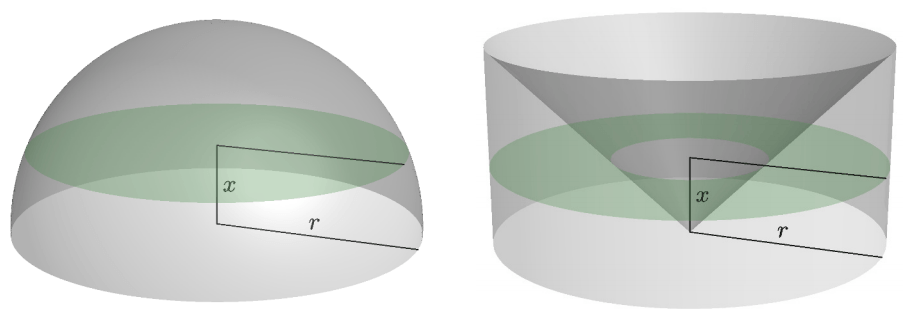
For the sphere, we can use the Pythagorean theorem to find the radius of the cross-section. We have that the radius of the cross-section is , so the area of the circle is .
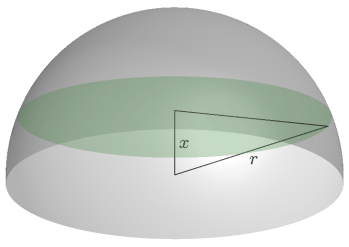
For the cylinder with the cone "carved out", we have the area between two circles. We have two similar isosceles right triangles. The area of the larger circle is , and the smaller one is . Thus, the area of the cross section is .
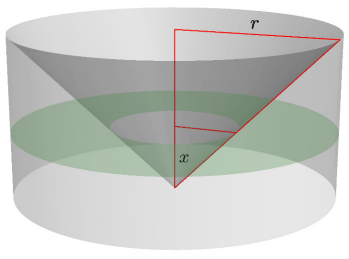
Since both cross sections have the same area, they must have the same volume. We know the volume of the cylinder with cone carved out is . This is just half of a sphere, so the whole sphere has a volume of .