Interactive · 1 question
+1 contributors

What is a Colloid?

Got Milk?
Milk is an example of a colloid! There are many substances within milk such as calcium, sugar, and vitamins. What makes milk a colloid is the triglyceride fats (dispersed state) which are suspended in a water-like liquid (medium phase).
Triglycerides or fatty acids have a glycerol with three fatty acid tales. The glycerol can interact with water, whereas the fatty acid tales are hydrophobic (dislikes water). The fatty acids and water are immiscible, meaning they do not mix. This is what prevents the fat in milk from solvating to create a solution rather than a colloid. Another term for this type of mixture is an emulsion, a uniform mixture of liquid substances where one substance is suspended in the other.
Different Types of Colloids
A liquid medium is not necessary to create a colloid, other states can act as the medium and dispersed state.

Liquid-liquid colloids are often called emulsions. A common example of an emulsion is oil and water. These two liquids are immiscible which means that they do not mix. Sometimes shaking the two liquids can create a dispersion of one liquid in another.

Here is an emulsion starting to separate. The liquid layers have different colors making it easier to tell them apart.
Image source: By Cassie Gates
One example of a surprising colloid is ruby glass. When glass is heated the molecules move faster and further apart, sometimes enough that glass can be stretched and molded. Tiny solid chemicals are sometimes added to glass to create different colors. Ruby glass is created using salts containing the element gold. As the molten glass cools, it reaches a point where it is considered a solid and the tiny particles of gold containing salts are evenly dispersed.
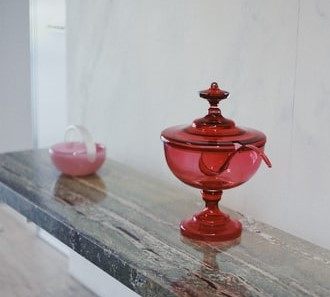
Tiny particles in the glass create an even mixture of two solid states.
Which of these is NOT an example of a colloid?