Що таке суміш?

Interactive · 1 question

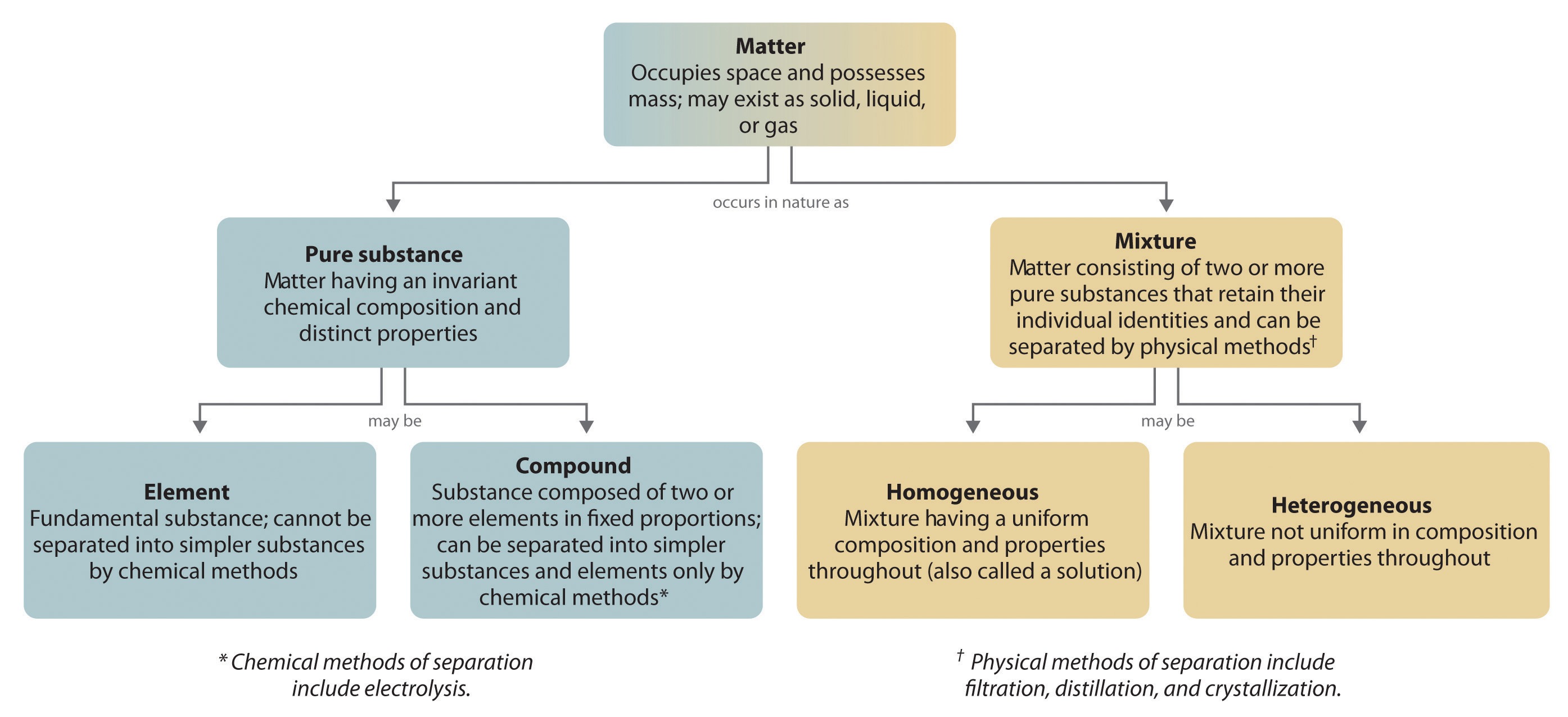
Mixtures are very much what they sound like. They are 2 or more compounds that are mixed up together. The individual components can undergo changes in their physical properties, but they will not undergo chemical changes.

There are broadly 2 types of mixtures; heterogeneous and homogeneous. Solutions are a type of homogeneous mixture.

The picture shows three ingredients: coffee, milk, and sugar. Next, we see two possible mixtures of these ingredients. A homogeneous mixture is a normal cup of coffee with a uniform blend of the ingredients. A heterogeneous mixture would have visible lumps of sugar and milk in the coffee.

Image by: Gabi Slizewska

Heterogeneous Mixtures

The word heterogeneous comes from the Greek words heteros, meaning other, and genos, meaning kind or type. So, in a heterogeneous mixture, we have separate, distinct types of compounds that are not uniformly mixed together.

In a chocolate chip cookie, we have chocolate spread out and mixed with dough. But, we can very easily point out where the chocolate is and where the dough is. Moreover, sometimes you'll get an area that has a lot of chocolate, and sometimes an area with almost no chocolate. The chocolate is not uniformly mixed with the dough. These all indicate that a chocolate chip cookie is a heterogeneous mixture.

Homogeneous Mixtures

The word homogeneous comes from the Greek words homos, meaning same, and genos, meaning kind or type. So, in a homogeneous mixture, it appears as though there is only a single type of thing. In a homogeneous mixture, we cannot tell the components apart, and everything is uniformly distributed. Alloys are a common example of homogeneous mixtures of metals.

Solutions

Solutions are liquid homogeneous mixtures. This is the most common form of mixtures encountered in chemistry. In a solution, rather than saying the components are mixed together, we say components dissolved. A solution has 2 distinct parts to it: solvent and solute. The solute is the part that dissolves. The solvent is the part that does the dissolving.

If we place sodium chloride into water it will form a solution. In this example, the salt is the solute. It is the part that dissolves. The water is the solvent, it is the part that dissolves the salt. We can also say that salt is soluble in water. That is to say, it is capable of being dissolved in water.

Which is a homogeneous mixture, but not a solution?

Choose one answer

Illustrated · 1 min

Photograph of a French cafe.

By Panoramafotos.net - Own work, Attribution, Wikimedia Commons

Welcome to the Expii Cafe! While you choose a refreshing drink, take a moment to learn about the types of mixtures and solutions.

Mixtures are just what they sound like- combinations of different things that are still two (or more) different things, even when mixed together.

A heterogeneous mixture is one with an uneven distribution of components, or easily separated chunks. If you're looking to drink a heterogeneous mixture today, may I recommend an oreo milkshake? The cookie pieces are dispersed throughout a creamy mixture of ice cream and milk.

Photograph of an Oreo flavored milkshake with visible chunks of cookie

By mazaletel from Anchorage, USA - oreo milkshakeUploaded by JohnnyMrNinja, CC BY 2.0, Wikimedia Commons

Maybe you want something a little bit more classic. A glass of milk is also a heterogeneous mixture, but a specific kind called a colloid. This means that its tiny particles of fat are suspended in water, and will not fall out.

Similarly, orange juice contains tiny pieces of orange that do slowly separate out of the water. This is called a suspension. If you order one, I'd recommend shaking well before drinking it!

Solutions are homogeneous, meaning evenly mixed. They contain a substance, called the solute, that is evenly distributed throughout a solvent. A classic example is a mixture of water and salt- table salt, with the molecular formula NaClNaCl, splits apart into its component ions, sodium (Na+Na^{+}) and chloride (Cl−Cl^{-}), in water. Water is an extremely popular solvent, though I'd advise against ordering salt in your drink. Could I tempt you with a nice lemonade, containing lemon juice and sugar dissolved in water, instead?

Photograph of a clear mug filled with lemonade.

By Adryan R. Villanueva - Own work, CC BY-SA 4.0, WIkimedia Commons

Interactive · 2 questions

Defining a Mixture

A mixture is defined as a combination of 2 or more substances in which each substance keeps its own identity and properties (can be separated into components). Mixtures can be solids, liquids or gases. The components don't undergo chemical bonding which is why they are able to retain their original chemical properties.

Which of the following are mixtures?

Choose all correct answers

Video

(Video) Types of Mixtures

by Duell Chemistry

In this video, Mr. Duell talks about different types of mixtures. You will learn about the difference between homogeneous and heterogeneous mixtures as well as properties of suspensions, colloids, and solutions. Finally, you will learn how the Tyndall effect helps us distinguish between colloids and solutions.

Read · 1 min

The Chemistry of Mixtures

Why do the components stay separate in heterogeneous mixtures? Because they experience different intermolecular forces. For example, consider oil and water. We know they don't mix. Water is a polar covalent molecule. Hydrogen and oxygen have very different electronegativities. So, they form a dipole. But, the dipole is incredibly strong. So, water experiences a unique dipole-dipole interaction called hydrogen bonding. Oils generally consist of carbon-hydrogen bonds. They're non-polar and experience dispersion forces. So, water hydrogen bonds to itself. And oil prefers to interact with itself.

What about homogeneous mixtures? They experience similar intermolecular interactions. For example, polar molecules will dissolve other polar molecules via dipole-dipole interaction. Polar molecules also dissolve ions through ion-dipole interactions. Non-polar molecules will dissolve other non-polar molecules.

Type a concept, like “slope” or “photosynthesis”.

↑ ↓ to choose · Enter to openSearch explanations and problems