Interactive · 1 question

Compare the Numerators

Comparing two or more fractions essentially means figuring out which one is bigger. This can be simple if the fractions have the same denominator (the number on the bottom), but might be a little more complicated if they don't. If the denominators are the same, you can just compare the numerators (the top numbers)!

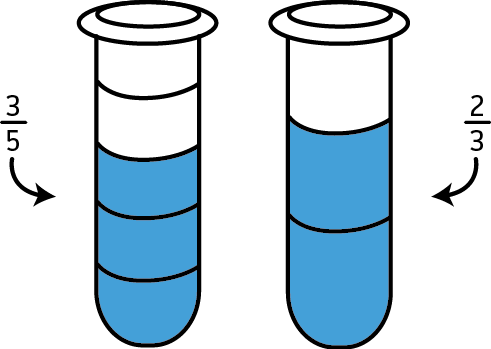
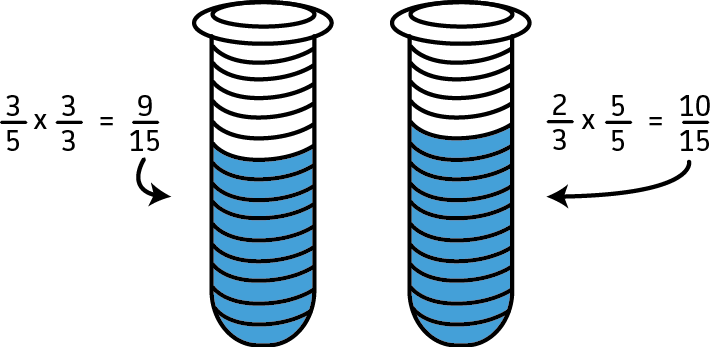
If numerators and denominators are different, convert each fraction. You'll want either the numerators or the denominators to be the same.

For now though we'll try an example with like denominators.

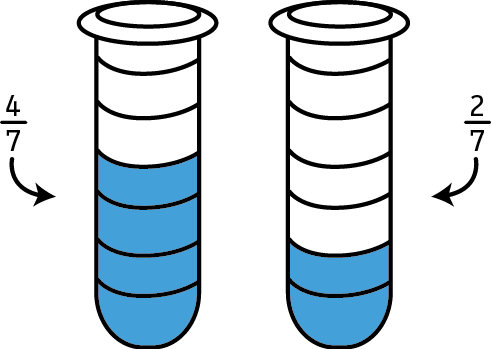
Which is bigger, 47\frac{4}{7} or 27\frac{2}{7}?

Choose one answer

Video · + 1 min read

(Video) Comparing Fractions

by Math Antics

Math Antics has an outstanding video on comparing fractions.

Summary\large{\text{Summary}}

Comparing fractions just means finding which fraction is bigger. Sadly, this is not always easy.

If you had to compare 13\frac13 and 110\frac1{10} you might be tempted to say that 110\frac{1}{10} is bigger since 1010 is bigger than 33. But, this isn't the case. 13\frac13 is bigger than 110\frac1{10}. The fraction with the bigger denominator is actually smaller! How can this be?

If we were to divide these two fractions, we would see that the decimal value of 13\frac13 is bigger than that of 110\frac1{10}. 13=0.333...110=0.1\begin{align} \frac13&=0.333...\\ \frac1{10}&=0.1 \end{align}

Even though 0.333…0.333\dots is a repeating decimal, we can see it is bigger than 0.1.0.1. This is because the tenths place of 0.333…0.333\dots has a bigger digit.

If two fractions have the same bottom number, then you can easily compare them. The larger number will have a larger top number.

If you had to compare 14\frac14 and 34\frac34, you would know 34\frac34 is bigger since they have the same bottom number and 33 is bigger than 11.

We can use this idea even when fractions don't have the same bottom number by cross multiplying. You multiply the top number of each fraction by the bottom number of the other fraction. The bigger product means that the fraction with that top number is bigger.

Let's use this to compare 25\frac2{\color{#29A603}{5}} and 34\frac3{\color{#8925AE}{4}}. We can instead rephrase this to compare 2×42\times\color{#8925AE}{4} and 3×53\times\color{#29A603}{5}. We get that: 8<158<15

Since we made 1515 with the numerator of the fraction 34\frac34, we know that it's the bigger fraction.

Checking Your Work

You can find fraction calculators to help check your work. Alternatively, use a pocket calculator. Plug in the fractions you start with and you'll get decimals. If you have equivalent fractions, the decimals will be the same. Otherwise one fraction will be larger or smaller than the other.

Interactive · 2 questions

Compare the Denominators

Another way to compare positive fractions is to compare denominators when the numerators are the same. With like numerators, whichever fraction has the smaller denominator will be the greater number. This can be easier than comparing numerators when the denominators are the same if finding a least common denominator would be difficult.

For starters let's say you want to compare two fractions with the same numerator. Then the larger fraction has the smaller denominator. For instance,

1213>1217\frac{12}{13} > \frac{12}{17}

The numerators are both 1212, but the left fraction has smaller denominator.

This strategy also works for improper fractions. For example,

85>87\frac{8}{5} > \frac{8}{7}

The numerators are both 88, but the left fraction has smaller denominator.

Let's use an example here:

Which fraction is greatest?

Choose one answer

Type a concept, like “slope” or “photosynthesis”.

↑ ↓ to choose · Enter to openSearch explanations and problems