Що таке неправильний дріб?

Illustrated · 1 min

What is an improper fraction?

Fractions get separated into two categories. The first is the category of proper fractions. These fractions have numerator (the top number) smaller than the denominator (the bottom number). The positive ones will be between 00 and 11 on the number line. The negative ones will be between −1-1 and 00 on the number line.

The second category is the improper fractions. These fractions have numerator bigger than the denominator. The positive ones will be to the right of 11 on the number line. The negative ones will be to the left of −1-1 on the number line.

Of course, it is easier to visualize what the positive fractions represent.

The positive fractions in the second category will always be greater than 11. Think of a fraction as a container with some stuff in it. The denominator tells you how much one container can hold. However, the numerator tells you how much is actually in the container.

A fraction is improper when there's too much stuff for the container. In other words, you need more than one container to hold all of it. In this picture, one container is being overfilled. Yikes!

The "stuff" can be whatever you want. In this picture we're using rocks.

Proper Fraction is a container that can hold 3 rocks and is currently holding 2.
Improper Fraction is a container that can hold 3 rocks and is currently holding 4: 3 inside and 1 on top.

Both containers can hold 3 rocks. If you add more, the container will overflow. Both (2) rocks on the left fit into their container, since 2 is less than 3. However, the 4 rocks on the right are overflowing. This is because 4 is more than 3. There isn't space for all of them. I guess you can call the second bin top heavy. Haha.

Interactive · 6 questions

Proper vs. Improper Fractions

Before we start, let's quickly review the difference between proper and improper fractions.

Proper fractions have an absolute value less than 1.

Improper fractions have an absolute value greater than 1.

If absolute values aren't your cup of tea, there's another way you can identify an improper fraction. We can ignore any negative signs and check to see if the numerator is bigger than the denominator. If it is, the fraction is improper. Otherwise, the fraction is proper.

The fraction 54\frac{5}{4} has a bigger numerator than denominator. On the other hand, 45\frac{4}{5} is the other way around. This means 54\frac54 will be to the right of 11 on the number line. Also, 45\frac45 will be to the left of 11 on the number line.

Now, let's use those definitions to answer a few practice questions.

A: 3.4
B: 7/2
C: -5/6
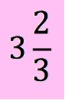
D: 1 and 2/3

Which of the fractions above are proper? Check all of them off.

Choose all correct answers

Video · + 1 min read

(Video) Mixed Numbers

by Math Antics

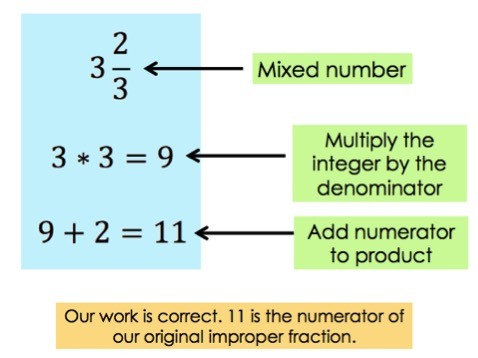
Here’s a video by Math Antics that covers improper fractions. It also covers some other topics. These include mixed numbers, converting fractions to mixed numbers, and converting mixed numbers to fractions. All of the topics are important. However in this explanation we'll focus on the first one.

Summary\large{\text{Summary}}

Let's talk about the two main types of fractions. We'll summarize what the video went over.

A proper fraction is such that the top number is smaller than the bottom number.

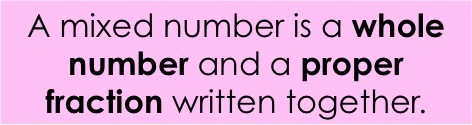
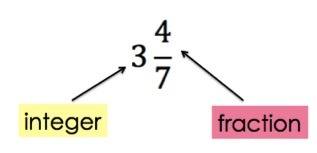
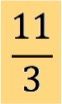
An improper fraction is a fraction where that the top number is larger than the bottom number. In other words, the numerator is greater than or equal to the denominator. We can convert these to mixed numbers. These numbers are also called mixed fractions. Moreover, the other ones are made by combining a whole number and a proper fraction. But the whole number is hidden inside the fraction. It's what makes the numerator bigger than the denominator. 1+12=321+\frac12=\frac32

On the number line, proper fractions are between 00 and 11. The other fractions are above 11.

Finally, mixed numbers are equivalent to improper fractions. That is, every mixed number can be written with a numerator larger than the denominator. The reverse is also true.

So why use one over the other? If you are comparing two numbers, mixed numbers are easier to handle. You compare the whole number parts, and then compare the fractions. However, other operations are done more easily with improper fractions. If you need to add, subtract, multiply, or divide, don't convert to a mixed number.

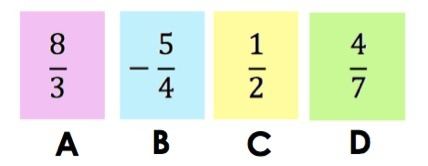
Select all of the fractions that are improper. There may be more than one correct answer.

Choose all correct answers

Type a concept, like “slope” or “photosynthesis”.

↑ ↓ to choose · Enter to openSearch explanations and problems