Interactive · 1 question
We're beginning our study of stoichiometry. Stoichiometry is the relationship between different quantities of reactants and products. In this lesson, we'll study converting moles of reactant to moles of product. But, in future lessons, we'll also learn how to convert masses and convert volumes. Then, we can convert between mass and volume calculations by using the density.
Eventually, we'll use our skills to calculate yields. We can calculate a reaction's theoretical yield and compare it to the actual yield. The comparison is called the percent yield. Why do we care? It's important for chemical synthesis. For example, let's say we designed a reaction mechanism for synthesizing a new compound. We want to know how much we should theoretically produce. We compare the theoretical value to the actual to see how sources of error influenced our procedure. So, stoichiometry is exceptionally important! But, for now, let's start with mole-to-mole stoichiometry.

Image source: By Caroline Monahan
Steps on how to convert moles of reactants to moles of products:
-
Make sure the chemical equation is balanced!
-
Determine which reactant is the limiting reagent by calculating the moles of each reactant.
-
Use the limiting reagent to convert from moles of reactants to moles of products.
This may be a little confusing at first, but with some practice, it becomes a lot easier!
+ → +
1) Make sure the chemical equation is balanced
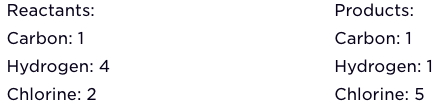
We don’t have equal numbers of each element on each side of the equation. The carbon is balanced. But, hydrogen and chlorine are not. So, we have to balance it before proceeding.
- We have four hydrogens atoms in the reactants but only one hydrogen in the products. So, let's make the products have four hydrogens by adding a coefficient of four in front of the .
+ → +

- Now we still need to balance the chlorines. There are 8 chlorines in the products but only 2 chlorines in the reactants. Let’s fix this by adding a coefficient of 4 to the on the reactant side.
+ → +
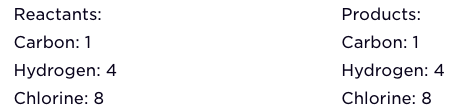
- Perfect! The equation is now balanced.
2) Using the chemical equation and the information given in the problem, we can now determine the limiting reactant.
Reminder: The scientist reacted 4.564g of with 3.456g of .
+ → +
To find the moles of reactant, we use the molar mass. It will be the conversion factor from grams to moles.
Molar Mass of : 16.04g/mol
Molar Mass of : 70.9g/mol
Now, we can determine the moles of each reactant. The easiest method is to use dimensional analysis to convert our units.
: 0.2845 mols
: 0.04874 mol
Now, we can determine which reactant is the limiting reagent. How? We use the mole ratio to convert each reactant into the moles of one of the products. Whichever reactant creates the smaller amount is the limiting reactant!
0.2845 mols = 1.138 mols HCl
0.04874 mol = 0.04874 mol HCl
- produces less than . So, is the limiting reactant!
The conversion factors used to get these numbers are from the coefficients from the chemical equation. In this case there is 1 to every 4 and so on!
3) Use the limiting reactant to determine the number of moles of product that can form!
0.04874 mol = 0.04874 mol
0.04874 mol = 0.01219 mol
From this reaction, we have concluded that we can produce 0.04874 mols and 0.01219 mols .
Here's a practice problem to try:
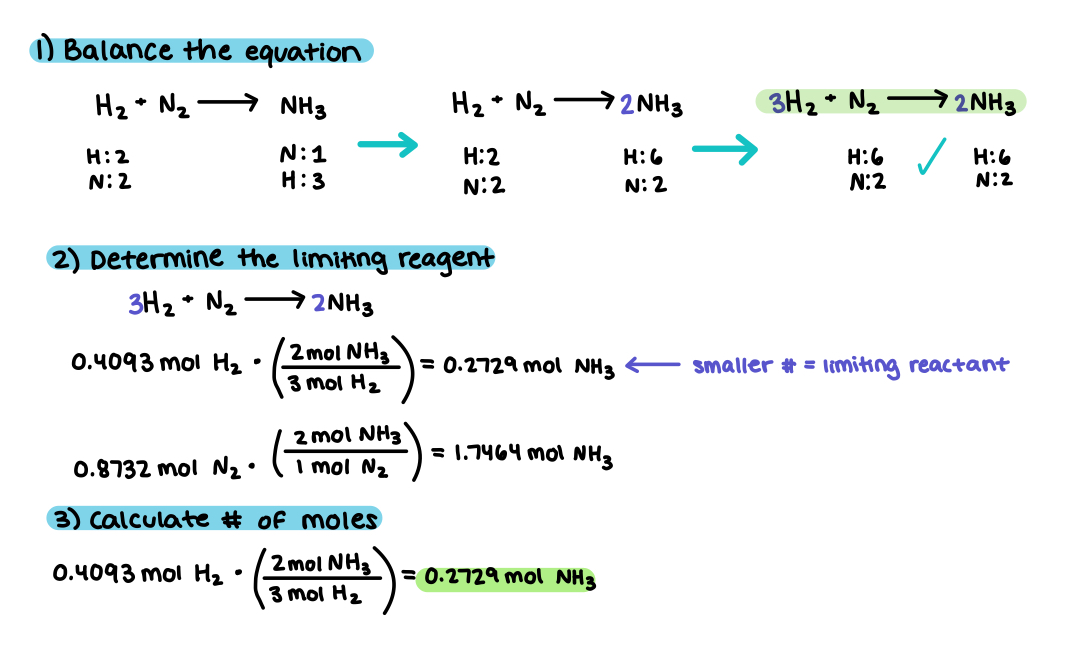
A student reacts 0.4093 mols with 0.8732 mols to form , how much product was produced in mols?
Here's the math to solve the practice problem above: