Interactive · 1 question

+3 contributors


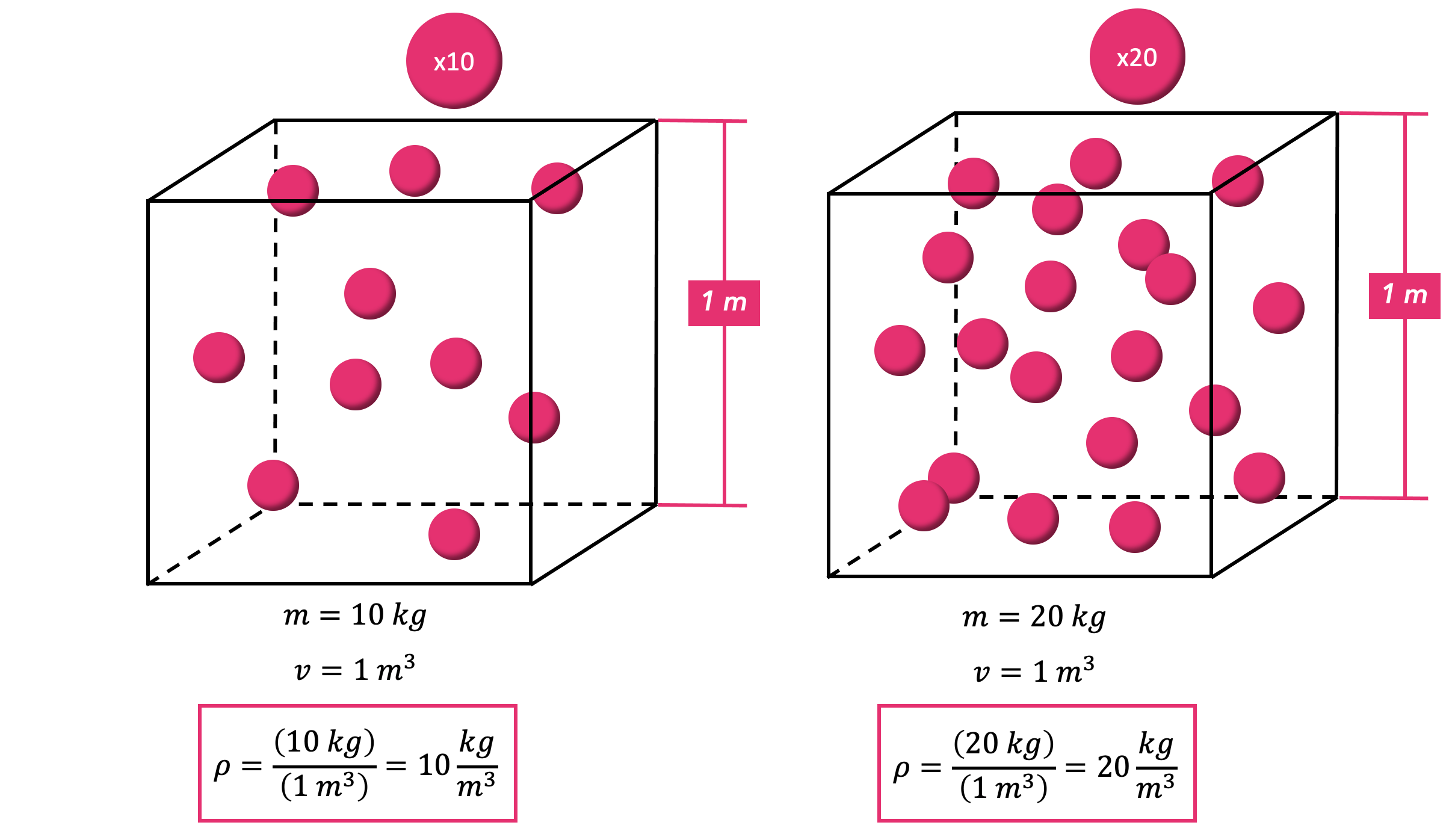
Density is a measurement of how much of something there is in a given volume. The term "density" most often refers to , which is mass per volume. In chemistry, mass density is typically expressed in units of grams per milliliter (). For the remainder of this explanation, the type of density will always be specified, but moving forward it is safe to assume "density" refers to mass density.
Calculating Mass Density
Calculating mass density is a simple task regarding a simple calculation. First determine the mass of the sample, then the volume, then divide the mass by the volume. As an example, lets say we have of an unknown substance. We place it on a scale and determine it to have a mass of . The mass density () is calculated as follows.
An unknown substance has a mass of 847 grams and occupies half of a 1 liter bottle. What is the mass density in grams per milliliter?
To find the mass density of our substance we must first determine the volume in milliliters. We are given that the volume is half of a 1 liter. Now we can divide our mass by our volume to find mass density.
Mass Density of Water and other materials
Much of the metric system is based around the properties of water. As it happens, the original definition of a gram is the amount of mass in milliliter of water. What this means is that water has a mass density of . Over time these definitions have changed, and this relationship is no longer exact, but it is still close enough for all practical purposes.
The fact that the mass density of pure water is always brings up an interesting fact: the mass density of a pure substance is always the same. What this means is that if we have a block of pure material, it doesn't matter where or how many times we cut it, the pieces will always have the same mass density as each other and as the original block. This is because mass density is a physical property. Be careful with this though. If we were to make a hollow aluminum sphere, the sphere would be less dense than aluminum since it is hollow. Only the outer shell would have the mass density of aluminum.
Other Types of Density
Mass density is by and far the most commonly used type of density. However, in chemistry it is useful to understand two other types of density: and . Charge density is a measurement of how much electric charge there is in a given volume. It is uncommon in chemistry to numerically evaluate charge density, but rather they are qualitatively compared. As an example, we may say that the charge density of a lithium nucleus is more positive than the charge density of a helium nucleus, but the actual values would not be calculated. Charge density has a strong relation to electronegativity. Number density is a measurement of how many countable units there are in a given volume. For example, we might say that there are moles of glucose in a liter. Each molecule of glucose is a countable unit, and we are counting moles. Number density is often addressed by a different name: concentration : The amount of mass in a specified volume. Typically expressed in units of grams per milliliter. : The amount of electric charge in a specified volume. This is usually not explicitly evaluated. : The amount of countable units in a specified volume. This is often referred to as concentration.