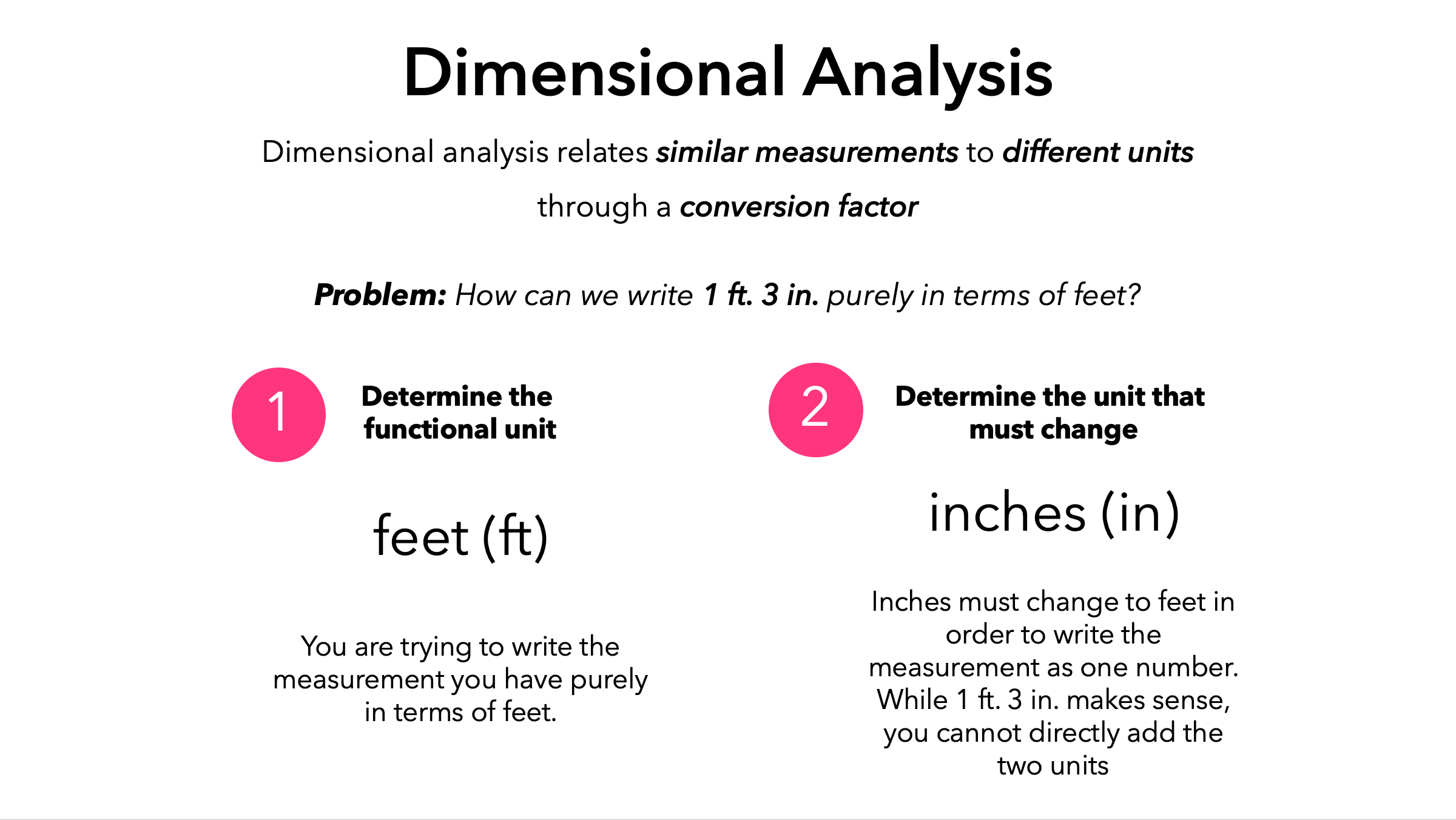
The point behind dimensional analysis is to allow us to convert measurements to desired units without getting a headache. First, let's examine the name of dimensional analysis. We are clearly trying to "analyze" some numbers or measurements, which is what we usually use dimensional analysis for. The "dimensional" here just refers to the fact that we use dimensional analysis on so-called "dimensional units" which is just a fancy term for a unit that measures a certain dimension like length or time. An unit can be a dimension, as long as it has the unit symbol written after it ("2" is not a dimension, but 2 meters is).
A dimension can be thought of as a degree of freedom; a number that can change depending on the object being measured and can be used to reliably differentiate two objects. We can use a "dimension" as a measuring stick to rank everything in the universe by.
Think about why we might be considered as living in three spatial ("related to space", so no time or crazy physics) dimensions.
There are in fact "dimensionless units", like percent and radians, but these do not affect units because they are just numbers at their core.
Dimensional analysis, is very easy. In dimensional analysis, first we take every concept and unit and add, subtract, multiply, or divide them as the problem dictates. The order of these operations is not exactly dimensional analysis; you just need to carefully examine the problem and think about what the units of the final answer need to be. Dimensional analysis now tells us how to simplify the units.
Units that are the same can be added or subtracted and retaining the unit. Since this is not hard (just keep the unit!), we will ignore this from now on.
Now, division of units is also not hard. If two units that are exactly the same are divided, we can just cancel them. Therefore, 3 kilogram-meters divided by 2 meters gives 3/2 kilograms.
Sometimes, the units are the same dimension, but cannot be directly divided. In this case, you must use a conversion factor to change the unit. A conversion factor always equals 1, but this is a special 1. The conversion factor cancels one of the unwanted units and replaces it with something we can use. Be sure to have the conversion factor on the right side of the unit of they actually cancel.
For example, if wanted to divide 5 hours by 10 minutes, I would first multiply 5 hours by 60 minutes/1 hour. This would give me 300 minutes divided by 10 minutes, which is clearly 30 without any units.
The relevant calculation is
1ns1ft⋅1s1,000,000,000ns⋅1min60s⋅1hr60min⋅1,000,000⋅5280ft1mi⋅19173511445225mi1pc=35.56...
Finally, we should examine the multiplication of units. This is normally done the same as with division and canceling, but there is one caveat. If two units cannot be cancelled but are still multiplied, this is represented with a hyphen. Division has a sort of similar thing with the word per. Thus, the henry is the kilogram-meter squared per second squared-ampere squared. Multiplying bricks by broken windows is the brick-broken window. The multiplication typically tells engineers and scientists that somewhere there is an integral, but that is far beyond the scope of this.
Last problem. If you get this one, you should be able to solve any dimensional analysis problem.
The weber is the unit of magnetic flux. It can be defined as the tesla-meter square or the volt-second. Given that the tesla is newton-second per coulomb-meter and the volt is joules per coulomb, and that there is a force of 6 newtons for 7 seconds, 2 meters, and 1 coulomb, what was the energy (in joules) required in this crazy circumstance?
A lot of the information given was extraneous. Make to sure to check for this in all dimensional analysis problems. The key thing is to see that the two expressions for a weber can be equated.