Похідні в локальному екстремумі

Before this, knowЛокальні та глобальні екстремумиЩо таке критичні точки?

Read · 1 min

Fermat's Theorem states that all relative extrema of a function lie at critical numbers.

Be careful, though; the converse of Fermat's Theorem does not hold.

A critical number of a function ff is a number xx such that f′(x)=0f'(x)=0 or f′(x)f'(x) is undefined.

We will prove the result only for a local maximum, and the local minimum will follow by a similar argument.

Suppose for the sake of contradiction that f′(x)f'(x) is either positive or negative.

By definition, a function ff has a local maximum at xx if there exists some α>0\alpha>0 such that f(x)>f(y)f(x)>f(y) for all yy such that ∣x−y∣<α|x-y|<\alpha.

Also by definition, for all δ>0\delta>0 there exists some β>0\beta>0 such that: f′(x)−δ<f(y)−f(x)y−x<f′(x)+δf'(x)-\delta<\frac{f(y)-f(x)}{y-x}<f'(x)+\delta for all yy such that ∣x−y∣<β|x-y|<\beta.

Take y>xy>x such that y−xy-x is less than both α\alpha and β\beta.

Thus, we know that f(y)−f(x)<0f(y)-f(x)<0 and y−x>0y-x>0.

Therefore, f(y)−f(x)y−x<0\frac{f(y)-f(x)}{y-x}<0.

This means that f′(x)−δ<0f'(x)-\delta<0 for all δ>0\delta>0.

This means that f′(x)<0f'(x)<0, since we assumed that f′(x)≠0f'(x)\ne 0.

Now, take y<xy<x such that x−yx-y is less than both α\alpha and β\beta.

Thus, we know that f(y)−f(x)<0f(y)-f(x)<0 and y−x<0y-x<0.

Therefore, f(y)−f(x)y−x>0\frac{f(y)-f(x)}{y-x}>0.

This means that f′(x)+δ>0f'(x)+\delta>0 for all δ>0\delta>0.

This means that f′(x)>0f'(x)>0, since we assumed that f′(x)≠0f'(x)\ne 0.

We just reached the conclusion that f′(x)>0f'(x)>0 and f′(x)<0f'(x)<0 simultaneously. This is a contradiction!

Thus, our original assumption was incorrect, and f′(x)f'(x) is either 00 or undefined.

Video · + 4 min read

(Video) Finding Intervals of Increase, Decrease, Local Maximums, and Local Minimums

by PatrickJMT

Here's a video by patrickJMT where he shows you how to apply the first derivative test to a function to find the intervals on which it increases and decreases and where local minimums and maximums are.

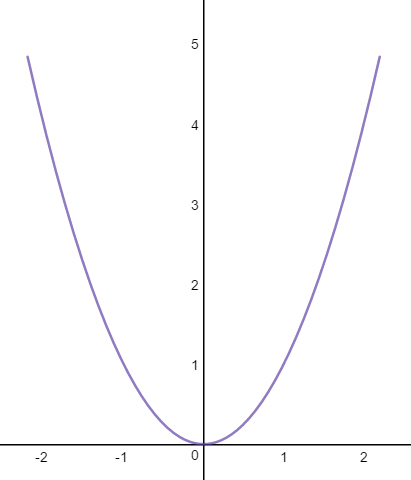
He demonstrates this test with the function f(x)=x2f(x)=x^2.

We can see on the graph that the function decreasing from negative infinity to zero. (−∞,0) ↘(-\infty,0)\ \searrow The function then increases from zero to infinity. (0,∞) ↗(0,\infty)\ \nearrow Finally, there's a local minimum at x=0x=0.

But we can also find all this information out by looking at the first derivative. This is helpful because sometimes we don't have the graph or don't want to draw one.

To apply the first derivative test we:

  1. Take the derivative of the function.
  2. Figure out where the derivative equals zero or is undefined. These are the critical points.
  3. Look at the sign of the derivative. Plug in a value within each critical point's interval to see if the derivative is positive or negative. Positive means it's increasing. Negative means it's decreasing.
  4. If it goes from decreasing to increasing, that critical point is a local min. If it goes from increasing to decreasing that critical point is a local max.

This might not make sense so let's try it with our quadratic function above. First, we take the derivative. f(x)=x2f′(x)=2x\begin{align} f(x)&=x^2\\ f'(x)&=2x \end{align}

Next, set it equal to zero and solve. 2x=0x=0\begin{align} 2x&=0\\ x&=0 \end{align}

Since x=0x=0 is within the domain of our original function we know that it is a critical point.

Now we take a look at the sign of the derivative. To do this draw a number line and place all critical points on the line. In this example, we only have the one.

We want to plug a number to the left of the critical point and to the right into the derivative in order to see if it's positive or negative. Let's try x=−10x=-10 and x=2,000,000x=2,000,000. f′(−10)=2(−10)=−20f′(2,000,000)=2(2,000,000)=4,000,000\begin{align} f'(-10)&=2\color{red}{(-10)}\\ &=-20\\ f'(2,000,000)&=2\color{red}{(2,000,000)}\\ &=4,000,000 \end{align}

Since x=−10x=-10 is to the left of our critical point and returns a negative value, all numbers to the left of x=0x=0 give us a negative number. Similarly, since x=2,000,000x=2,000,000 is to the right of our critical point and returns a positive value, all numbers to the right of x=0x=0 give us a positive number.

Where ever our derivative is negative our original function is decreasing. Similarly, where ever our derivative is positive our original function is increasing. So, based on our sign chart, we can conclude that our original function is decreasing from negative infinity to zero and increasing from zero to infinity. (−∞,0) ↘(0,∞) ↗(-\infty,0)\ \searrow\\ (0,\infty)\ \nearrow Notice that this is exactly what we go above from looking at the graph!

Finally, we can look at the sign change around the critical points. Since it goes from decreasing (the left) to increasing (the right) this indicates that our critical point is a local minimum. And looking at the graph we can see that x=0x=0 is a local minimum.

Similarly, if it goes from increasing to decreasing we know that the critical point is a local maximum.

Let's look at a harder example, in which we can't easily graph and see the answer. f(x)=(x2−1)3f(x)=(x^2-1)^3

The first step we do is take the derivative. f(x)=(x2−1)3f′(x)=3(x2−1)2⋅[x2−1]=3(x2−1)2⋅2x=(6x)(x2−1)2\begin{align} f(x)&=(x^2-1)^3\\ f'(x)&=3(x^2-1)^2\cdot\color{red}{[x^2-1]}\\ &=3(x^2-1)^2\cdot2x\\ &=(6x)(x^2-1)^2 \end{align}

Now we look for our critical points: where the derivative equals zero or is undefined. (6x)(x2−1)2=06x=0or(x2−1)2=0x=0orx2=1  x=±1(6x)(x^2-1)^2=0\\ \begin{alignat}{3} &6x=0\quad&&\text{or}\quad&&(x^2-1)^2=0\\ &x=0\quad&&\text{or}\quad&&x^2=1\\ &\ &&\ &&x=\pm1 \end{alignat}

In this example, we have three critical numbers: x=−1x=-1, x=0x=0, x=1x=1. Let's go ahead and make a sign table with these.

We have four intervals we have to test: (−∞,−1)(-\infty,-1), (−1,0)(-1,0), (0,1)(0,1), and (1,∞)(1,\infty). To test these, we need to choose a number within each interval. Let's begin with the interval greater than one and choose the number 2. If we plug any number into the square term, (x2−1)2(x^2-1)^2, we will always get out a positive. And if we plug a positive into the 6x6x term we will always get a positive. A positive times a positive is always a positive.

The same logic can be applied to the intverval (0,1)(0,1) because all the numbers in the interval are positive.

For the two intervals less than zero, we will get a positive value in the square term and a negative value in the 6x6x term. A negative times a positive is always a negative.

As you can see, our original function is decreasing on the interval from negative infinity to zero and increasing on the interval zero to infinity. (−∞,0) ↘(0,∞) ↗(-\infty,0)\ \searrow\\ (0,\infty)\ \nearrow

The only point where the derivative changes from increasing/decreasing to decreasing/increasing is at x=0x=0. It is going from decreasing to increasing so we know that it is a local minimum.

To find the exact point of this local minimum we take the critical point, x=0x=0, and plug it back into our original function. f(0)=((0)2−1)3=(−1)3=−1\begin{align} f(0)&=(\color{red}{(0)}^2-1)^3\\ &=(-1)^3\\ &=-1 \end{align}

The local minimum is at the point (0,−1)(0,-1).

Finally, let's just take a quick look at the graph of this function to double check our work.

Video · + 1 min read

(Video) Second Derivative Test to Find Local Extrema

by PatrickJMT

Here's a video by patrickJMT where he shows you how to use the second derivative test in order to figure out if a critical point is a local max or a local min.

The second derivative test tells us that, given cc is a critical point,

  • if f′′(c)>0f''(c)>0 then cc is a local minimum
  • if f′′(c)<0f''(c)<0 then cc is a local maximum
  • if f′′(c)=0f''(c)=0 then anything could happen

If the last option happens then you have to go back and use the first derivative test in order to figure it out.

The example he looks at is the function: f(x)=xx2+4f(x)=\frac{x}{x^2+4}

Let's begin by finding the derivative. f(x)=xx2+4f′(x)=[x]′(x2+4)−x[x2+4]′[x2+4]2=(x2+4)−x(2x)(x2+4)2=x2+4−2x2(x2+4)2=4−x2(x2+4)2\begin{align} f(x)&=\frac{x}{x^2+4}\\ f'(x)&=\frac{\color{red}{[x]'}(x^2+4)-x\color{red}{[x^2+4]'}}{[x^2+4]^2}\\ &=\frac{(x^2+4)-x(2x)}{(x^2+4)^2}\\ &=\frac{x^2+4-2x^2}{(x^2+4)^2}\\ &=\frac{4-x^2}{(x^2+4)^2}\\ \end{align}

Now we can find the critical points by looking at where the derivative equals zero or is undefined. f′(x)=04−x2(x2+4)2=04−x2=0x2=4x=±2\begin{align} f'(x)&=0\\ \frac{4-x^2}{(x^2+4)^2}&=0\\ 4-x^2&=0\\ x^2&=4\\ x&=\pm2 \end{align}

These are points within the functions domain so they are critical points.

Next we take the second derivative of this function. f′(x)=4−x2(x2+4)2f′′(x)=[4−x2]′(x2+4)2−(4−x2)[(x2+4)2]′[(x2+4)2]2=−2x(x2+4)2−(4−x2)(2)(x2+4)[x2+4]′(x2+4)4=−2x(x2+4)2−2(4−x2)(x2+4)(2x)(x2+4)4=−2x[(x2+4)2+2(4−x2)(x2+4)](x2+4)4=−2x[(x2+4)+2(4−x2)](x2+4)3=−2x[x2+4+8−2x2](x2+4)3=−2x[12−x2](x2+4)3\begin{align} f'(x)&=\frac{4-x^2}{(x^2+4)^2}\\ f''(x)&=\frac{\color{red}{[4-x^2]'}(x^2+4)^2-(4-x^2)\color{red}{[(x^2+4)^2]'}}{[(x^2+4)^2]^2}\\ &=\frac{-2x(x^2+4)^2-(4-x^2)(2)(x^2+4)\color{red}{[x^2+4]'}}{(x^2+4)^4}\\ &=\frac{-2x(x^2+4)^2-2(4-x^2)(x^2+4)(2x)}{(x^2+4)^4}\\ &=\frac{-2x[(x^2+4)^2+2(4-x^2)(x^2+4)]}{(x^2+4)^4}\\ &=\frac{-2x[(x^2+4)+2(4-x^2)]}{(x^2+4)^3}\\ &=\frac{-2x[x^2+4+8-2x^2]}{(x^2+4)^3}\\ &=\frac{-2x[12-x^2]}{(x^2+4)^3}\\ \end{align}

We want to check the points x=−2x=-2 and x=2x=2. f′′(−2)=−2(−2)[12−(−2)2]((−2)2+4)3=4[8]83=116f′′(2)=−2(2)[12−(2)2]((2)2+4)3=−4[8]83=−116\begin{align} f''(-2)&=\frac{-2\color{red}{(-2)}[12-\color{red}{(-2)}^2]}{(\color{red}{(-2)}^2+4)^3}\\ &=\frac{4[8]}{8^3}\boxed{=\frac1{16}}\\ \\ f''(2)&=\frac{-2\color{red}{(2)}[12-\color{red}{(2)}^2]}{(\color{red}{(2)}^2+4)^3}\\ &=\frac{-4[8]}{8^3}\boxed{=-\frac1{16}}\\ \end{align}

Since x=−2x=-2 gives us a positive value in the second derivative, we can conclude that that point is a local minimum.

Similarly, since x=2x=2 gives us a negative value in the second derivative, we can conclude that that point is a local maximum.

If we graph this function, we can see we we're correct.

Type a concept, like “slope” or “photosynthesis”.

↑ ↓ to choose · Enter to openSearch explanations and problems