Правило знаків Декарта

Before this, knowКритерій існування раціонального кореняЗнаходження коренів за допомогою теореми про середнє значення

Read · 1 min

In our study of how to find the roots of polynomials, we have discovered multiple methods such as the rational roots test, conjugate root theorem, and the intermediate value theorem. This next lesson will add one more tool to our tool box!

##Introduction

The Descartes' Rule of Signs can help us determine the number of positive and negative roots a polynomial has. While it can only tell us the number of roots, not the actual roots themselves, the rule is still very helpful if we cannot graph or factor the polynomial easily.

The Descartes' Rule of Signs states that the number of sign changes of f(x)f(x) is equal to the maximum number of positive roots. Similarly, the number of sign changes of f(−x)f(-x) is equal to the maximum number of negative roots.

There may be some complex roots, as visible with the quadratic formula, so there can be multiple possibilities for the number of roots. To find those possibilities, subtract a factor of 22 from the maximum number of both positive and negative roots until you hit 00 or a negative number.

Let's look at an example polynomial:

f(x)=4x3−3x2+2x4−5x+6f(x) = 4x^3 - 3x^2 + 2x^4 - 5x +6

The first step to using this rule is to rewrite the polynomial in order of increasing to decreasing degree. f(x)=2x4+4x3−3x2−5x+6f(x) = 2x^4 + 4x^3 - 3x^2 - 5x +6

Now, let's count the number of sign changes.

There is a sign change from 4x34x^3 to −3x2-3x^2 and −5x-5x to 66. As there are 22 sign changes, we know that there are 22 or 00 positive roots.

To find the number of negative roots, we have to find the number of sign changes for f(−x)f(-x).

Let's first write f(−x)f(-x).

f(−x)=2(−x)4+4(−x)3−3(−x)2−5(−x)+6f(-x) = 2(-x)^4 + 4(-x)^3 - 3(-x)^2 - 5(-x) +6 f(−x)=−2x4−4x3+3x2+5x+6f(-x) = -2x^4 -4x^3 + 3x^2 +5x + 6

There is one sign change from 4x34x^3 to 3x23x^2, so there is one negative root.

Therefore, in total there are 22 or 00 positive roots and 11 negative root.

Video · + 1 min read

(Video) How to use Descartes rule of signs to determine the number of positive and negative zeros

by Brian McLogan

Already, we have learned how to find roots of polynomials using the rational roots test, the conjugate root theorem, and the intermediate value theorem, so now check out this video by Brian McLogan to learn how to use the Descartes' Rule of Signs to learn the number of positive and negative real zeroes in a polynomial. Remember that real numbers include both rational and irrational numbers.

Just like Brian says in the video, the Descartes' Rule of Signs states that the number of positive real zeroes equals the number of sign changes in the polynomial or minus an even integer.

Look at the example equation Brian uses in his video: f(x)=3x3−4x2−17x+6f(x) = 3x^3 -4x^2 -17x +6

We can see there are 2 total sign changes: +3x3+3x^3 to −4x2-4x^2 and −17x-17x to +6+6. Notice that there is no sign change from −4x2-4x^2 to −17x-17x. Therefore we know there are either 2 real positive zeroes, or after subtracting an even integer, no real positive zeroes. If the number of sign changes was higher, then we would repeatedly subtract two to find all possible numbers of real positive zeroes.

To find the number of negative real zeroes, we find the number of sign changes in f(−x)f(-x) or minus an even integer. The first step is to evaluate f(-x), which using the previous equation would be: f(x)=−3x3−4x2+17x+6f(x)= -3x^3 -4x^2 +17x +6. There is only one sign change from −4x2-4x^2 to +17x+17x, so there is 1 real zero.

Illustrated · 1 min

Descartes' Rule of Signs

In this lesson, we're going to learn aboutDescartes' Rule of Signs. It helps us figure out how many positive and negative real roots a polynomial might have. A root is a number that makes the polynomial equal to zero.

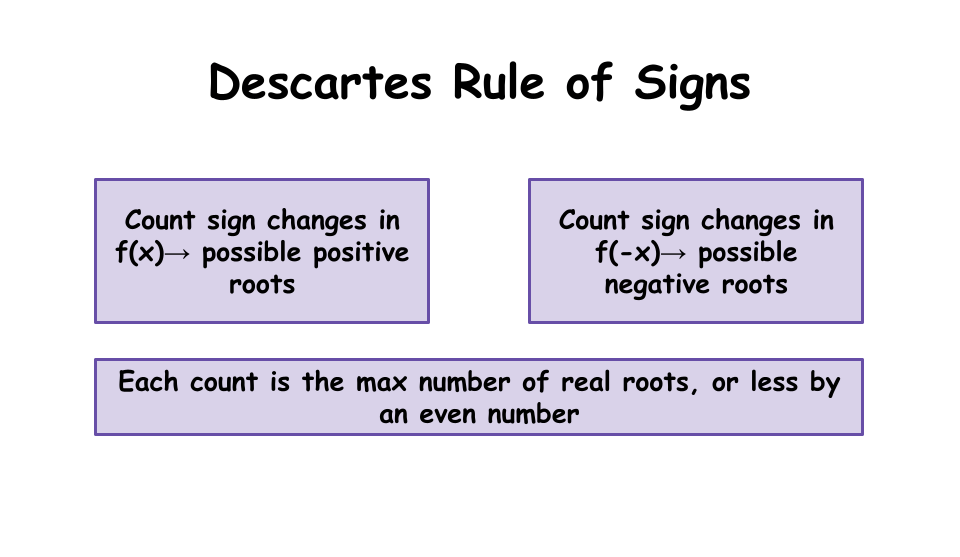
Descartes Rule of Signs
Count sign changes in f(x) → possible positive roots
Count sign changes in f(−x) → possible negative roots
Each count = max number of real roots, or less by an even number

Image source: by Anusha Rahman

Let’s start with positive roots. First, write your polynomial in standard form, from highest to lowest exponent. Then look at the signs of the numbers in front of the terms. Every time the sign changes from plus to minus or minus to plus, that’s called a sign change. The number of positive real roots is equal to the number of sign changes, or less than that by an even number.

To find the number of negative real roots, you do one extra step. Replace every xx in the polynomial with –x–x and simplify. Then, count the sign changes again, just like before. That tells you the number of possible negative roots.

This rule doesn’t tell you exactly how many roots, but it gives you a good idea. For example, if there are 33 sign changes, you could have 33, or 11 positive roots (3–2=1)(3 – 2 = 1).

Type a concept, like “slope” or “photosynthesis”.

↑ ↓ to choose · Enter to openSearch explanations and problems