Illustrated · 2 min
Electrostatic Interactions
What are Electrostatic Interactions?
-
There are two types of electrostatic interactions: Electrostatic attractions, and electrostatic repulsions.
-
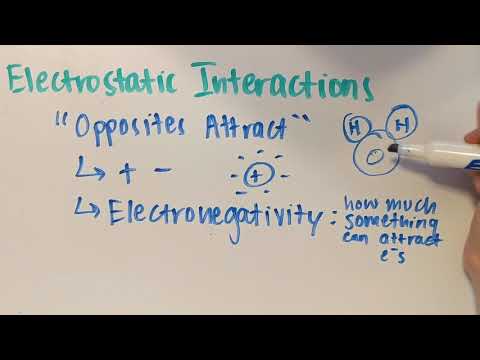
Electrostatic Attractions are interactions between opposite charges.
- The attraction wants to pull the opposite charges together.
- Ionic bonds are formed by the electrostatic attractions between ions.
- Covalent bonds are formed by electrostatic attraction between the nuclei's protons and the shared electron pair.
- Electrostatic attraction also happens between molecules or atoms. But, it doesn't form a bond. Instead, they interact with each other via partial charges or dipoles.
- Electrostatic Repulsions are interactions that occur between molecules that have the same partial charges.
- The repulsion wants to push the like charges away from each other.
- These molecules don’t actually form a bond, but they interact with each other if they are in close proximity to the same charge.

Image source: Caroline Monahan
What are Partial Charges?
- Partial Charges occur when an atom within a molecule is more electronegative than the other atoms. The electrons are pulled towards that atom. What's the result? That atom has a partial negative charge. The other atoms have a partial positive charge. We say that the bond is polar covalent.
- Partial charges are the basis of Van der Waal's forces.
- London dispersion forces are dipoles created by the random movement of electrons. Sometimes, more electrons congregate on one side of the atom or molecule. So, one side is slightly positive the other is slightly negative.
- Dipole-dipole interactions occur between polar covalent molecules. Because they have partial charges they can attract each other.
- Hydrogen bonding, is a special case of dipole-dipole interactions. Hydrogen's electronegativity is small. So, when it bonds with very electronegative elements, (oxygen, nitrogen, or the halogens) a strong dipole is created.
- Ion-dipole interactions occur between ions and polar covalent molecules. This is common in decomposition reactions. For example, let's say we dissolve sodium chloride in water. Water is the universal solvent! The water molecules' partial positive attracts and stabilizes the chloride anion. The water's partial negative attracts and stabilizes the sodium cation.

Image source: Caroline Monahan