Структура йонних сполук

Before this, knowЕлектростатична взаємодія

Illustrated · 1 min

Covalent bonds can be either polar or nonpolar. Molecules share electrons. Meanwhile, ionic compounds do not share electrons. Instead, the more strongly electronegative ion steals the electrons.

Image by: Valeri Natole

Ionic bonds are composed of two oppositely charged ions, called cations and anions. The opposite charges attract, and the positively charged ion 'steals' an electron from the negatively charged one. This is a bit different from covalent bonds, in which electrons are 'shared' between the two atoms.
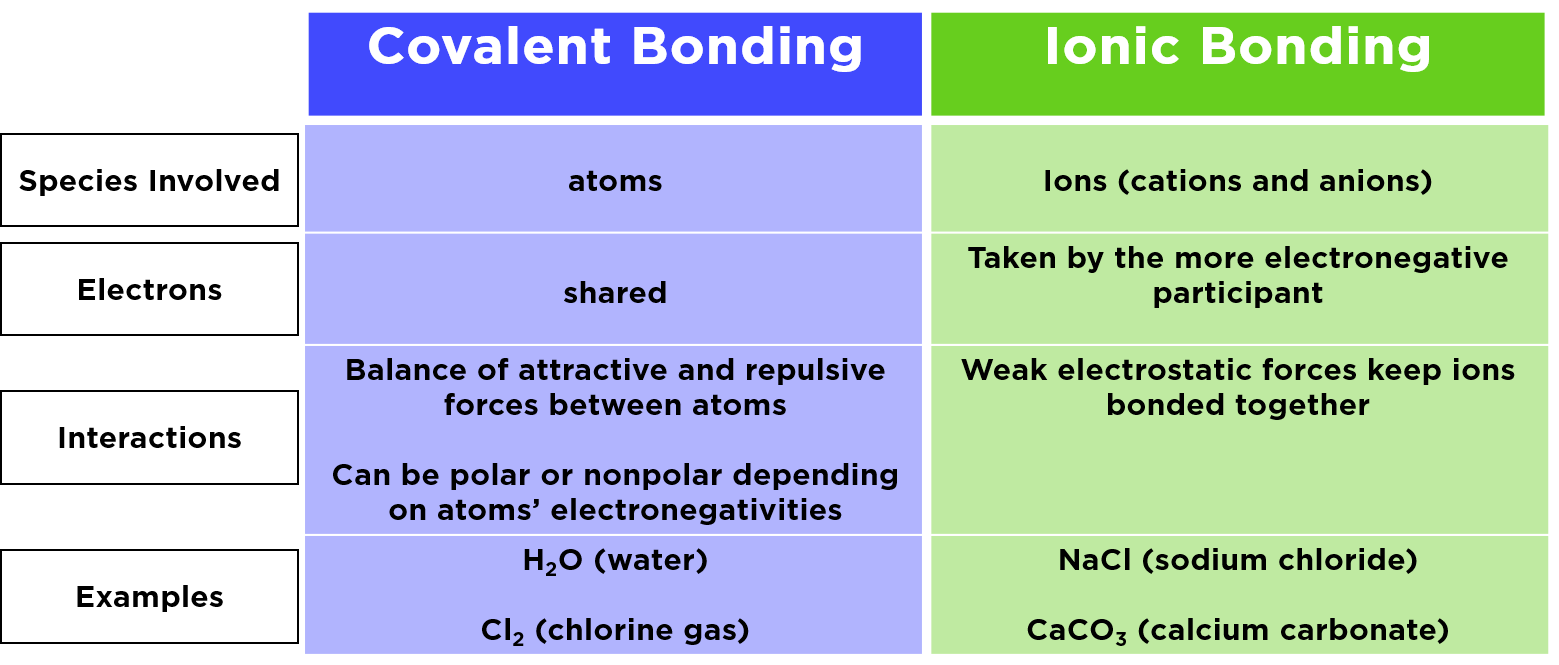
This table shows the differences between covalent bonding and ionic bonding. In covalent bonds, atoms are involved. Electrons are shared between them. It is a balance of attractive and repulsive forces between atoms. The bond can be polar or nonpolar depending on the atoms' electronegativities. Examples include H2O (water) and Cl2 (chlorine gas).

In ionic bonds, ions (cations and anions) are involved. Electrons are taken by the more electronegative participant. Weak electrostatic forces keep the

Image by: Valeri Natole

In ionic compounds, the positive and negative ions arrange themselves into a crystal in order to minimize their electric potentials. Let's examine what this means. Consider the prototypical ionic compound, Sodium Chloride (NaClNaCl). NaClNaCl is composed of positive Na+Na^{+} ions and negative Cl−Cl^{-} ions in a 1 to 1 ratio. These ions want to attract oppositely charged ions as close as possible and push ions with the same charge as far away as possible. If we were to arrange a bunch of these ions together into a plane, it may not be surprising that they arrange themselves into a checkerboard pattern.

A diagram of sodium chloride

Image by Jasper Brown

In such a pattern, every positive ion is surrounded by negatively charged ions, and every negative ion is surrounded by positive ions. Extending this into the third dimension, checkerboard patterns would layer themselves on top, but each layer would be the inverse of the previous. The alternating pattern creates a crystal. That's why ionic compounds are almost always solids and have massive melting temperatures.

Illustrated · 1 min

Diagram of the magnetic field of a horseshoe magnet, depicting the attraction between opposite poles.

Diagram of the magnetic field of a horseshoe magnet, depicting the attraction between opposite poles. Image source: By Geek3 CC BY 2.0, via Wikimedia Commons

Just like negative and positive poles of magnets, negative ions, called anions, and positive ions, called cations are attracted to each other.

In chemistry and life, lower energy states are more accessible and more stable. If you've found a low-effort way of doing your household chores, you're less likely to start coming up with new ways that would take more work. In the same way, all chemical reactions lead toward a more stable, lower energy state.

Particles that are attracted to each other have a form of potential energy that allows them to move closer- that pull that you feel when holding two magnets with opposite charges at a small distance from each other. In order to release this energy, they need to move as close to each other as physically possible, to form a combined object with no charge.

That's a more complicated explanation for a rule that makes a lot of intuitive sense- whenever there are charged particles, they will strive to combine together to form a particle with no overall charge. This means that not only will an Mg+2Mg^{+2} ion be attracted to a Cl−Cl^{-} ion, but that when combined, they will form MgCl2MgCl_{2} in order to have a neutral charge.

In order for ions to form in the first place, extra electrons need to be added or removed from an atom. Most often, atoms end up taking electrons from each other to form lower energy, more stable, full outer shells. For example, when Na, which has one outer shell electron, and Cl, which is one electron short of a full octet, collide, Cl will take an electron from Na, creating Na+Na^{+} and Cl−Cl^{-}. This interaction isn't the actual bond they'll form- that comes next, as the Na+Na^{+} and Cl−Cl^{-} are pulled together by their electromagnetic attraction to make a neutral compound.

Video

(Video) Giant Ionic Structures or Lattices | Properties of Matter | Chemistry | FuseSchool

by FuseSchool - Global Education

Did you know that ionic compounds don't exist as single molecules? They actually form huge, repeating lattices. This video has a great animation showing what a lattice looks like and why it forms. You will also learn some properties of ionic compounds.

Interactive · 1 question

Formation of an Ionic Bond:

What is an ionic bond?

Remember: Compounds can contain multiple types of bonds! So one chemical compound can have both a covalent bond and an ionic bond!

How do ionic bonds form?

  • The nonmetal attracts the valence electrons from the metal, causing the metal to lose those valence electrons and become cationic, whereas the nonmetal gains those valence electrons and becomes anionic.
Image showing how fluorine (F) takes the valence electrons from sodium (Na) and becomes anionic (-) while the sodium atom becomes cationic (+)

Image source: By Caroline Monahan

You can also check to see if a molecule is ionic by a simple calculation!

\quad\quad\quad\quad\quadElectronegativity atom 1 - electronegativity atom 2

Now let's try a practice problem!

Which of the following molecules contain an ionic bond?

Choose all correct answers

Type a concept, like “slope” or “photosynthesis”.

↑ ↓ to choose · Enter to openSearch explanations and problems
