Поведінка цілої раціональної функції на нескоінченності

Before this, knowСтандартний вигляд цілої рпціональної функції

Video

(Video) End Behavior of Polynomial Functions

by Dan Ozimek

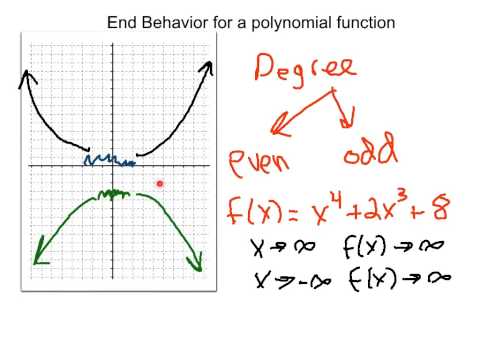
In this video by Dan Ozimek, the concept of "end behavior" when referring to polynomials is described. This is important for understanding what the shape of a graph should look like.

Video

(Video) End Behavior of Polynomial Functions

by NotesCollegeAlgebra

In this video by NotesCollegeAlgebra the end behavior of specific polynomial functions are shown.

Illustrated · 2 min

Polynomial End Behavior

The end behavior of a polynomial is exactly what it sounds like: we want to know what happens to a polynomial function toward the "ends" of the xx-axis. That means we want to describe the behavior of a polynomial as it reaches positive and negative infinity.

As we approach positive infinity on the xx-axis, we the polynomial function can either increase or decrease. The same concept applies to a polynomial approaching negative infinity on the xx-axis: it can either increase or decrease.

We will look at two ways to find the end behavior: graphically and algebraically.

####Graphically

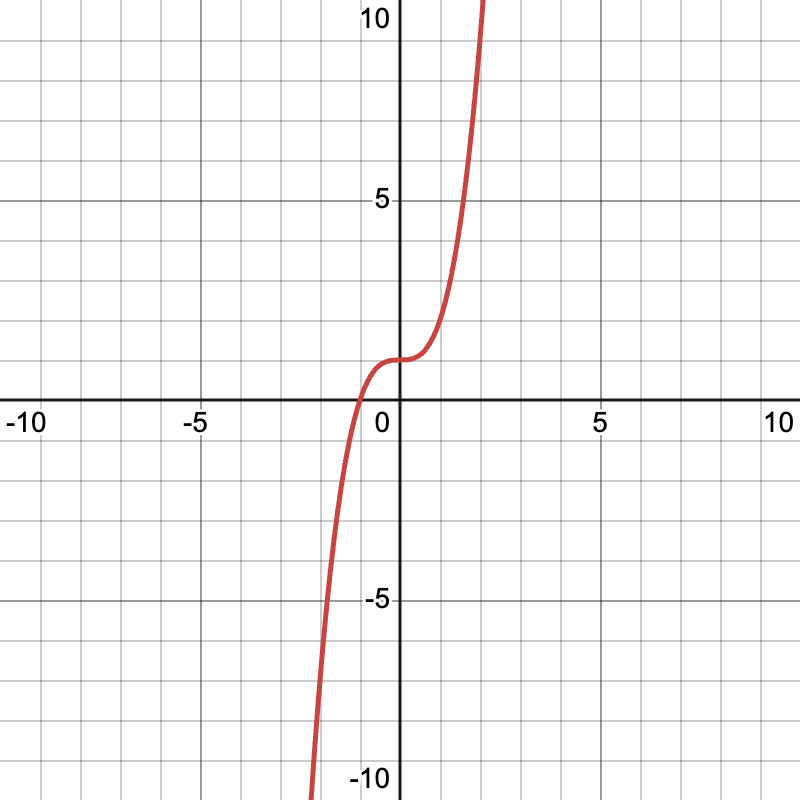
Let's look at the graph of y=x3+1y=x^3 + 1.

Graph of y=x^3 + 1

Graph made using Desmos

Let's first look at the polynomial approaching positive infinity. As the values on the xx axis get bigger, the values in the polynomial also get bigger. As xx approaches positive infinity, f(x)f(x) approaches positive infinity. Mathematically, we write:

x→+∞,f(x)→+∞x \rightarrow +\infty, f(x) \rightarrow +\infty

We can do the same analysis for the other side of the yy-axis. As the values on the xx axis get smaller, the values in the polynomial also get smaller. As xx approaches negative infinity, f(x)f(x) approaches negative infinity. Mathematially, we write:

x→−∞,f(x)→−∞x \rightarrow -\infty, f(x) \rightarrow -\infty

####Algebraically

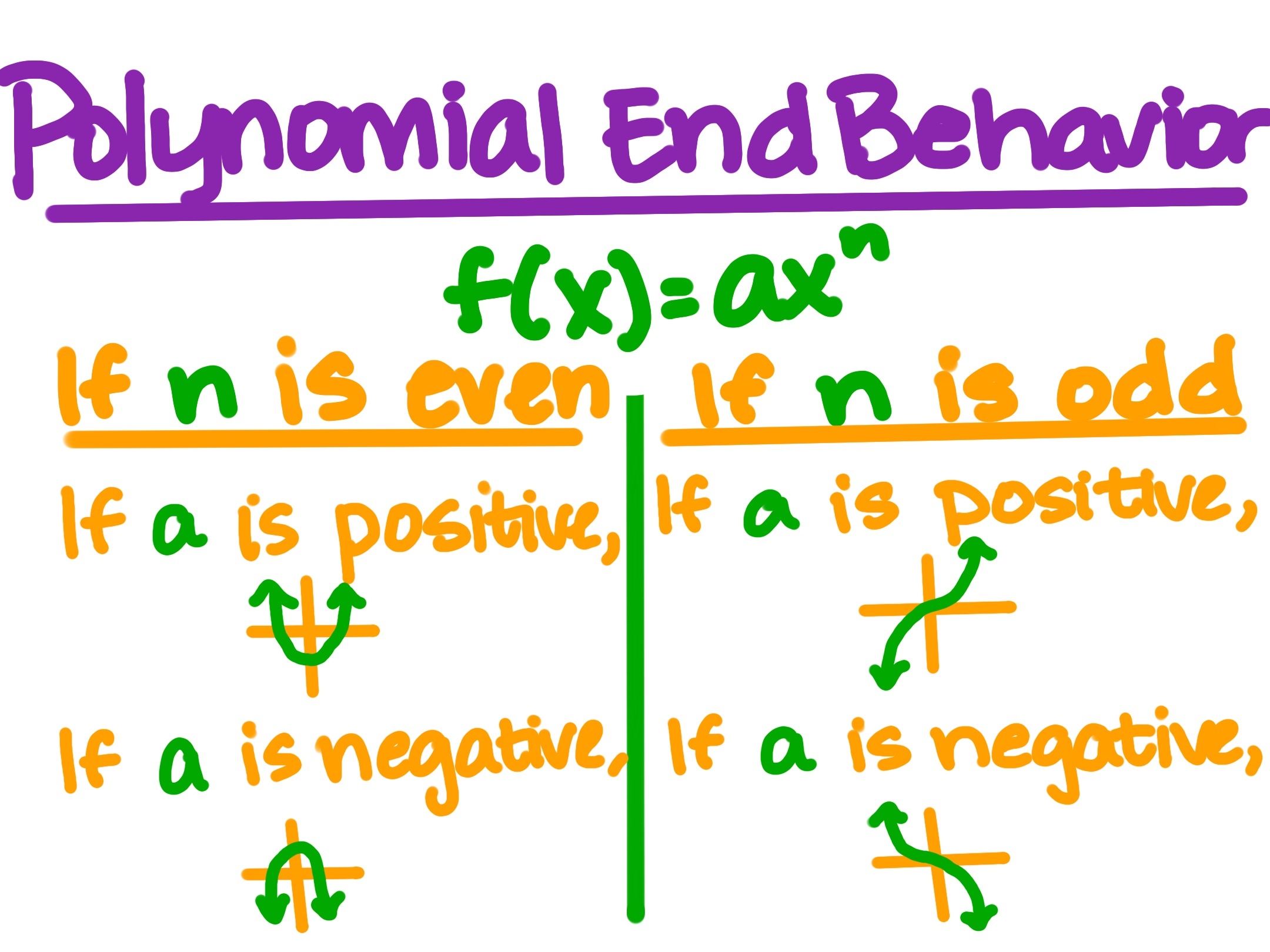
Sometimes, we don't have the graph of the polynomial available to us, but we still want to know the end behavior of a polynomial. We can use the degree of the monomial (nn) and the leading coefficient (aa) to help us.

f(x)=axnf(x) = ax^n

If nn is even: the behavior at both ends of the polynomial are the same.

  • If aa is positive: both ends will approach positive infinity.
  • If aa is negative: both ends will approach negative infinity.

If nn is odd: the behavior at both ends of the polynomial are opposites.

  • If aa is positive: x→+∞,f(x)→+∞x \rightarrow +\infty, f(x) \rightarrow +\infty and x→−∞,f(x)→−∞x \rightarrow -\infty, f(x) \rightarrow -\infty
  • If aa is negative: x→+∞,f(x)→−∞x \rightarrow +\infty, f(x) \rightarrow -\infty and x→−∞,f(x)→+∞x \rightarrow -\infty, f(x) \rightarrow +\infty

####Connecting the Dots

We can see that in the above example, we looked at a continuous function that approaches infinity. It has one turning point, with no global minimum or global maximum. It intersects the xx-axis once.

Illustrated · 1 min

Polynomial End-Behavior

In this next lesson on polynomials, you will learn about polynomial end-behavior, which is the behavior of the ends of a function. Think about where the function goes as it approaches infinity!

Polynomial end behavior
**If $n$ is even: the behavior at both ends of the polynomial are the same.**

- If $a$ is positive: both ends will approach positive infinity.
- If $a$ is negative: both ends will approach negative infinity.


**If $n$ is odd: the behavior at both ends of the polynomial are opposites.**

- If $a$ is positive: $x \rightarrow +\infty, f(x) \rightarrow +\infty$ and $x \rightarrow -\infty, f(x) \rightarrow -\infty$
- If $a$ is negative: $x \rightarrow +\infty, f(x) \rightarrow -\infty$ and $x \rightarrow -\infty, f(x) \rightarrow +\infty$

Image source: by Anusha Rahman

Memorize these rules to understand polynomial end-behavior!

If nn is even: the behavior at both ends of the polynomial are the same.

  • If aa is positive: both ends will approach positive infinity.
  • If aa is negative: both ends will approach negative infinity.

If nn is odd: the behavior at both ends of the polynomial are opposites.

  • If aa is positive: x→+∞,f(x)→+∞x \rightarrow +\infty, f(x) \rightarrow +\infty and x→−∞,f(x)→−∞x \rightarrow -\infty, f(x) \rightarrow -\infty
  • If aa is negative: x→+∞,f(x)→−∞x \rightarrow +\infty, f(x) \rightarrow -\infty and x→−∞,f(x)→+∞x \rightarrow -\infty, f(x) \rightarrow +\infty

Type a concept, like “slope” or “photosynthesis”.

↑ ↓ to choose · Enter to openSearch explanations and problems