Нерівності з квадратними коренями

Before this, knowЗворотні функції та корені

Video · + 1 min read

(Video) Solving an Equation Containing Two Radicals

by PatrickJMT

Here's a video by PatrickJMT where he goes through a problem with radicals on both sides of the equation sign.

Summary\large{\text{Summary}}

The steps are generally:

  1. Isolate your radicals as much as possible.
  2. Square both sides to remove the radicals.
  3. Repeat steps 1 and 2 if necessary until there's no more radical terms.
  4. Solve for xx.
  5. Plug xx values back in to make sure they work.

The example he looks at is: x+3=2x+4−1\sqrt{x+3}=\sqrt{2x+4}-1 As you can see, we have a radical on both sides of the equal sign. To solve for xx, we start by taking the square root of both sides. This will remove the square root on the left, but not the right. (x+3)2=(2x+4−1)2x+3=(2x+4−1)(2x+4−1)\begin{align} \left(\sqrt{x+3}\right)^2&=\left(\sqrt{2x+4}-1\right)^2\\ x+3&=\left(\sqrt{2x+4}-1\right)\left(\sqrt{2x+4}-1\right) \end{align} Next, we want to FOIL the right hand side and isolate the remaining radical. x+3=(2x+4)−2x+4−2x+4+1x+3=2x+4−22x+4+1x+3=2x+5−22x+4−x−2=−22x+4x+2=22x+4\begin{align} x+3&=(2x+4)-\sqrt{2x+4}-\sqrt{2x+4}+1\\ x+3&=2x+4-2\sqrt{2x+4}+1\\ x+3&=2x+5-2\sqrt{2x+4}\\ -x-2&=-2\sqrt{2x+4}\\ x+2&=2\sqrt{2x+4} \end{align} Now, we square both sides again. (x+2)2=(22x+4)2x2+4x+4=4(2x+4)x2+4x+4=8x+16x2−4x−12=0(x−2)(x−6)=0x=2x=6\begin{align} (x+2)^2&=\left(2\sqrt{2x+4}\right)^2\\ x^2+4x+4&=4(2x+4)\\ x^2+4x+4&=8x+16\\ x^2-4x-12&=0\\ (x-2)(x-6)&=0\\ x=2\quad&\quad x=6 \end{align}

Remember that these are potential solutions! When dealing with radicals we can get extraneous solutions so we need to plug them back in and check if they work.

Let's start with x=2x=2. x+3=2x+4−1(2)+3=2(2)+4−15=8−1\begin{align} \sqrt{x+3}&=\sqrt{2x+4}-1\\ \sqrt{(\color{#8925AE}{2})+3}&=\sqrt{2(\color{#8925AE}{2})+4}-1\\ \sqrt5&=\sqrt8-1 \end{align} These are not equal. So x=2x=2 is an extraneous solution.

Let's now check x=6x=6. x+3=2x+4−1(6)+3=2(6)+4−19=16−13=3\begin{align} \sqrt{x+3}&=\sqrt{2x+4}-1\\ \sqrt{(\color{#8925AE}{6})+3}&=\sqrt{2(\color{#8925AE}{6})+4}-1\\ \sqrt9&=\sqrt{16}-1\\ 3&=3 \end{align} These are equal. Therefore, x=6\boxed{x=6} is the solution.

Test Yourself: Solve 4x+1−x+3=2\sqrt{4x+1}-\sqrt{x+3}=2

Choose all correct answers

Video · + 1 min read

(Video) Radical Equations

by yaymath

Here's a video by yaymath showing you how to solve a radical equation where the radical is on both sides.

Summary\large{\text{Summary}}

When this happens, we want to take the square root of both sides and then simplify. If there are any remaining radicals, take the square root again.

Let's look at the example he does. x−15=3−x\sqrt{x-15}=3-\sqrt x As you can see, we have a radical on both sides. So, we square both sides. (x−15)2=(3−x)2x−15=(3−x)(3−x)\begin{align} \left(\sqrt{x-15}\right)^2&=\left(3-\sqrt x\right)^2\\ x-15&=\left(3-\sqrt x\right)\left(3-\sqrt x\right) \end{align} Multiplying the binomials on the right hand side, we get: x−15=9−3x−3x+xx−15=9−6x+x\begin{align} x-15&=9-3\sqrt x-3\sqrt x+x\\ x-15&=9-6\sqrt x+x \end{align} The next step is to isolate our remaining radical. x−15=9−6x+x−15=9−6x−24=−6x4=x\begin{align} x-15&=9-6\sqrt x+x\\ -15&=9-6\sqrt x\\ -24&=-6\sqrt x\\ 4&=\sqrt x \end{align} Finally, square both sides and solve. (4)2=(x)216=x\begin{align} \left(4\right)^2&=\left(\sqrt x\right)^2\\ 16&=x \end{align}

But wait! When it comes to radicals, you need to plug the solutions back in and check if they actually work. "Solutions" that don't work are called extraneous solutions.

So, plug in x=16x=16 into the original equation. x−15=3−x(16)−15=3−(16)1=3−41≠−1\begin{align} \sqrt{x-15}&=3-\sqrt x\\ \sqrt{(\color{#8925AE}{16})-15}&=3-\sqrt{(\color{#8925AE}{16})}\\ \sqrt 1&=3-4\\ 1&\ne-1 \end{align} Since these aren't equal, x=16x=16 is an extraneous solution. Therefore, this equation has no solution.

Test Yourself: Solve 2x−10=4+x−3\sqrt{2x-10}=4+\sqrt{x-3}

Choose all correct answers

Illustrated · 1 min

Example Walkthrough

Note that there is a difference between:

  1. Eliminating radicals in the denominator
  2. Eliminating radicals in an equation

Remember, we can manipulate an expression, but we need to make sure it still equals to its old form. Let's take a look at a few examples:

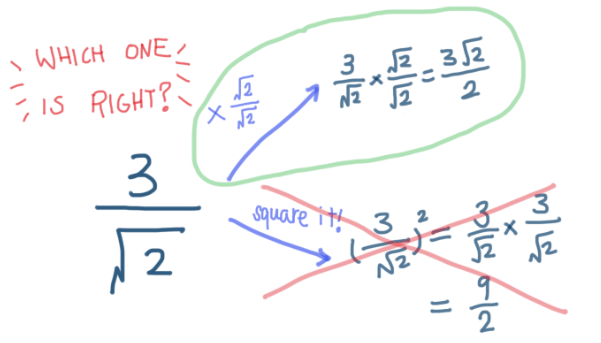
How do we get rid of the square roots? We can square an expression or rationalize the denominator...

Image source: by Christine

Consider Both Methods

In the ×22\times \frac{\sqrt{2}}{\sqrt{2}} case, we are multiplying the original expression with 1.

In the square it case, we are multiplying the original expression with 32\frac{3}{\sqrt{2}}.

Therefore, we should go with the first method.

We prefer to rationalize denominators as opposed to squaring an expression.

Image source: by Christine

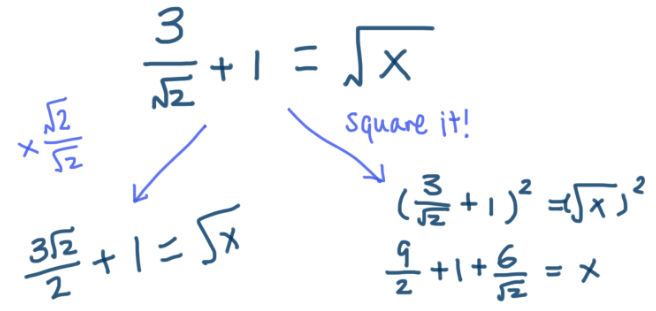
Let's take a look at another example:

We always want to get rid of the square root in a way that does not change the value of the expression.

Image source: by Christine

The ×22\times \frac{\sqrt{2}}{\sqrt{2}} method doesn't change the equation, since we are multiplying by 1.

The square it method also doesn't change the equation, since both sides are squared.

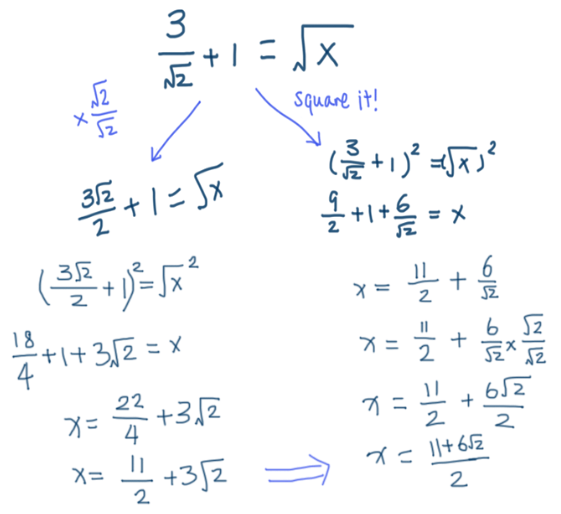
Both are correct! However, we need to simplify the equations further.

If the variable is in the square root, the easiest way to get it out is to square it

Image source: by Christine

Interactive · 1 question

Before diving into this lesson, it may be helpful to review how to solve exponential equations and exponent properties. That mindset may be helpful when tackling this next lesson.

Eliminating Radical Terms in Equations

Sometimes, in order to isolate the variable in an equation, we have to eliminate the radical terms. For example, if we have the following equation... x+2=5\sqrt{x+2} = 5

To "get rid of" the radical terms without changing the actual relationship between the numbers and variables, we square both sides of the equation. (x+2)2=52((x+2)12)2=25x+2=25x=23\begin{align} (\sqrt{x+2} )^2 = 5^2\\ ((x + 2)^{\frac{1}{2}} )^2=25\\ x+2=25\\ x=23 \end{align}

Since we are dealing with radicals, we have to be extra careful! Let's think about if we can always square both sides of an equation without consequences.

For example, take a look at the equation below: y=−x\sqrt{y}=-x

We proceed by squaring the both sides: (y)2=(−x)2y=x2\begin{align} (\sqrt{y})^2&=(-x)^2\\ y &=x^2\\ \end{align}

Notice how some numbers that work in y=x2y=x^2 might not work in y=−x\sqrt{y}=-x. Think about what would happen if xx is 99. Think about what would happen if xx is any positive number.

Consider y=−x=−9\sqrt{y}=-x=-9. The square root of a number can never be negative!

Therefore, whenever you square the both sides of an equation to get rid of the radical terms, make sure to double check for extraneous solutions in the end.

Here is an example problem:

Solve for x.x.

x−5=6\sqrt{x-5} = \sqrt{6}
Choose one answer

Type a concept, like “slope” or “photosynthesis”.

↑ ↓ to choose · Enter to openSearch explanations and problems