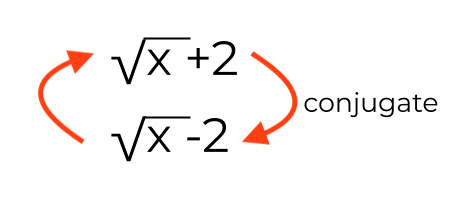
To rationalize a denominator, you need to multiply the top and bottom by the conjugate of the denominator. A conjugate is the same two term expression but with the sign in the middle changed. So, for example, if you have 3+2, the conjugate would be 3−2.
Example 1:
5−23
To rationalize this denominator, we multiply both the top and bottom by the conjugate 5+2.
5−23⋅5+25+2=25+25−25−43(5+2)=5−435+6=35+6
Example 2:
7+34
What is the conjugate needed to rationalize the denominator?
Multiplying the top and bottom by this conjugate, we get:
7+34⋅7−37−3=7−94(7−3)=−247−12=−27+6
Conjugates also work when there are variables. Let's look at the example:
x−2x
In this example, the conjugate is x+2.
x−2x⋅x+2x+2=x2+2x−2x−4x(x+2)=x−4xx+2x
The problems run from approachable to very hard, and each is rated by how often real students solve it, so you can pick your next step. These are real problems from the AMC 10 and AMC 12, the national math competitions for middle and high school students, each with a worked solution on LIVE by Po-Shen Loh.
Multiply a radical expression by its conjugate to simplify
Radicals are complex and messy all the time, but they're easier to handle in some places than others. For example, an expression is considered more "complex" if it has a radical in its denominator than if it has a radical in its numerator. Let's think about what we should do if we're stuck with a radical at the bottom of your fraction.
Multiply it by the conjugate! Or, more accurately, multiply both the numerator and the denominator by the conjugate. This will essentially move the radical to the numerator, leaving you with a radical-free denominator.
Let's try it out: simplify √(5x)+410
This fraction is relatively simple, but there's a radical in the denominator. To deal with it, we have to get the radical out, which we can do by multiplying both levels of the fraction by the denominator's conjugate.
The conjugate of 5x+4 is 5x−4, which we find by simply flipping the sign of the second term.
Next, we can multiply both parts of the fraction by the conjugate, which essentially amounts to multiplying the whole number by 1.
Numerator first: What is 10∗(5x−4)?
10∗(5x−4)=105x−40. Now we have our numerator!
While you could get the 10 within the radical (500x−40) by squaring it and slipping it in, that wouldn't have been the simplest form of the equation so it really would have just been extra work for you. Instead, keep the new number outside the radical.
Next, let's find the denominator. What is (5x+4)∗(5x−4)? Simplify your answer all the way.
(5x+4)∗(5x−4)=5x−16. Remember that when multiplying two conjugates (a+b and a−b together, the result is always a2−b2. If we do the work, we can see that the two middle terms that would typically appear when multiplying two binomials together seem to cancel each other out:
Now we have 105x−40 as our numerator and 5x−16 as out denominator, or: 5x−16105x−40. This may look more complicated than the fraction we had at the beginning of the problem, but the most important thing is that the radical is no longer in the denominator.
Your first instinct may be to wonder why we rationalize the denominator. A lot of the time, the standard is to keep radicals out of the denominator. The video above from Patrick JMT is a good video explaining how to rationalize the denominator.
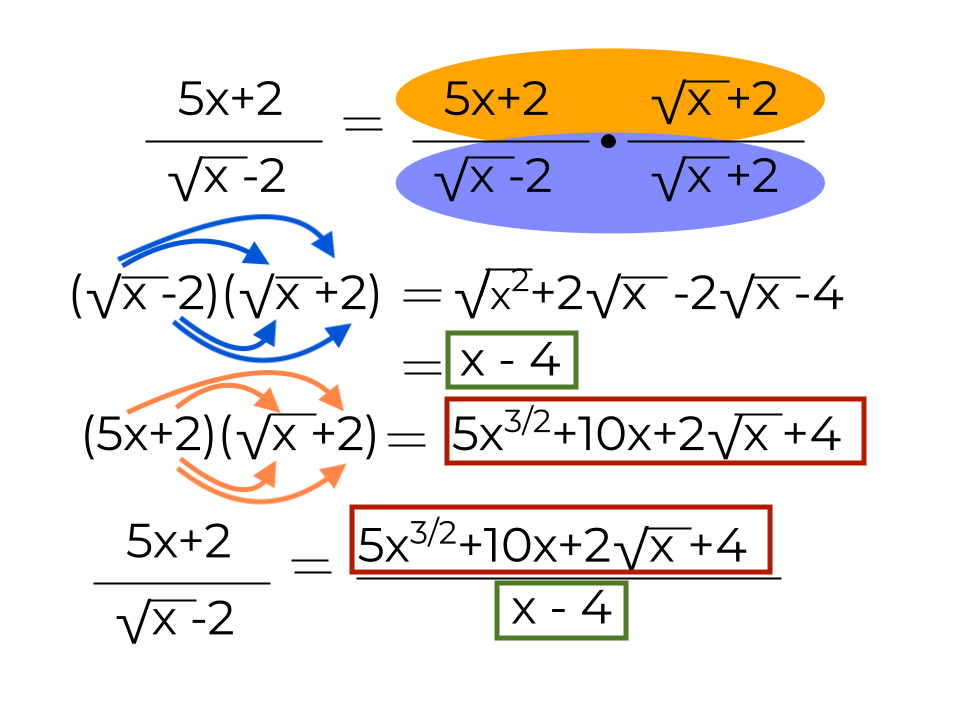
To simplify expressions that have a root in the denominator we multiply the numerator and denominator by the conjugate.
Image source: by Amy Feraco
The conjugate is the same expression but with a different sign. Let's try to rationalize the expression (x−25x+2). If you think you can solve it yourself, try it! Then press continue to see the problem worked out!
Image source: by Amy Feraco
Now, let's try some other practice problems.
Rationalize the following expression: (x+1x−1)
The correct answer is x−1. We start by multiplying by the conjugate.
(x+1x−1)=(x+1x−1)(x−1x−1)=(x+1x−1)(x2−x+x−1)=(x+1x−1)(x−1)=(x+1x−1)(x−1)=x+1
Rationalize the following expression: (1−xx)
The correct answer for this one is 1−xx+xx. Let's look at what happens when we multiply by the conjugate.
The goal of this lesson is to learn how to simplify fractions with a radical in the denominator. Ultimately, we will get rid of the radical in the denominator. You can also think of it as getting rid of the square root (or cube root) from the bottom, and moving the radical to the top.