Формула Ейлера

Before this, knowПолярна форма запису комплексного числа

Interactive · 1 question

Euler's Formula

Maybe you remember learning about the infamous Leonhard Euler a while back....he's got another formula!

Euler's Formula states that eiφ=cos⁡φ+isin⁡φe^{i\varphi}=\cos \varphi + i\sin \varphi for any real number φ.\varphi.

This formula is one of the most important contributions to complex analysis −- and it will be very helpful when you are trying to solve equations with complex numbers! Here's an illustration of how Euler's Formula works in the complex plane.
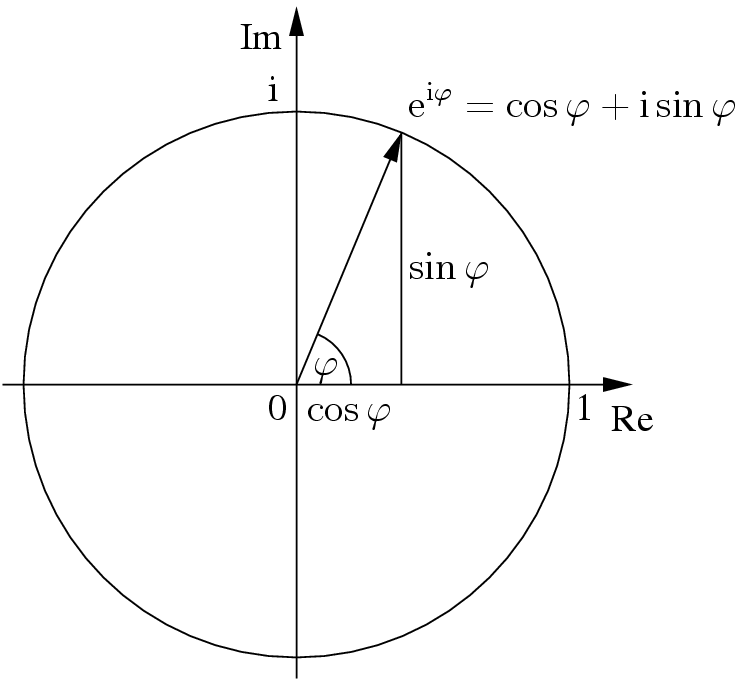
Illustration of Euler's Formula in the complex plane: a unit circle with an arbitrary plotting of the point e^{i phi}=cos phi + i*sin phi

Illustration of Euler's Formula in the complex plane.

By Gunther - Own work, CC BY-SA 3.0, WIkimedia Commons

You already know how to plot sine and cosine on the unit circle when given an angle, φ.\varphi. Now, we can do the same thing, but in terms of e!e! Given a real number, φ,\varphi, we can plot the complex number eiφe^{i\varphi} on the unit circle, since eiφ=cos⁡φ+isin⁡φ.e^{i\varphi}=\cos \varphi + i\sin \varphi. If you need a refresher on how to graph complex numbers, click here.

Since the complex number eiφe^{i\varphi} is on the unit circle, it has a magnitude of 1,1, and it makes an angle of φ\varphi with the positive real axis. If you vary φ,\varphi, you can plot every point on the unit circle!

Basically, the big takeaway is that you can write cos⁡φ+isin⁡φ\cos \varphi + i\sin \varphi as eiφ.e^{i\varphi}. This will come in handy later, especially when we are learning how to put complex numbers in exponential form. For now, let's do a quick example to see if you feel comfortable with the formula.

Simplify eπ2i.e^{\frac{\pi}{2}i}.

Choose one answer

Interactive · 1 question

At this point, we understand expressions such as aba^b, for real numbers aa and bb. Now let's think about how we evaluate aza^z, for a complex number zz.

At first, this question may seem unmotivated and nonsensical, but extending exponents to the complex numbers has many uses in math and physics. It is a wonderful example of the power of math to unify different concepts. Complex exponents unify geometry and complex numbers, for example, and allow us to see a "bigger picture" when investigating AC circuits in physics.

Complex exponents do not make much sense given the traditional definition of exponents. However, as with other problems, we begin with what we do know. Any complex number zz can be written as x+yix+yi, for real xx and yy. As a result, aza^z becomes ax+yia^{x+yi}.

Now, we need a good definition for what this should be. We start from the basics: we still want ep+q=epeqe^{p+q}=e^pe^q even for complex exponents. As a result,

\begin{equation} a^z=a^{x+yi}=a^x a^{yi}. \end{equation}

We can handle axa^x, since aa and xx are real. But ayia^{yi} just seems unreal.

Euler's equation (one of numerous) answers just this question. It is a jewel of mathematics. We claim that

\begin{equation} e^{i \theta}=\cos\theta+i\sin\theta. \end{equation}

At this point, you may already guess at the aforementioned connections between complex numbers and geometry. Let's look at where this equation comes from.

It is important to keep in mind that this is a definition for eiθe^{i \theta}. It is, in fact, the best definition.

A knowledge of calculus helps to explain Euler's formula, but feel free to take this on faith for now (as this is Algebra 2). We have, from the theory of Taylor series, that \begin{equation} e^z=1+z+\frac{z^2}{2!}+\frac{z^3}{3!}+\frac{z^4}{4!}+... \end{equation} \begin{equation} \cos z=1-\frac{z^2}{2!}+\frac{z^4}{4!}-\frac{z^6}{6!}... \end{equation} \begin{equation} \sin z=z-\frac{z^3}{3!}+\frac{z^5}{5!}-\frac{z^7}{7!}..., \end{equation}

for all complex numbers zz.

Now, let z=iθz=i \theta in the first equation above. Consider the sum of all the even powers of θ\theta in this expansion.

The sum of the even powers of θ\theta in eiθe^{i \theta} is exactly cos⁡θ\cos\theta ! Also verify that the sum of the odd powers of θ\theta is isin⁡θi\sin\theta.

One of the wonderful things about this formula is that the trigonometric functions can be redefined in terms of complex exponents.

Do you see how we can define cos⁡z\cos z with complex exponents?

Choose all correct answers

Illustrated · 1 min

Euler's Formula for Complex Numbers

We are familiar with Euler's Identity with rectangular coordinates, but something happens when we add complex numbers to the mix: the formula changes!

Euler's Formula for Complex Numbers
e^ix = cos(x) + i sin(x)

Image source: by Anusha Rahman

Remember that:

In the next lesson, you will learn about the exponential form of a complex number.

Video

Euler's formula and continuous rotations

by All Angles

In this video by All Angles, you will learn more about Euler's Formula.

Type a concept, like “slope” or “photosynthesis”.

↑ ↓ to choose · Enter to openSearch explanations and problems

