Полярна форма запису комплексного числа

Interactive · 2 questions

The most typical way to express a complex number would be to decompose it into its real and imaginary components, i.e. z=a+biz=a+bi. This is called the rectangular form of a complex number, and it's easy to see why. We can imagine plotting all complex numbers on a plane parametrized by rectangular coordinates, with the real and imaginary components serving as the x- and y-coordinates, respectively.

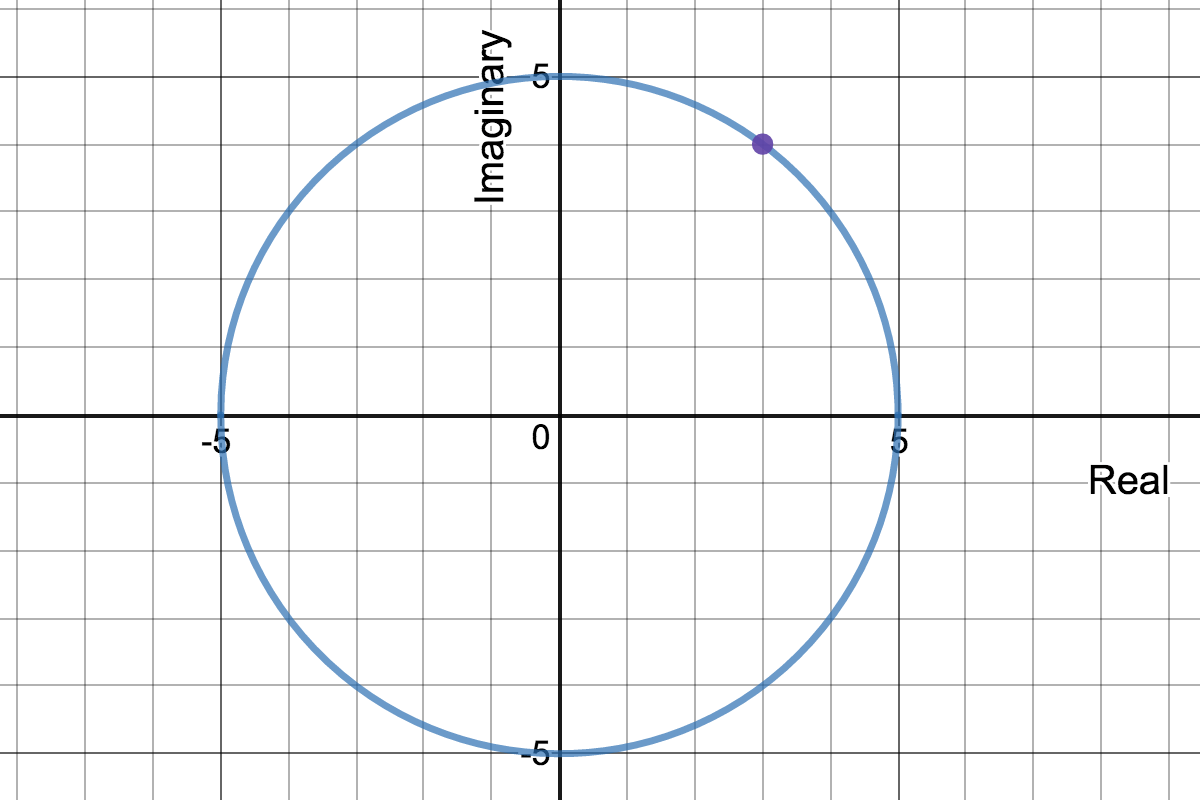
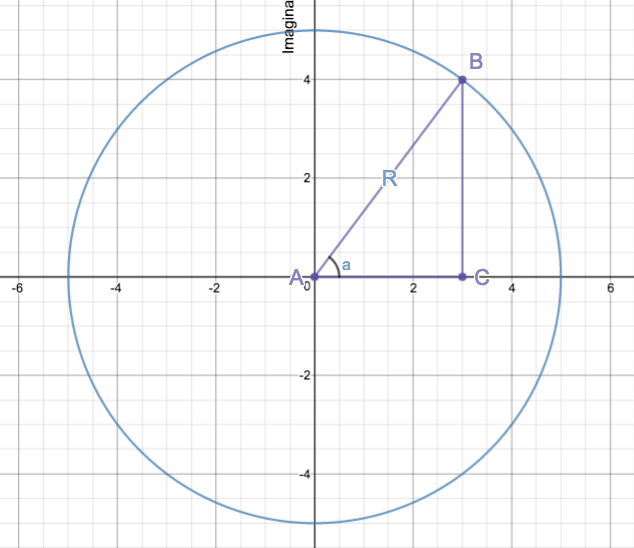
However, if we visualize complex numbers as points on a plane, then switching from rectangular to polar coordinates gives us another way to think of complex numbers. We can express a complex number in terms of its distance from 00, rr, and the angle θ\theta that the ray from 00 to the number makes with the positive real axis. This angle is measured counterclockwise, as it is in polar coordinates.

The distance from a number to 00 is call the absolute value or magnitude of the number. Note that this definition is simply a generalization of the definition of absolute value of a real number. The previously described angle is called the argument of a number. For example, if z=1+iz = 1 + i, we would write ∣z∣=2|z| = \sqrt{2} and arg⁡(z)=π/4\arg(z) = \pi/4.

It should be relatively easy to see that, if a complex number zz has magnitude rr and argument θ\theta, then: z=r(cos⁡θ+isin⁡θ)z = r(\cos\theta + i\sin\theta) This is called the polar form of a complex number.

Thus, if you want to convert from polar form to rectangular form, remember that Re(z)=rcos⁡θRe(z) = r\cos\theta and Im(z)=rsin⁡θIm(z) = r\sin\theta.

If you want to convert a complex number z=a+biz = a+bi from rectangular from to polar form, then use the following conversions, which are also quite easy to show: r=a2+b2r = \sqrt{a^2+b^2} tan⁡θ=ba\tan\theta = \frac{b}{a}

For convenience, we sometimes write z=rcisθz = r\mathrm{cis}\theta. This shorthand is used because "cis" has the first letter of cosine, the letter i, and the first letter of sine.

Clearly, adding numbers would be a disaster, unless we convert to rectangular form and then convert back, which negates the whole point of using a different form.

Polar form is incredibly useful for multiplication. Prepare yourselves for one of the most important and mind-blowing fact about complex numbers. Let's see what happens when we multiply two complex numbers, rcisαr\mathrm{cis}\alpha and scisβs\mathrm{cis}\beta:

(rcisα)(scisβ)=[r(cos⁡α+isin⁡α)](s(cos⁡β+isin⁡β))(r\mathrm{cis}\alpha)(s\mathrm{cis}\beta) = [r(\cos\alpha + i\sin\alpha)](s(\cos\beta + i\sin\beta)) (rcisα)(scisβ)=rs(cos⁡α+isin⁡α)(cos⁡β+isin⁡β)(r\mathrm{cis}\alpha)(s\mathrm{cis}\beta) = rs(\cos\alpha + i\sin\alpha)(\cos\beta + i\sin\beta) (rcisα)(scisβ)=rs[(cos⁡αcos⁡β−sin⁡αsin⁡β)+i(sin⁡αcos⁡β+cos⁡αsin⁡β)](r\mathrm{cis}\alpha)(s\mathrm{cis}\beta) = rs[(\cos\alpha\cos\beta - \sin\alpha\sin\beta) + i(\sin\alpha\cos\beta + \cos\alpha\sin\beta)]

The two terms in parentheses should look very familiar.

What is cos⁡αcos⁡β−sin⁡αsin⁡β\cos\alpha\cos\beta - \sin\alpha\sin\beta?

Choose one answer

Math as a puzzle

Many contest problems feel more like puzzles than homework. They are a good way to find out how much fun math can be. These are real problems from the AMC 12 and AIME, the national math competitions for middle and high school students, each with a worked solution on LIVE by Po-Shen Loh.

Interactive · 4 questions

Graphical Explanation

As a refresher, a complex number is a number that can be written in the form a+bia + bi where aa and bb are real numbers and i=−1i = \sqrt{-1}.

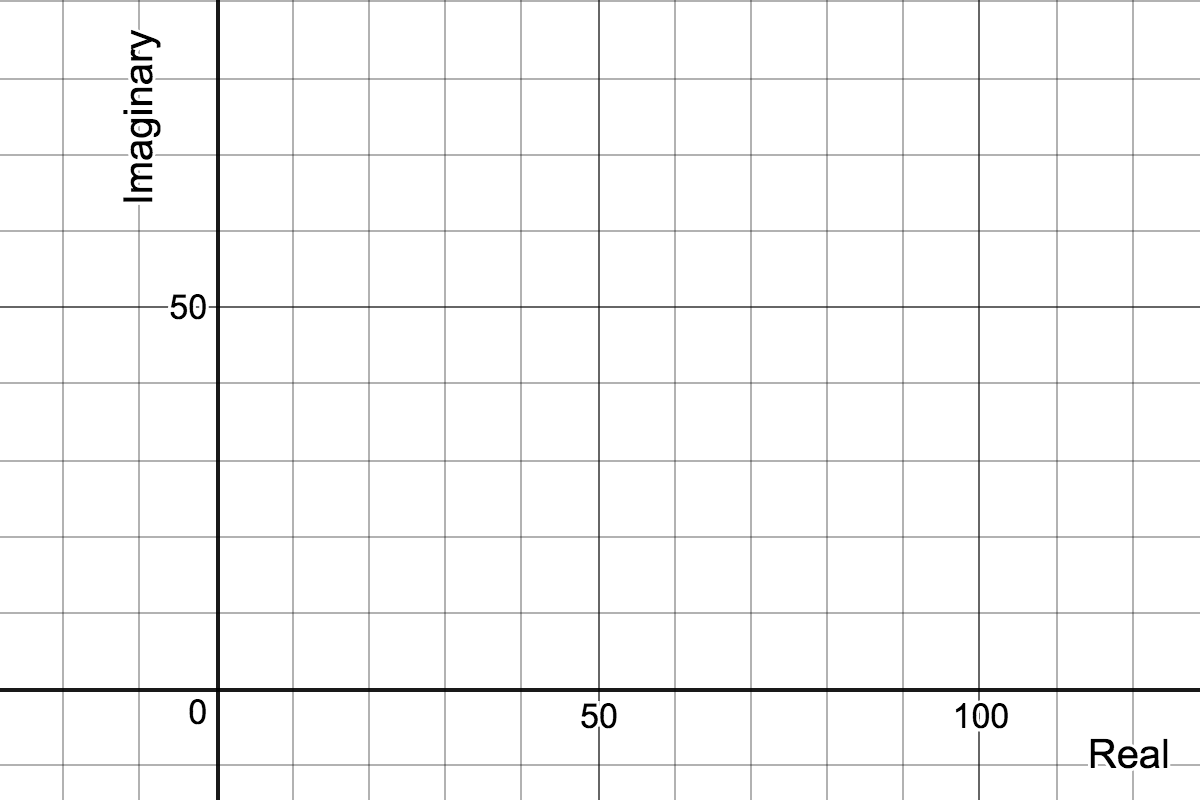
With that out of the way, allow me to introduce to you the complex plane. Here is a picture:

A coordinate plane with "real" in the x-axis and "imaginary" for the y-axis.

Created by Desmos

This graph looks almost identical to the normal coordinate plane! The only difference is that instead of the xx-axis we have the real axis and instead of the yy-axis we have the imaginary axis. So, the real axis is the horizontal axis, and the imaginary axis is the vertical axis.

With this information, try doing the following question using intuition:

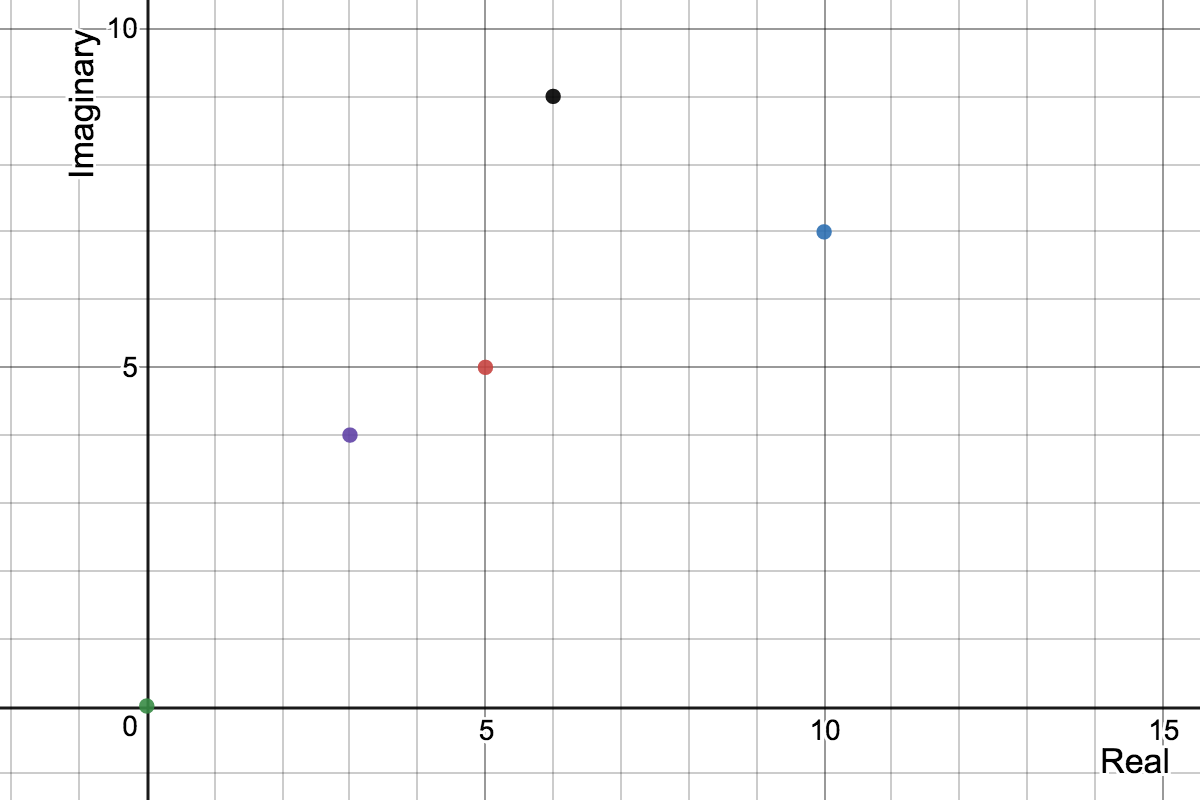
Points on a complex plane/graph at (0,0), (3,4), (5,5), (6,9), (10,7)

Created by Desmos

What is the color of the point representing the complex number 3+4i3+4i?

Choose one answer

Interactive · 1 question

Algebraic Explanation

We want to express a+bi=R(cos⁡θ+isin⁡θ)a + bi = R(\cos \theta + i\sin \theta). This means the magnitude of the left hand side and right hand side must match. Therefore

a2+b2=R2cos⁡2θ+R2sin⁡2θ=Rcos⁡2θ+sin⁡2θ\sqrt{a^2+b^2} = \sqrt{R^2 \cos^2 \theta + R^2 \sin^2 \theta} = R \sqrt{\cos^2 \theta + \sin^2 \theta}.

Recall that cos⁡2θ+sin⁡2θ=1\cos^2 \theta + \sin^2 \theta = 1. Therefore, R=a2+b2R = \sqrt{a^2+b^2}.

Now, we use the fact that the real part and imaginary part's must match. In particular

Rcos⁡θ=aR \cos \theta = a cos⁡θ=aa2+b2\cos \theta = \frac{a}{\sqrt{a^2+b^2}}

and

Rsin⁡θ=bR \sin \theta = b

sin⁡θ=ba2+b2\sin \theta = \frac{b}{\sqrt{a^2+b^2}}.

Notice that ∣a∣≤∣a2+b2∣|a| \le |\sqrt{a^2+b^2}| as if we square both sides

b2≥0b^2 \ge 0 a2+b2≥a2a^2 + b^2 \ge a^2 a2+b2≥a\sqrt{a^2+b^2} \ge a

where the last step is valid because both sides are necessarily positive. Think about why it is important that ∣a∣≤a2+b2|a| \le \sqrt{a^2+b^2}.

If ∣a∣>a2+b2|a| > \sqrt{a^2+b^2} then ∣cos⁡θ∣>1|\cos \theta| > 1 which is impossible! Also, under these equations we have

cos⁡2θ+sin⁡2θ=a2a2+b2+b2a2+b2=a2+b2a2+b2=1\cos^2 \theta + \sin^2 \theta = \frac{a^2}{a^2+b^2} + \frac{b^2}{a^2+b^2} = \frac{a^2+b^2}{a^2+b^2} = 1.

All these together imply that these will produce valid solutions for θ\theta.

What is the polar form of 5+5i35 + 5i\sqrt{3}?

Choose one answer

Video

How to Express a Complex Number in Polar Form

by David Wright

In this video by David Wright, you will learn how to write a complex number in polar form.

Illustrated · 1 min

The Polar Form of a Complex Number

We've learned previously that a complex number has two parts: a real part and an imaginary part.

z=a+biz = a + bi

, where aa is the real part and bb is the imaginary part.

But we can also write complex numbers using polar coordinates: the polar form of a complex number.

Polar Form of a Complex Number
z=r(cos(theta) + i sin (theta))
r = modulus (length)
theta = argument (angle)

Image source: by Anusha Rahman

In polar form, a complex number is written as:

z=r(cos⁡θ+isin⁡θ)z = r(\cos \theta + i \sin \theta)

We can also write it more simply, using Euler's formula:

z=rcisθz = r \text{cis} \theta

In both equations, rr is the modulus (or length) of the complex number, and θ\theta is the argument (or angle) it makes with the positive xx-axis.

To find rr, use the formula:

r=a2+b2r= \sqrt{a^2 + b^2}

To find θ\theta, use the formula:

θ=tan⁡−1(ba)\theta = \tan ^{-1} (\frac{b}{a})

The polar form is especially helpful for multiplying and dividing complex numbers. In polar form, multiplying is straightforward: you multiply the rr values and add the angles. Dividing complex numbers means dividing the rr values and subtracting the angles. Once a complex number is written in polar form, you can apply De Moivre’s Theorem to compute powers efficiently.

The polar form provides an efficient way to find and graph roots of unity.

Type a concept, like “slope” or “photosynthesis”.

↑ ↓ to choose · Enter to openSearch explanations and problems