Розклад за допомогою групування: кубічний многочлен

Before this, knowСпочатку винеси за дужки одночлен

Illustrated · 1 min

Grouping Cubics

We can break a polynomial into smaller groups with a common factor. This method is especially helpful when factoring cubic functions. This is called factoring by grouping. Rearranging the terms in descending exponent order helps. Here's an example: Let's say you need to factor 3x2+6+2x+x33x^2+6+2x+x^3

First, let's rearrange the terms.

x^3 + 3x^2 + 2x + 6

Image source: by Joshua Siktar

We can see the decreasing exponent order, where the cubic term is first, and the constant term is last. You'll see why the order is important in this next step.

We can factor this expression by literally boxing terms into groups, as seen below:

x^3 + 3x^2 is the first group; 2x + 6 is the second group.

Image source: by Joshua Siktar

 We use these groups because each group has a common factor. The first two terms have a common factor of x2x^2. The last two terms have a common factor of 22. Let's factor out each term.

x^2(x + 3) group 1, 2(x + 3) group 2

Image source: by Joshua Siktar

Each group has a common factor of x+3x+3. We can add these groups back together to get: (x2+2)(x+3).\boxed{(x^2 + 2)(x + 3)}.

Grouping Cubics Example. 3x^2+6+2x+x^3 --> Sort ---> x^3+3x^2+2x+6 ---> Group ---> [x^3+3x^2]+[2x+6] ---> Factor ---> [x^2(x+3)]+[2(x+3)] ---> Simplify ---> (x^2+2)(x+3)

Image source: By Caroline Kulczycky

As you can see, we looked for the greatest common factor, GCF, between the first two terms and the last two terms. Then, we essentially factored out the x+3x+3. You can use this pattern for nearly all polynomials.

Once you master these fundamentals, you will apply these concepts to more complex topics, like sums and differences of cubes.

Stretch your creativity

Contest problems rarely look like the examples you studied. Solving one means finding your own way in. These are real problems from the AMC 8, AMC 10, AMC 12 and AIME, the national math competitions for middle and high school students, each with a worked solution on LIVE by Po-Shen Loh.

Interactive · 5 questions

What If We Don't Have a GCF?

Remember that the acronym GCF stands for greatest common factor. It is the largest possible term that can divide evenly into each term of an expression. Factoring the GCF is a good way to start factoring, it doesn't always work.

Some polynomials have four terms that don't share a factor. You can still factor these, but you need to start by grouping the terms.

We can use the following steps when there are four terms and no common factors:

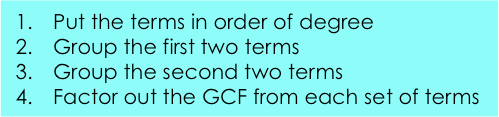
1) Put the terms in order of degree. 2) Group the first two terms. 3) Group the second two terms. 4) Factor out the GCF from each set of terms.

Image source: by Joshua Siktar

Let's work through an example. Suppose that we want to factor the polynomial 2x3+7x2−8x−282x^3+7x^2-8x-28.

STEP 1: Put the terms in order of degree

Are the terms in our polynomial (2x3+7x2−8x−282x^3+7x^2-8x-28) in order of degree?

Choose one answer

Video

(Video) Factoring by Grouping

by mathman1024

This video by mathman1024 demonstrates the factor by grouping method.

Summary\large{\text{Summary}}

The first polynomial our instructor factors is x3+3x2+7x+21x^3+3x^2+7x+21. He uses parentheses to group his polynomial into two binomials:

(x3+3x2)+(7x+21)(x^3+3x^2)+(7x+21)

Next, he factors a greatest common factor out of each binomial.

x2(x+3)+7(x+3)x^2(x+3)+7(x+3)

The polynomial now consists of two terms. Both are multiplied by the binomial x3x_3. He can factor out that binomial, which gives us the following:

(x+3)(x2+7)(x+3)(x^2+7)

And there's our answer!

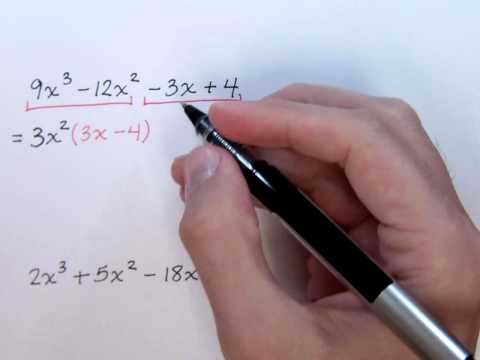
He goes on to factor one more example polynomial: 9x3−12x2−3x+49x^3-12x^2-3x+4. Try to factor this polynomial on your own. You can use the explanation in the video to check your answer.

Test Yourself: Factor −x3+x2−3x+3-x^3+x^2-3x+3

Choose one answer

Interactive · 1 question

A common factor is a term or expression that divides evenly into all of a polynomial's terms. For example, the polynomial ab+acab + ac has a common factor of aa.

Now, when we are tasked with factoring an expression that contains a common factor, the first thing we want to do is factor out that common factor.

So, if we needed to factor the polynomial ab+acab + ac, we would start by factoring out the polynomial's common factor of aa, like so:

ab+acab + ac =a(b+c)= a(b + c)

On a side note, if we were to multiply the term aa by the binomial b+cb + c, we would get our original ab+acab + ac expression. You can utilize this technique of redistributing a term that you've just factored out to check your work when factoring other polynomials.

Example 1:

Factor 5x+10xy+25xz25x + 10xy + 25xz^2.

Each of this expression's terms can be divided evenly by the term 5x5x. Therefore, the expression's factored form is 5x(1+2y+5z2)5x(1 + 2y + 5z^2).

Example 2:

Factor 27x+9y+36z3\frac{27x + 9y + 36z}{3}.

There are two ways you could go about factoring this expression.

Method 1: Divide all of the numerator's terms by 33 and then factor the result.

27x+9y+36z3\frac{27x + 9y + 36z}{3} =9x+3y+12z=9x + 3y + 12z =3(3x+y+4z)=3(3x + y + 4z)

Method 2: Factor the numerator and then divide that factored expression by 3.

27x+9y+36z3\frac{27x + 9y + 36z}{3} =9(3x+y+4z)3=\frac{9(3x + y + 4z)}{3} =3(3x+y+4z)=3(3x + y + 4z)

Example 3:

Factor 2x+8x2+5y2x + 8x^2 + 5y.

While this expression does not contain any common factors, its first two terms can be divided evenly by the term 2x2x. This means that we can group those first two terms using parentheses and factor a common factor out of that newly created binomial, like so:

2x+8x2+5y2x + 8x^2 + 5y =(2x+8x2)+5y= (2x + 8x^2) + 5y =2x(1+4x)+5y= 2x(1 + 4x) + 5y

Test Yourself!

What is the factored form of a3+3a2b+3ab2+b3a^3 + 3a^2b + 3ab^2 + b^3?

Choose one answer

Video

(Videos) Factoring Trinomials: Grouping and Trial and Error

by PatrickJMT

These videos by Patrick JMT show how to factor by grouping.

Summary\large{\text{Summary}}

The grouping method is used quite often in factoring. Let's look at the polynomial 12x2+34x+1012x^2+34x+10

We factor out a 22 to get 2(6x2+17x+5)2(6x^2+17x+5). Now, we factor 6x2+17x+56x^2+17x+5. First multiply 66 and 55 to get 3030. What are two numbers that multiply to get 3030 and add to 1717. How about 22 and 1515?

Now, we can rewrite the middle term using 22 and 1515. 2(6x2+2x+15x+5)2(6x^2+2x+15x+5)

Now, we factor by grouping. Look at the first two terms. What is the GCF? 2x2x. What about the second two terms? 55. Now we can rewrite such that 2[2x(3x+1)+5(3x+1)]2[2x(3x+1)+5(3x+1)]

Now, we can write this like 2(2x+5)(3x+1)2(2x+5)(3x+1)

Type a concept, like “slope” or “photosynthesis”.

↑ ↓ to choose · Enter to openSearch explanations and problems