Read · 1 min

+1 contributors

A half-life is the amount of time required for half of a sample decay or degrade. It is a common misconception that half-life is only used in relation to radioactivity. Half-life is actually a general term that can be used to describe any decaying process. More importantly, a half-life does not even need to be exponential. Zeroth order half-lives exist, and describe processes that occur at a constant rate. With this being said, first order half-lives are most common, and certainly most pertinent to radioactivity.
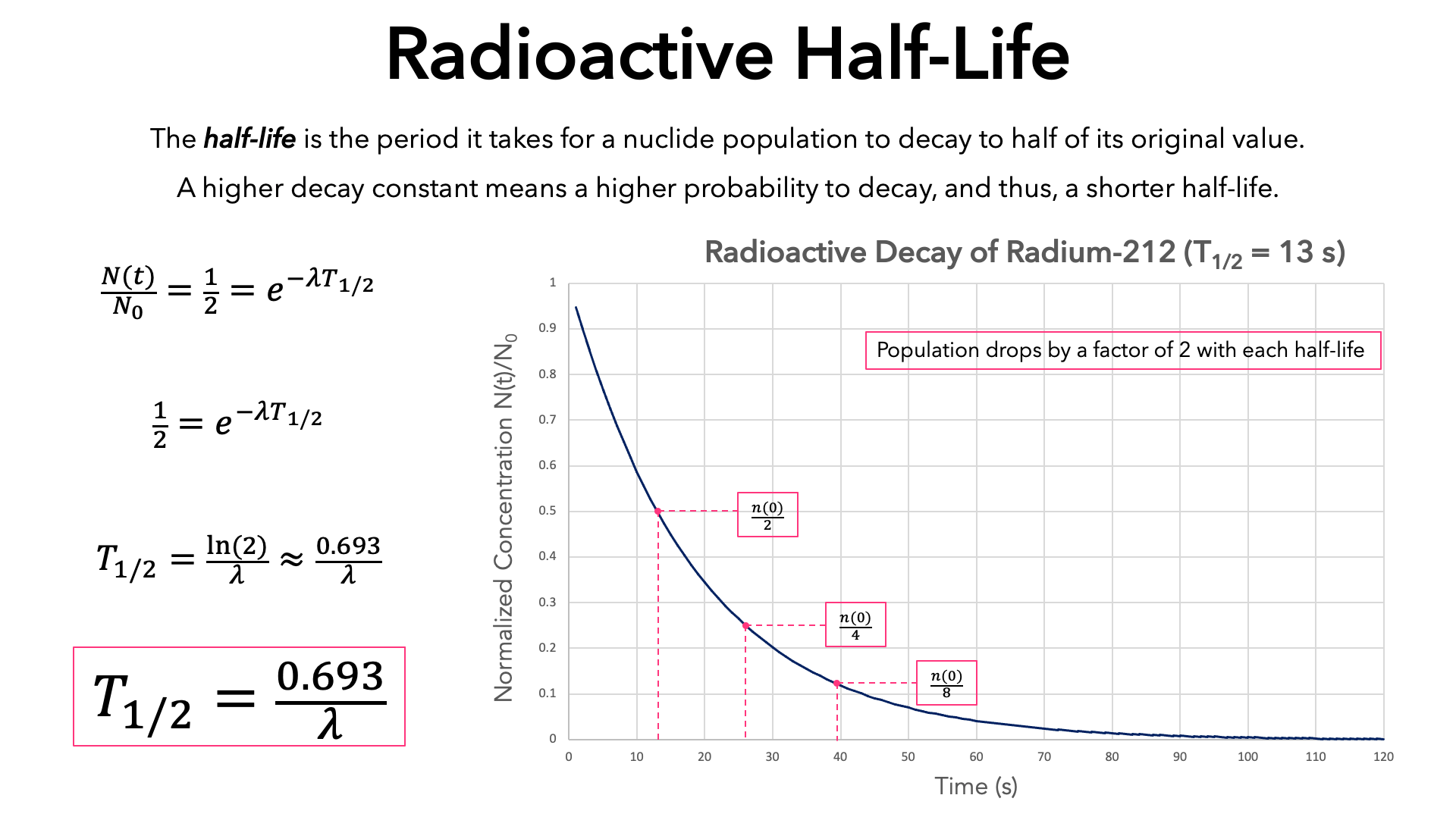
Half-lives are determined experimentally by measuring the time it takes for half of the population to decay. Mathematically, When the time, , equals the half-life, half of the population decays.
A similar concept is the natural lifetime, , which is the time it take for of the sample to remain. The natural lifetime is more common than the half life in many fields of chemistry and physics. It is related to the half life in the following manner.
Thus, we can see the natural lifetime of a substance is approximately 1.44 times as long as the half life.