Гіперболи з центром $(0,0)$

Illustrated · 1 min

Hyperbolas with Centers at the Origin

As we know, a hyperbola is a type of conic section, meaning it's formed by the intersection of a plane with a double cone. The plane cuts through both cones, resulting in two separate curves.

The hyperbola centered at the origin is the "simplest" hyperbola, in that there is no horizontal or vertical translation. To find the equation of a hyperbola centered at the origin, you need to know its key parameters: lengths of the semi-major axis, aa, and the length of the semi-minor axis, bb. There are two standard form equations you need to memorize for the equation of the hyperbola.

For a hyperbola centered at the origin with its transverse axis along the xx-axis: x2a2−y2b2=1\frac{x^2}{a^2} - \frac{y^2}{b^2} = 1

For a hyperbola centered at the origin with its transverse axis along the yy-axis: y2a2−x2b2=1\frac{y^2}{a^2} - \frac{x^2}{b^2} = 1

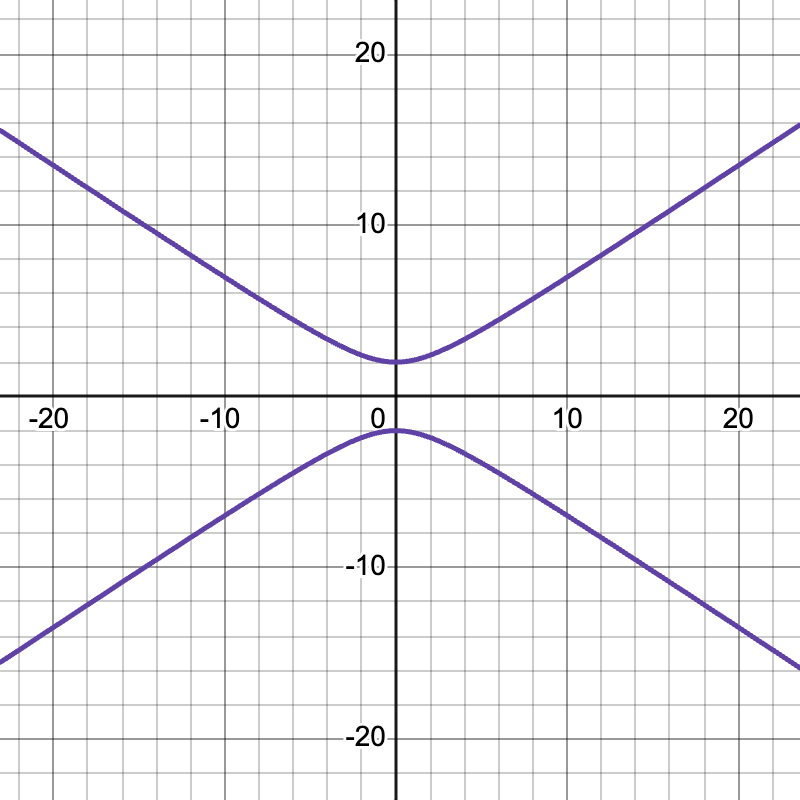
Here is a graph of the hyperbola: y222−x232=1\frac{y^2}{2^2} - \frac{x^2}{3^2} = 1

Graph of \frac{y^2}{2^2} - \frac{x^2}{3^2} = 1

Graph made by Desmos

Looking Further

In the next few lessons, you will learn some important concepts, including the equation of the asymptote, hyperbolas vertically or horizontally translated, the foci, and more.

Video

(Video) Hyperbolas: Center at the Origin

by Anusha Rahman

In this video by Anusha Rahman, you will learn about hyperbolas with their centers at the origin.

Summary

There are two types of hyperbolas: horizontal and vertical. The equation for a horizontal hyperbola is x2a2−y2b2=1\frac{x^2}{a^2} - \frac{y^2}{b^2} = 1. The equation for a vertical hyperbola is y2a2−x2b2=1\frac{y^2}{a^2} - \frac{x^2}{b^2} = 1.

Illustrated · 1 min

Hyperbolas with the Center at the Origin

We've already learned that a hyperbola is a type of curve that has two separate branches. It sort of looks like two mirrored curves that open away from each other. Remember that hyperbolas have a subtraction sign in their equation.

Hyperbolas with a center at the origin follow a standard form.

Made using Desmos

When a hyperbola has its center at the origin, (0,0)(0,0), its standard form looks like:

x2a2−y2b2=1\frac{x^2}{a^2} - \frac{y^2}{b^2} = 1

, if the hyperbola opens left and right, or,

y2b2−x2a2=1\frac{y^2}{b^2} - \frac{x^2}{a^2} = 1

, if the hyperbola opens up and down.

The number under the positive term tells you the direction of the opening. If x2x^2 is first and positive, the hyperbola opens left and right. If y2y^2 is first and positive, it opens up and down.

The values of aa and bb help you draw a bounding box and asymptotes. The box goes out aa units horizontally and bb units vertically from the center. The asymptotes are diagonal lines through the corners of the box. You can sketch the two branches by drawing curves that follow the asymptotes and pass through the edges of the box. The center is at the origin, so the graph is symmetric around it.

Type a concept, like “slope” or “photosynthesis”.

↑ ↓ to choose · Enter to openSearch explanations and problems