
Illustrated · 4 min
Lagrange Points in a Restricted Three Body System
To all those who love math, you may already be familiar with the work of Joseph-Louis Lagrange. His contributions to number theory, algebra and calculus are wide-reaching and integral (no pun intended) to our understanding of the subject today.
However, what you may not be familiar with are his works in astronomy. Namely, his discovery of Lagrange Points
To understand this concept let us look take a look at a two body system we're familiar with.
Considering the Earth-Sun System
The depiction below is almost comically out of proportion to the actual distance between the Earth and the Sun. However the more important part of the animation is the precise orbital center of these two bodies. Most people assume the Sun is stationary and the Earth orbits around it. This is incorrect. Instead, the Sun and the Earth obit somrthing called the barycetner. This is the point at which two objects balance one another.
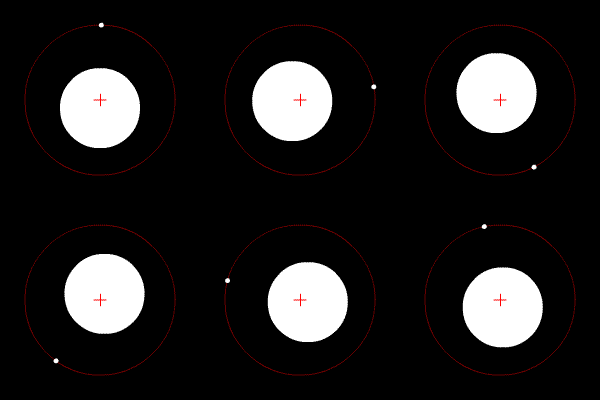
The barycenter is illustrated by the red cross
In a two body system the barycenter will necessarily be one of the foci of the elliptical orbit of each body. You might find this somewhat familiar, and, indeed, Kepler's first law of planetary motion is reminiscent:
The orbit of a planet is an ellipse with the Sun at one of the two foci
However, we see a contradiction. The Sun isn't stationary, because, as we know, it takes an elliptical path around two foci in space just like the Earth. Therefore Kepler's law doesn't perfectly describe the motion of the planets around the Sun. (Disclaimer: We still use and praise Kepler's laws for their general applicability).
Now that you understand a barycenter, we can continue on and explore Lagrangian Points.
Considering the Lagrange Points
Note that simple physics and geometry will be required to understand Lagrange Points.
Lagrange Points simply refer to areas in space that would have the same orbital period, but a different position, than the smaller orbital body in a two body system.
In any given system there will be five points. Each of them with specific physics and geometry to justify its particular effect.
Point
Realize that is slightly inside of the Earth's orbit. Intuitively one might assume that, as a result, the orbital period (T) of this body must be smaller than the Earth's. However, consider this:
Earth:
:
Where is the applied force of the sun on the body, is the applied force of the Earth on the body and is the net centripetal force.
At the effect of the sun's gravity on the point is reduced due to the Earth's gravitational tug. Therefore, it can have a different orbital radius and still have the same orbital period.
Point
In point the situation is roughly reversed from the case of point :
:
A body that's farther away from the Sun should have a larger orbital period, however the combined force of the Earth and the Sun pulling the body at towards the barycenter is enough to give it the same orbital period as the Earth.
In the diagram below consider that the object with the larger mass is the sun and the object with the smaller mass is the Earth. At points and the physics that allows this to occur might be apparent.
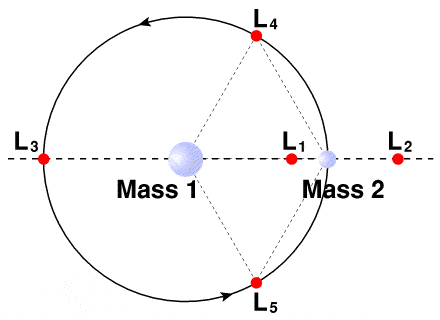
The Lagrange points are notated as Ln
Point
Point is just slightly outside of the Earth's orbit, however it is closer to the sun. While this may seem counterintuitive remember that the barycenter displaces the Sun from the exact center of the Earth's orbit and will push it closer to a point diametrically opposed, which you might call .
So, once again, despite it's larger orbital radius, a body at may have the same orbital period.
Points and
Notice that both points and create equilateral triangles with the and In doing so we note that both the radius between and for both of these Lagrange Points are equal. Therefore, we can now consider the force vectors and realize that they're being pulled a lot by and a little by . The result of these component vectors is a force vector that points not towards the center of the sun, but towards the barycenter of the system. This is what allows these two points to maintain the same orbital period as , or what we've been considering the Earth.
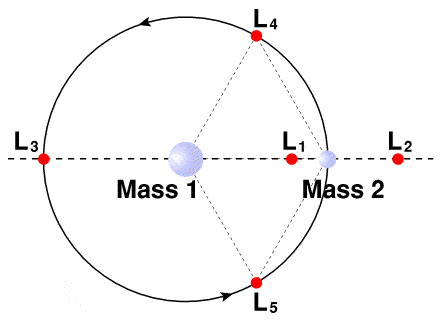
Points L4 and L5 are perfectly symmetrical
Lagrange Point Applications and Final Comments
Points 1 and 2 are useful to place satellites that need to escape the light pollution (in many different sections of the light spectra) of the Earth. For instance the Herschel Infrared Telescope was positioned at . However, , and are all unstable orbits and will, without any mechanical assistance, eventually degrade, causing the bodies to float off into space.
Points 4 and 5 are stable orbits, in fact, the Trojan asteroids are in the and points of Jupiter. Yet, we must note that stable orbits in and only exist in a system where the is much larger than and the object occupying the Lagrange point is considerably smaller than . This is the basic idea behind arestricted three body system. The Earth-Sun and Jupiter-Trojan systems are good examples of this.
Finally, realize that Lagrange points can exist between any two bodies have the dominant gravitation command over a region of space. For instance, there are Lagrange points in the Earth-Moon system and the Pluto-Charon System.
Lagrange points are an interesting and weird function of physics and our universe!